Showing posts sorted by relevance for query author. Sort by date Show all posts

Monday, March 27, 2006

Blog Love

Though I still think of myself as new to the blogsphere, I have noticed a trend when I find a new blog. Like any relationship, there are cycles and a flow to blog love. Yes, there are many stages for the blog readers:

Stage One: Flirting

This is the stage when you first find the new blog. Probably you noticed a new link on a reliable site. Or maybe you happened across the site by accident. Whatever the case, you like what you see. The most recent entry makes you think and chuckle a bit. You add a bookmark to your browser and plan to return the next day. You leave comments on every new post, hoping the author will look at your blog.

Things you might say at this stage:

    That’s a tight entry – I wish I had wrote it.

    I wonder why I never came across this before now.

    Look at me! Look at me!

    Oh, I hope they like my blog.

    Maybe my therapist is right. Maybe I do need friends who aren’t on the internet.


Stage Two: Infatuation

It’s all chemistry and obsession at this stage. You religiously check back at this site every hour to see if it has been updated. Every new entry on their blog seems like gold.When you write an entry, you hope that the other blog author will agree with you.

You stay up way too late methodically going through every month in the archive. This is not so much to read the past posts, but to find pictures of the blog author.

Things that you might say at this stage:

    This is the best blog I have ever read, EVER!

    I have fallen in love for the first time and this time I know it's for real!

    I already have the bridesmaids dresses picked out. My colors are blush and bashful.

    I wonder if they noticed me watching them from the bushes.


Stage Three: Marriage (Never Monogamous)

At this point, you have a committed relationship with the other blog author. There is a link to their blog on yours and vice versa. Each of you exchange comments and maybe an e-mail or two. You know the other blog author’s writing patterns and can predict when a new entry will appear.

Things you might say at this stage:

    I wish I could meet this blogger in person.

    I can’t wait until their next post.

    Is it possible to have sex via blogs?

    This is much more satisfying than actually finding a steady boyfriend.


Stage Four: Doubt

Now that you have the mutual links, second thoughts start to haunt you. Their last entry didn’t really inspire you. What if this blogger isn’t as cool as you thought? There are some things in the blog that make you wonder if they really think like you do after all. At this point, you start to wonder about other blogs that might be out there.

Things you might say at this stage:

    Eh -- It’s an okay blog.

    Why does that blog spend all its time with its loser friends? Can’t they get a job?

    When are they ever going to fix all those broken links? It’s driving me nuts.

    Didn’t somebody write a post just like that two months ago?

    I can’t believe that blog just drank all the milk and put the empty carton back in the fridge.


Stage Five: Stability

The doubts have passed. For every great entry, there are three fluffy ones (kinda like this one). That’s okay. Each of you comments on the other blog, but not every post. Still, you value their companionship and insight.

Things you might say at this stage:

    What a nice blogger, I am glad that we encountered each other.

    I look forward to the next post – if there is nothing better on television.

    What was the name of that all-gay-man porno site I found the other day?

    I wonder what sunlight feels like on my skin.

Sunday, April 29, 2007

Camp It Up

While doing research for another project, I ran across a 1965 New York Times article entitled “Not Good Taste, Not Bad Taste.” The author, Thomas Meeman, explained to an uninitiated audience the meaning of “Camp” as an emerging “New York scene.” Four years before the Stonewall Riots, Meeman reported that homosexuals had (shockingly!) created an aesthetic that some non-homos found appealing. “Camp,” Meeman reported, was “a previously unnamed sensibility, a third stream of taste, entirely apart from good taste or bad taste, that encompasses the curious attraction that everyone – to some degree... has for the bizarre, the unnatural, the artificial and the blatantly outrageous.” Since 1925, Meeman stated, Camp had “been synonymous...with homosexual.”

Meeman offered a list of examples. Camp consisted of things like Tiffany Lamps, Monopoly sets in Italian, Batman comics (which the author labeled “low camp”), feather boas, and Marlene Dietrich. He also authoritatively rejected things as decidedly not Camp, like Humphrey Bogart movies or Kelvinator refrigerators. Astoundingly, he claimed that “no television is Camp.” (!) Clearly he hadn’t watched the big shows of 1965: Bewitched, Johnny Quest, or Shindig! It seems to me that the networks were Camp-powered for 1965.


The article dripped with anxiety about the rise of Camp, particularly its link to the gays. “In many areas of American cultural life,” the author noted, “Camp taste is becoming dominant over what is today generally accepted as good taste.” This left Meeman uneasy as he also stated, “Camps taste and homosexual taste are frequently the same thing.” Maybe that one-to-one link explains why Meeman felt the need to state that he personally had “no fondness for Camp” and that he also had a wife. **cough**

Of course, the author didn’t bother to actually interview any real-life homosexuals about their views on Camp. They might have been the acknowledged creators of Camp, but clearly they wouldn’t have anything relevant to say about it.

Instead, he turned to cultural critic Susan Sontag for all of his information. Indeed, Sontag is still often credited with “introducing” Camp to the nation. Sontag’s own take on (or appropriation of) Camp reassured that “though homosexuals have been its vanguard, Camp taste is much more than homosexual taste.” Good hetero folk, Sontag suggested, could totally get in on the fun and in no way be homosexual.

Meeman seemed unconvinced. Like any article dealing with homosexuals in 1965, it suggested that some sort of pathology had to be at the bottom of Camp. Meeman solicited a New York psychiatrist’s opinions about the cultural ramifications of Camp. The doctor didn’t mince words, “It’s not only extremely childish but also potentially dangerous to society – it’s sick and decadent.” Even Sontag concluded something similar, though without the predictions of Armageddon. Camp, Sontag argued, resulted from “the homosexual's desire to remain youthful.” Like much of mainstream society in the sixties, Sontag and the psychiatrist imagined homosexuals as psychologically less developed than their hetero peers. Their desires and sensibilities ranged from “childish” to vain efforts at “youth.”


Since this (let’s face it: Campy) article in the sixties, Camp has made its way into the mainstream lexicon. We all have a vague sense of what something “Campy” means. My secret desire, for instance, to redecorate my apartment after the bottle-interior on I Dream of Jeannie would qualify as Campy. In much the same way, Camp has also retained a subtle link to gays. We can’t help but think of an animated John Waters trying to explain Camp to Homer Simpson. Waters’ character calls Camp the "tragically ludicrous" or the "ludicrously tragic."

Camp, therefore, deserves more than passing consideration. Too often, Camp has been dismissed as irrelevant or “childish” play. It’s that play, though, that I think is so important.

Like any good postmodern term, it defies easy definitions. Most seem to agree, though, that Camp involves appreciating that which appears absurd even as it claims normalcy.

So, why do many (but not all) gays like Camp? I think Sontag stumbled on part of the answer, even in 1964. She referred to Camp as “something of a private code, a badge of identity even.” Queers learn a set of pop-cultural references that get deployed over and over. Go to an all gay-male dinner party and count the minutes until somebody mentions one of the following: All About Eve, Andy Warhol, or any nighttime soap that ever aired (or, if GayProf has been invited, Wonder Woman). Something Campy will appear in the night’s conversation – unless you are at the most boring gay party ever.


Campy icons are mentioned with both reverence and also a humor that centers on a sly knowing of their absurdness. It’s our common ability to love and laugh at these things, often discovered before coming out, that articulates a sense of shared identity.

Growing up with queer desires in this nation means having a social identity with only minimal mainstream representations. Queer boys learn quickly about gender and sexual performance as part of their identity. They become keenly sensitive to “seeming” gay/feminine. Many make conscious decisions about adopting certain masculine performances, particularly if it means avoiding being beaten or tormented in classrooms. Queer boys might know at some level that they are not heterosexuals, but they also know the right time to impersonate one.

Perhaps it is the artificiality of these personal performances that makes many of us so inclined to see the artificiality in all gender performances. When constantly being informed that either your desires are unnatural or (more often) don’t exist at all, almost everything takes on an aura of the absurd.

Camp suggests that gender is a masquerade. Many of the enduring Camp images smudge the boundaries between a gender binary and expose them as arbitrary and culturally defined. I Dream of Jeannie, for instance, centered on a hyper feminine giggling blonde. Nobody could mistake anything about Jeannie as masculine as she emerged from her big puff of pink smoke. Yet, Jeannie also had real power that had only been reserved for men. Though Tony Nelson got the title “Master,” (and who wouldn’t willingly call Tony “Master” – at least for a night?) it was clear that Jeannie’s magic really controlled the house. All of the gender roles and reversals in I Dream of Jeannie are so exaggerated that they become nonsensical.


In much the same way, Camp historicizes gender roles. For many who enjoy Campy things, it is the absurdity of looking back on previous generations’ presumptions about men and women or about the ways that relationships were imagined. Noting and mocking the ways that actors like Joan Crawford played out gender roles in decades past suggests that gender roles today are as contingent, changing, and political.


Perhaps Camp’s potential for undermining a sexual binary is what Meeman and his psychiatrist found so disturbing. Not only did purveyors of Camp reject the presumption that they had to be heterosexual, they also seemed to laugh at the cultural markers of that lifestyle as well. What Meeman didn’t appreciate, though, was that he could also have been in on the joke. Camp’s humor does not seek to exclude. Rather, it uses humor to expose existing divisions in contemporary society.

Monday, October 22, 2007

Homo-Pocus

Given that the previous two entries exposed my indoorsy-geeky side, I thought that I would make it a hat-trick by showing my knowledge of the Harry Potter books. At the start of this past weekend, J. K. Rowling, author of the obscenely popular children’s stories, stunned an audience at Carnegie Hall with the revelation that she conceived of Albus Dumbledore as a gay man.

Since you know me well (I think that we are close like that), it will come as no surprise that I can’t help but think of the good and bad with this announcement. Well, okay, I mostly think of the bad. Hey, this is a blog entitled the Center of Gravitas. Go elsewhere for images of My Little Pony and recipes for gumdrop cookies.

On the good side, it’s great that such a well-loved childhood figure will now have a legend of gayness around him. Those “in the know” will inform new readers about the author’s statements about Dumbledore. It will surely go into the Potter lore.

In some ways, of course, I appreciate Rowling’s effort to gay-up Dumbledore. Aside from Harry himself, Dumbledore was probably the character that captured most people’s imaginations. His death in book six (Should I have mentioned there would be spoilers here?) left many faithful readers feeling like they had lost a close friend.

For those who don’t know the Potter story (My God, how have you managed that?), a young orphan boy is rescued from his abusive guardians with the discovery that he is eligible to attend a special school for wizards. Well, except that the school is only open nine months a year and the wizarding version of social services is apparently quite inadequate. So, Harry gets returned annually to face cigarette burns and beatings for the summers (when he can’t use his magic to defend himself).


On his way to the school, he hears the legend of Dumbledore. According to the necessary exposition his youthful informants, Dumbledore is considered one of the most powerful wizards in all of Britain (if not the world). Yet, he is also kindly and wise to the students attending his school. During most of the day, he seems to hum to himself as he sweeps around campus in long, flowing robes decorated with suns and moons. Whenever Harry is in danger, though, Dumbledore suddenly appears as powerful as Merlin. He can spin out ropes made of fire or summon a Phoenix with the flick of his little wand.

It comes as little surprise that many real-life queer adults (and probably queer kids) found the Harry Potter stories appealing. All tales of magic tap into some basic fantasies about control and power. The queer, though, are also often attracted to narratives involving the sudden revelation of hidden worlds or exposed secrets. Plus, it didn’t hurt that Harry literally lived in a closet up until the events of the first book.

I had therefore been annoyed that Rowling had failed to make any of her characters explicitly queer. This latest turn of events, sad to say, does not really help us.

Now I don’t mean to sound ungrateful, but a gay Dumbledore is not much of an improvement on the same old queer images that we have seen elsewhere in the popular media. Rowling’s outing of Dumbledore hardly destroyed the closet around the fictional character. On the contrary, she only pointed out how tightly those closet doors were sealed.

If we are to now read Dumbledore’s experiences as those of a gay man, then the image he presents of our lives is an unhappy and empty one. Think I am being unfair? Let’s review the stereotypes that Rowling used to “hint” at Dumbledore’s true desires:

    * His childhood was marked by a violent/absentee father, an overbearing mother, and dysfunctional siblings (Did Rowling consult Freud for her views on homosexuality?).

    * His one and only love interest, Grindelwald, turned out to be a psychopathic killer.

    * His one and only love interest was unrequited.

    * The rest of his life is riddled with loneliness, despair, guilt, and regret.

    * His adult brother, Aberforth Dumbledore, is hinted to be into bestiality (on several occasions) with goats.

Despite his many magical powers, Dumbledore is not much of a queer hero. By the last book, he seems tangled in a web of pathology created by his unhappy homelife. His adult queer desires for Grindelwald are rejected and misplaced.

Indeed, the question at Carnegie Hall that prompted Rowling’s revelation asked if Dumbledore knew “true love” in his life. In response, the author stated, “Dumbledore is gay.” Are we to assume that being gay precludes the possibility of true love? Were Dumbledore’s queer desires not “true love,” but a twisted mistake? This seems more than confirmed when Rowling declared that Dumbledore's love was his "great tragedy." Boy, howdy, when has gay love not been perceived of as a tragedy in the hetero media? I'll just gesture in the general direction of Brokeback Mountain.


Obviously, I don’t imagine that Rowling conceives of herself as hostile or homophobic. She means well – I hope.

Still, Dumbledore fits a particular type of queer image that makes heterosexuals feel comfortable. He is helpful, attentive, a good listener, asexual, and a little sad. Dumbledore never once discusses his own sexuality or acts on it (given the tragic results that happened the one time that he did, who could blame him?). He certainly never burdens the heterosexuals around him by making them think about his sexuality, either. Instead, he does what all gay men should do: Devotes his life to helping good, heterosexual men and (sometimes) women achieve their goals. He is so devoted to helping the heterosexual hero in the books that he even returns from the grave to do so.

While Dumbledore is immensely powerful, he never uses that power to advance his own cause or to help his fellow queer wizards and witches. Heck, he can’t even be bothered to conjure up a disco ball and some mojitos for the local gay bar. Instead, he always marshals his magic to shore up the inherent strength of Harry the hetero. When he isn’t doing that, he also serves Harry some candy and shores up his ego. All the while, we are to believe, Dumbledore is secretly tormented because he will never find true love as (because he is?) a gay man.

Imagine Dumbledore as a magical mix between Queer Eye for the Straight Guy and the long-suffering Martha Dobie from The Children’s Hour. One can imagine Dumbledore vacillating between crying to Harry “I’m so guilty” and advising “You should always start applying wizarding cream from the back of your head.”

Moreover, by only revealing Dumbledore’s sexuality outside of the actual text, Rowling has kept up the notion that queer men and women are not appropriate content for children's literature, much less a reality of their world. Even Uncle Arthur was a more explicitly gay figure.

Dumbledore’s outing is therefore an unhappy compromise for queer visibility. Sure we get to claim his swirling robes as our own. We can even marvel at the firworks he creates that would make the Fourth of July on Boston Harbor seem like a sparkler in a wet saucer.

What we still don’t get, though, is an actual hero who reflects our realities. Queer youth, in particular, don’t get to see the real queer heroism of an individual fighting for the right to love and/or ball whomever he wants. We don’t see individuals making a space for themselves with almost no support from anywhere else in society as hostile attacks rain down on them.


Instead, we get Dumbledore, who simply gave up on his own queer life and rights. He might have been a great wizard, but he was a lousy gay man.

Friday, May 01, 2009

Of Blogs and Trolls


Geez – I return to [landlocked] Paradise Island for just a few days and patriarch’s world totally falls apart. People lost their damn minds over a flu outbreak currently affecting 0.00000003 percent of the nation’s population; Larry Krammer missed his own point in a shrill screed; a Supreme Court Justice called it quits; and Chrysler filed for bankruptcy. Okay, that last one was as predictable as the sunrise. Still, those others took me off guard.

All that aside, I recently had an e-mail exchange with HistoriAnn concerning a reoccurring troll outbreak on her space. No, I am not talking about Timothy Geithner -- This time. Rather, it's a reader who just won't take a hint -- or an explicit statement -- or an outright demand to just go away.

It got me to thinking, do trolls know that they are trolls? Maybe they actually think of themselves as a force of good rather than an unnecessary drag on humanity.

So, I devised this helpful quiz to determine whether you are a troll or not. Answer the following questions to know for sure:

1. I read blogs because:

    A. I want to be exposed to wider range of viewpoints than is available through mainstream media.

    B. My computer has a porn filter installed.

    C. I believe that I am the only person qualified to police the internet.


2. When I encounter a blog post that I disagree with, I:

    A. Simply move on and read another blog. Life is too short to worry about what other people are doing on their blogs.

    B. Leave a short comment of disagreement with an explanation.

    C. Leave comments suggesting that the blogger has questionable parentage. Then I click on all of that bloggers links and leave additional comments asking them all to just shut up.


3. My favorite blogs:

    A. Challenge me to think in new ways.

    B. Give helpful hints on knitting.

    C. Are written by people against whom I have sworn a blood oath to defeat.


4. Most bloggers respond to my comments by:

    A. Acknowledging them politely.

    B. Linking to my own blog.

    C. Deleting them.


5. After reading blogs, I feel:

    A. Like I spent time more productively than reading a magazine.

    B. Like I should have spent that time watching porn.

    C. Like I need to seek revenge.


6. My day job is:

    A. Clerical/Industrial.

    B. Technical/Professional.

    C. Handing out riddles before allowing people to pass over bridges.


7. The bloggers who I read most often:

    A. Write about events in their daily lives.

    B. Assess popular culture or news stories.

    C. Have filed a restraining order against me.


8. The best way to engage in an on-line discussion is to:

    A. Ask more questions of the author.

    B. Offer a counter example.

    C. Leave half a dozen comments on a single entry, all of which are longer than the author's original post.


9. If a blogger asks me to stop reading/commenting on their blog, I:

    A. Stop reading/commenting on their blog.

    B. Apologize for offending them and then stop reading/commenting on their blog.

    C. Develop a new alias to trick them so that I can keep commenting on their blog. After all, they clearly need my help to show them the errors of their ways.


10. If I find a blogger who has made a mistake on their blog, I:

    A. Send them a private e-mail noting the error.

    B. Leave a short comment.

    C. Phone their employer and ask that they be fired.


11. To my mind, the least interesting blogs are:

    A. Not updated often.

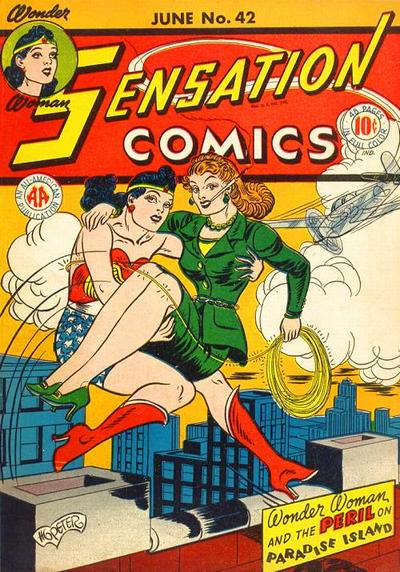
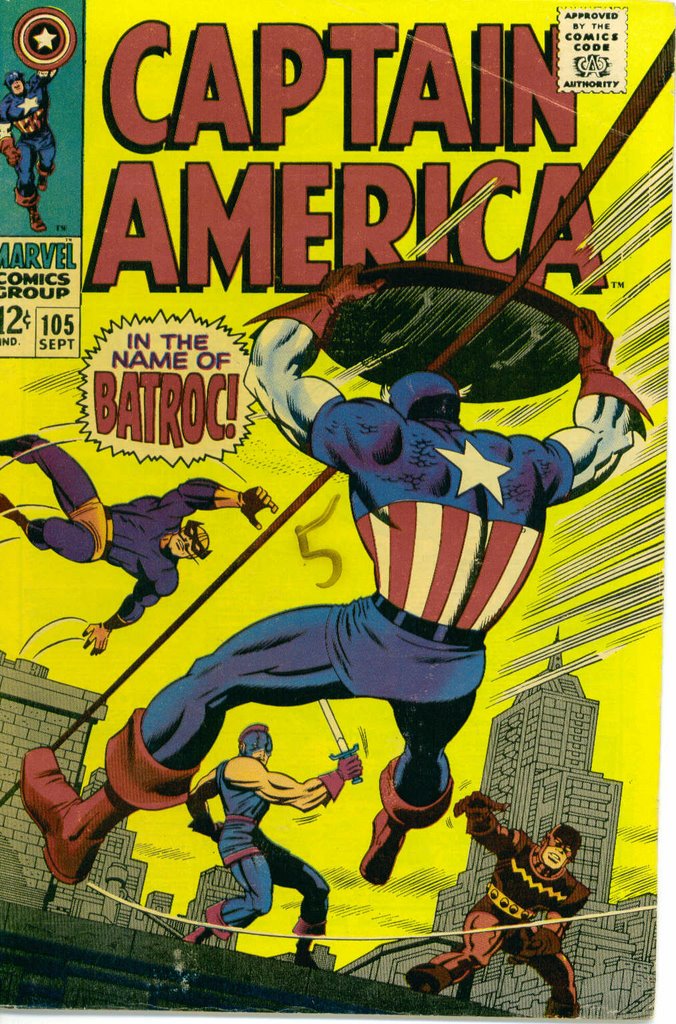
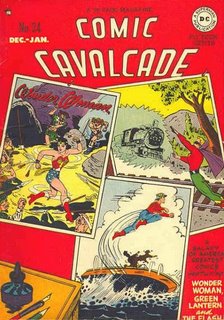
    B. Depend upon gimmicks, like campy comic book covers.

    C. Are written by people with whom I actually agree.


12. Before leaving an accusatory comment, I:

    A. Re-read the entry to make sure that I understand the tone and reasoning behind the post.

    B. Read some of the blog archive to get a sense of that blogger’s overall politics and purpose.

    C. Don’t bother reading the entry or anything else on the blog – I just know when a blogger is wrong.


13. When I read a blog written by somebody who identifies as a different race/gender/sexual orientation as myself, I:

    A. Take it as an opportunity to expand my own understanding of different experiences.

    B. Consider points of common humanity.

    C. Assume that their blog is part of a vast conspiracy intended to rob my race/gender/sexual orientation of our basic rights.


14. In real life, my friends:

    A. Don’t know that I read blogs.

    B. Occasionally receive e-mails from me recommending particular blogs or entries.

    C. Don’t exist outside the confines of my imagination.


15. The last time I spent a night on the town, I:

    A. Went for cocktails at my favorite bar.

    B. Saw a musical/play/movie.

    C. Replaced a newborn infant with a changeling.


16. If another commentator disagrees with me on a third-party’s blog, I:

    A. Allow the conversation to continue on its own. I said what I needed to say the first time.

    B. Leave it to the blog author to respond, or not respond, as s/he sees fit.

    C. Depend upon sarcasm and ALL CAPS to silence and intimidate my critics.


17. If a blogger makes reference to an event or issue that I didn’t previously know about, I:

    A. Look to read more about it in my local library or from reliable internet sources.

    B. Ask my friends about their knowledge of the event or issue.

    C. This has never happened because I know everything about everything.


18. My own blog:

    A. Is very similar in scope and content as the blogs that I read.

    B. Allows me to experiment with different ideas and sharpen my writing.

    C. I don’t have a blog – It would detract from all the time I need to spend “correcting” other bloggers.


19. When I have met bloggers in real life, I:

    A. Have been pleasantly surprised by their approachability.

    B. Exchanged helpful tips about html code.

    C. Predicted that their eldest daughter would prick her finger on a spindle and die.


20. Many blogs are explicitly partisan. I think:

    A. This is an important part of free speech and the exchange of ideas.

    B. This has been an important transformation in political discourse over the past ten years.

    C. This demands police intervention.


21. Without blogs, I would:

    A. Watch more television.

    B. Read more books.

    C. Beat up small school children.


22. I think of blog space as:

    A. The equivalent to an individual’s living room. We are all guests.

    B. Akin to a coffee shop. I use the same basic manners as I use in polite society. If I wouldn't say it out loud, I won't write it.

    C. A war zone where one must kill, kill, KILL.


23. Anonymity on blogs:

    A. Allows individuals to be free to express their ideas without fear of reprisal.

    B. Is often fragile, but should be respected.

    C. Is my exclusive right. Everybody else is a coward.


24. If I were only able to leave one last comment on a blog ever again, I would:

    A. Thank a particular blogger for hours of free entertainment over the years.

    B. Ask why a certain blogger is disturbingly haunted by Wonder Woman.

    C. Write, “To the last I grapple with thee; from hell’s heart I stab at thee; for hate’s sake I spit my last breath at thee.” Or words to that effect.


25. As a child, I:

    A. Learned basic manners.

    B. Read too many comic books.

    C. Never received the attention that I felt that I deserved.


Monday, October 09, 2006

Free to Be You and Me

Over the weekend I attended a presentation about the status of Academic Freedom in United States universities. Loosely defined, Academic Freedom refers to the right of professors in academic institutions to research and teach their beliefs without their livelihood being placed in jeopardy by those who disagree. At my weekend event, the speaker and audience did a great deal of hand wringing about the rising, and increasingly hysterical, attacks on humanities in the university. Something feels amiss, though, about how the left has decided to grapple with the newest threats to Academic Freedom.

For those who don’t know, the more recent salvos against Academic Freedom started in the early nineties with a former-liberal-turned-neoconservative named David Horowitz. In essence, Horowitz claimed that university-level humanities departments had become secret havens for Democrats. He further put forward (without any real evidence) the outlandish claim that these same faculty keep conservatives out, deprive them of funding, and openly indoctrinate their students to blindly vote Democrat. In an unexpected twist, Horowitz and crew claim their own Academic Freedom is being impinged.

I grow tired of those on the political right whining about their imaginary persecution. If we lefty faculty have the power to convert students’ political ideologies, we are doing a terrible job of it. Just look at the state of the nation – Do you really think that we would allow that to occur if we ruled the current generation of university students? Instead, university campuses are hot-beds of political indifference.

A faithful reader recently sent me a link to an editorial featured in the Chronicle of Education. A pale-knock-off of Horowitz, this author uses a dancing metaphor to discuss teaching. Dripping with condescension, he claims that academics on the left dance “an abomination: mimes pretending to defy gravity, tearing holes through figurative walls without even breaking a sweat, or collapsing in the middle of a performance into ironic 'metagiggles.'"

Meanwhile, he claimed that neoconservatives, like himself, “were enchanted by the unapologetically proud and earnest grands battements (big kicks) of old-school ballet. Here, indeed, was a physical form of expression that could do justice to the ideological elegance of the Ol' Gipper and 'trickle down' economics.”

Yet,he claimed that he had to “hide” this political/jiggy inclination as a junior professor. “What cruel institution,” you ask, “kept this man so terrified? Where did he suffer the yoke of liberalism? Where does this academic reside?” The answer: Brigham Young University.

Yes, that bastian of liberal thinking, BYU, allegedly kept this poor helpless neo-con in the political closet. I am sorry, but where could he have possibly been more comfortable? Bob Jones University? This silly editorial just suggests how conservatives have come to believe in their own imaginary persecution no matter their actual reality. They have mistaken being challenged in their beliefs with being silenced.

Don’t get me wrong. Many people of the left have a hard time letting the right speak. There have been some (though few) incidents in which the left has taken a low road and wrongly tried to silence the right on university campuses. These are not frequent, but do undermine the goals of universities as places of intellectual exchange.

In truth, however, I don’t think that neo-cons really care about the mission of universities. They use a thin veneer of academic lingo to mask their actual intent: to control knowledge. Neo-conservative academics are not interested in “leveling the academic playing field.” Rather, they want to bulldoze that field and build a gas station.

The left has not come up with good responses to these attacks. Either the left tries to “prove” their lack of bias (an always losing strategy) or they cave into the neo-conservative demands (usually as a way to prove their lack of bias).

In many ways, my history classes probably would be the right-wing’s worst nightmares. I eschew standard text books. Instead, I ask students to read histories about groups of Americans often omitted or given cursory attention in traditional U.S. histories. We read texts on Latinos, African Americans, gays and lesbians, Asians, and so forth. Contrary to neoconservatives’ fantasies, race, gender, and sexuality all influenced the way historical individuals came to understand the meaning of their life in the United States.

On more than one occasion, I have had complaints filed against me in the dean’s office accusing me of “indoctrinating.” The right’s vision of “not indoctrinating” seems to really mean that we should never hear or learn from people different from themselves. To my university’s credit, they have always supported me.

I think that we need to move discussions about Academic Freedom away from the defensive posture given to us by the right. Every new class has me start by explicitly outlining my background, sexuality, and historical perspective. I am as candid as possible with the students because, after all, my goal is to get them to engage and think about the materials in the class themselves. All of my cards are on the table. They can make their own decisions about my perspective. Contrary to popular belief, I am not looking to brainwash them into being mini-GayProfs (they usually become mini-GayProfs of their own accord).

Reading different historians' perspectives on race, gender, and sexuality offers students a particular set of tools. I don't claim that this tool box is an absolute guide to TRUTH. Our current methodologies will become outdated one day. Still, that tool box allows students to question social relations of power, government authority, imperialism, and resistance. Students have a chance to find out what that vision of the past looks like and for us to talk about it as a group. If it ultimately doesn’t appeal to some of them, that’s cool.

Our dancing editorialist, however, reveals something about his own teaching strategy as well. From his own words, it seems quite clear that he envisions the classroom as a place where he gets to indoctrinate students to his right-wing beliefs. He masks his intent with flowery language, but his mission is clear. With the freedom of tenure (“barely” earned, according to the author himself, suggesting a shaky research agenda (but that’s another issue), he felt at liberty to perform “an athletic, 15-minute-long, tightly choreographed celebration of the war on terrorism.” If we wash away the fanciful imagery, what he is really saying is that he used his classroom as a pulpit to announce his support of the current administration’s policies. Would Horowitz cry foul? Probably not.

You know what? I am okay with that, but not because I agree with him (obviously I think the man is delusional and probably belongs at BYU). Unlike those on the right, however, my own political ideology is not threatened knowing that he is expressing his viewpoint in the classroom.

My politics inform my research and my research informs my politics. It would be impossible for me, as a Latino historian, to disentangle those two components. Unlike the BYU Baryshinkov, though, I am not trying to dazzle or trick students into my political ideas. Instead, I think all of us on the left need to own our political perspective and be open about how it influences our teaching. Students are smart enough to decide what to do with that information.

Finally, there are many reasons why conservatives might not be in the humanities in great numbers that are less conspiratorial than Horowitz’s notions. One of the primary reasons could be that those attracted to right-wing politics are also inclined to want to make lots of money. Trust me – a career as a historian is not the fast-track to owning your own island. If I am lucky, I might be able to make a down payment on a Vespa – in ten years.

Another reason that conservatives find themselves outnumbered could also be related to the transformative power of learning itself. More education in the humanities means learning more about different people’s experiences and perspectives. At a certain point, that knowledge makes holding onto narrow, xenophobic, triumphalistic visions of the U.S. untenable.

Perhaps, though, the right-wing knows this to be true. That is why they want to stop universities from offering such knowledge.

Tuesday, July 10, 2012

Collegial is as Collegial Does

A few weeks ago, Dr. Crazy had a post about collegiality in academic departments. She suggested some pretty basic notions about how one should behave in such an environment. To crudely summarize, she suggests that collegiality involves no more than simply doing your job at its most basic level: teach, research, and serve to the best of one’s abilities as outlined in your contract.

I tend to agree with that assessment. Nonetheless, it strikes me that such a straightforward mandate still confuses many professors. So, allow me to provide a simple set of guidelines to help you gauge whether you are an ideal colleague or the professor everybody wishes would just die. Think about which of the following most closely resembles what you might say in these situations.

When it comes time to decide the course schedule for next semester:

    Best: “I am willing to teach a mix of upper level and service-oriented courses. While I certainly have preferences about scheduling, I am willing to negotiated with my colleagues to insure that we have a wide distribution of classes throughout the day.”

    Fair: “I have several courses that I teach over and over. They serve some basic requirements of the department.”

    Bad: “I will only teach classes between the hours of nine and noon. Teaching a survey class is clearly beneath my intellectual talents. Besides, I have a political obligation to offer an incredibly narrow graduate course that only appeals to two students every year.”

    Evil: “My class enrollment is by instructor permission only. That way I can make sure that only hot, fit students ever sign up. No fatties!”

When I take the last cup of coffee from the break room:

    Best: “I always make a fresh pot of coffee for the next person.”

    Fair: “I be sure to shut off the burner so that the whole office doesn’t fill with the smell of scorched coffee.”

    Bad: “I demand the secretary make a new pot of coffee.”

    Evil: “Coffee? I replaced all that with Postum© years ago.”

When it comes to time for committee assignments to be made, I think:

    Best: “Nobody likes service, but it is a necessary part of keeping any university operating. I will roll up my sleeves and serve on committees when needed.”

    Good: “If I really care about a particular issue, I am willing to serve on a committee or two.”

    Bad: “Gee, I would serve on some committees, but I think that my decision to have children means that I can neglect my basic duties for which I am paid. Selfish childless people can pick up my slack. After all, what else do they have to do with their empty lives?”

    Evil: “I see every committee assignment as a stepping stone to be dean one day.”

My thinking about new hires is usually along the lines of:

    Best: “I consider it a basic part of my job to advocate vigorously for new positions based on my particular intellectual training. Nonetheless, I also recognize that a diverse set of perspectives and coverage is required for a really solid academic department. Therefore, I am willing to yield on hiring decisions when other priorities are clear.”

    Fair: “I will work really hard to hire people in my immediate field."

    Bad: “If I didn’t get my way when a job position was conceived, I will do everything in my power to sabotage this search. It’s better to have a failed search than for other people to have won a new hire.”

    Evil: “If a candidate wants this job, they better invite me to their hotel room during the campus visit.”

When Running a Meeting:

    Best: “I have a clear agenda and will get you out of here in an hour.”

    Fair: “The agenda is set, but everybody can speak their mind on whatever topic they desire. It’s fine with me if we have to spend the whole afternoon chatting.”

    Bad: “Was there a meeting scheduled today?”

    Evil: “Let me tell you what we already decided as a committee.”

When Attending a Meeting:

    Best: “I did my due diligence and read any pre-circulated materials before I arrived. I listen attentively and will give my opinion based on a well reasoned argument about the best needs of the unit.”

    Fair: “I didn’t really have time to read up on this particular issue. Still, I’ll go along with whatever the majority has to say.”

    Bad: “I would have attended this meeting, but I needed to wash my cat.”

    Evil: “I am only here to point out how much I really, really, really hate the chair of this meeting.”

When I find that I am in the minority on an issue facing the department:

    Best: “I will voice my opinion and give my reasons for objecting. In the end, though, I must have faith in democracy.”

    Fair: “I will withhold my opinion but then complain bitterly to colleagues over drinks later.”

    Bad: “I take this decision very personally. It shows that there is a larger conspiracy at play to take away my power and agency!”

    Evil: “I pack a gun.”

When advising students about what courses to take:

    Best: “I emphasize the strengths of the department. I also take some time to consider the particular interests of the student and their own career ambitions. My goal is always to give a student the widest range of perspectives that we offer.”

    Fair: “I am vaguely aware of what my colleagues teach, but, whatever. I guess that I wouldn’t actively dissuade a student from taking a class with another professor -- if that is what they really want to do.”

    Bad: “I take the time to trash all the colleagues in my unit that I dislike. A student should leave my office knowing that my department is nothing but a snake pit of dissension filled with people who aren’t half as smart as I am.”

    Evil: “I take the time to explain the power of the dark side of the force and invite the student to become my protégé. Together we can topple the department chair and rule together.”

When serving on a masters thesis or dissertation committee:

    Best: “I read the entire thesis/dissertation. My goal is to provide strategies for the student to revise the work to the best of hir abilities.”

    Fair: “I read the entire thesis/dissertation. My goal is to get this over with as soon as possible.”

    Bad: “I read some of the thesis/dissertation. My goal is to show that I personally know a lot more about this particular topic than the student.”

    Evil: “I plagiarized several chapters of this thesis/dissertation. Nonetheless, I will still vote to fail the student just because I can.”

During the summer:

    Best: “I drink a lot.”

    Fair: “I drink a lot.”

    Bad: “I drink a lot.”

    Evil: “I drink a lot.”

When a hardworking undergraduate student tells me that ze is applying for graduate school:

    Best: “I am supportive and offer to write a letter. Still, I do provide a candid assessment of the job market and encourage the student to think about the time, energy, money and effort that goes into obtaining an advanced degree.”

    Fair: “I write a letter of recommendation and wish the student well.”

    Bad: “I write a letter of recommendation but also frighten the student with horror students about the academic world. I cite the Center of Gravitas as evidence of academia's moral bankruptcy.”

    Evil: “I promise to write a letter of recommendation but never quite get around to it. I assure the student that, even if the job market is terrible, they will absolutely get a tenure-track job because they are the exception.”

When a colleague in my field publishes a book:

    Best: “I buy and read it.”

    Fair: “I send an e-mail of congratulations.”

    Bad: “Do I have colleagues in my field?”

    Evil: “I tell anyone who will listen that I would have written a much better version of that same book.”

When editing an academic journal:

    Best: “My goal is to give authors clear and concise feedback as quickly as possible. No journal can accept everything submitted, but I work really hard to be fair and prompt. I understand that my authors often have tenure and/or promotion pressures. Any delay only harms their research agendas and makes my journal look unprofessional.”

    Fair: “I farm out a lot of my duties and depend almost entirely on others’ opinions. Still, I aim for an initial turn around of six to eight weeks. After all, I have a basic competence in my job.”

    Bad: “I decide that my journal will devote itself to publishing many, many ‘Special Editions’ so that I can reward all my friends by printing their articles. Others can submit manuscripts, but they really shouldn’t hold their breath.”

    Evil: “I regularly sit on manuscripts for over a year and a half (or longer if I can!). When I do finally get around to making a decision, it’s usually a negative one. Heck, somebody has to teach these young scholars a cold hard lesson. If the author doesn’t like it, then they shouldn’t have bothered my prestigious journal with their pitiful article in the first place.”

My office:

    Best: “Is a place where I work quietly.”

    Fair: “Is a place where I meet students from time to time.”

    Bad: “Is a place where I can really turn up the volume on my music.”

    Evil: “Smells suspiciously of sulphur.”

When a colleague in my field comes up for tenure:

    Best: “I diligently read as much of the file as possible. During the meeting, I aim to make sure that every candidate gets a fair hearing by offering well informed insights on the research, service, and teaching.”

    Fair: “I read the cover letter to the file and dip in and out of the other materials. Unless there are clear problems, my default impulse is always to vote in favor of the candidate.”

    Bad: “I didn’t really have time to read the file. I’ll go to the meeting and try to get a sense of which way the wind is blowing and then make up my mind.”

    Evil: “I met with the candidate a full year before they went up for tenure to remind them that they needed my vote to advance. If they didn’t spend the past several months groveling, it’s curtains!”

The secretary/support staff in my unit:

    Best: “Are not paid nearly enough given that they do 90 percent of the heavy lifting! I support any effort to improve their working conditions.”

    Fair: “Do their job well and I acknowledge that.”

    Bad: “Are fine, but I don’t understand why they won’t pick up my dry cleaning.”

    Evil: “Should only be paid for nine months given that is the length of the academic year.”

If I had not become an academic, I would have:

    Best: “Found another avenue to share my knowledge and research with a wider public. My goal would always be to find a way to enrich our intellectual conversations.”

    Fair: “Found a job that allowed me to earn much more money.”

    Bad: “Run for public office as a Republican so that I could dismantle higher education as we know it.”

    Evil: “Harvested the souls of the innocent.”

The role model who influenced my career:

    Best: “The hardworking professors who took an interest in me as a student. They not only taught me the knowledge that I need for this job, but also what it means to be a committed educator.”

    Fair: “Wonder Woman.”

    Bad: “I did it on my own. Nobody ever helped me and I was always falling through the cracks.”

    Evil: “Pope Benedict XVI.”


When writing a book review for a journal:

    Best: “I highlight the strengths of the book and the author’s intent. I limit my critique to one or two questions at most. It is important to recognize the hard work that goes into writing any monograph.”

    Fair: “I offer faint praise, but conclude with criticism.”

    Bad: “Most of my review is simply critique about what the author might have written but didn't. I can only think of holes in the work and imagine an entirely different book than the one that I am reviewing.”

    Evil: “Every book review is just an opportunity to ruin somebody’s career.”

When a colleague passes me in the hall:

    Best: “I greet them and ask how they are doing.”

    Fair: “I smile warmly.”

    Bad: “I avoid eye contact.”

    Evil: “I make a distinctive rattling sound.”

Wednesday, April 18, 2007

TornWordo Dares to Ask

I was deeply saddened by the events at Virginia Tech. There are discussions to be had about the meaning and repercussions of that violence. It will take time to learn everything that we need to know. Right now, though, I think that we all need to grieve a bit.

Such events often get me to thinking about the silliness of blogging. Maybe it’s just that a low-grade existential crisis is always near my surface. Still, with all the violence and despair in the world (Iraq, Afghanistan, Darfur, and on and on), it can be hard to imagine that a few Wonder Woman comics and a wry reference to Charlie’s Angels amounts to something purposeful.

Then I think blogging can be beneficial in terms of my own entertainment or exchanging ideas. We all need these things, right? So, I keep going – much like Kelly Garrett did when she landed that plane while undercover as a flight attendant.

To that end, TornWordo had a nifty deal on his blog. He answered five questions posed to him by another blog author. He likewise offered to ask five questions to others who wanted. I will do the same, if you would like me to ask YOU five questions.

Here are the questions posed to me by Torn:

1. If your ex came back begging, would you take him? Please explain your answer.

    Oh.Dear.God. NO!

    In the last year of our relationship, Liar Ex (Who Told Many Lies) made it his life-goal to quash out whatever love that I had for him. This wasn’t just a case where his feelings changed and we parted. Nobody can control their feelings, but he handed me a number of dirty deals.

    I loved him very much. Indeed, at the end I even reduced myself to basically groveling in an effort to keep the relationship together. Let me tell you, that required more than a little therapy to work out.

    Instead of being honest, however, the decisions that Liar Ex (Who Told Many Lies) made while ending the relationship showed a sleazy, selfish, cowardly inner character. Liar Ex (Who Told Many Lies) imagined he was quite clever to have treated me like shit. He often dehumanized me by referring to me as “clutter” or a “unit” or something else that implied non-human status. He even made fun of me to his loser friends when I was feeling the worst.

    Now I know just what to think of him. Time and time again, he had opportunities to be a stand-up guy, but always opted against it. Even after all of the deceptions and depraved indifference to my feelings, he managed to believe that he was the wronged party. Perhaps the only good thing about all that lying, cowardliness, and selfishness is that I have no romanticized notions about that relationship left.

    Being single does not leave me doing cartwheels, but it’s infinitely better than a relationship with a mediocre individual like Liar Ex (Who Told Many Lies). I've tried to learn from the bad choices I made in that relationship. In many ways, I am still learning. One thing has become clear to me recently. If I am going to get into another LTR, it has to be with a man who has some balls.


2. Your writing seems very methodical, like what I imagine you wish of your students, lol. Your posts come off quite polished. Do you make many revisions before you post? (How long did you spend answering these questions?)

    When I write an entry, I try and devote a significant amount of time to it. This is one of the reasons that I don’t post often. Well, that and I am kinda lazy.

    If I write on a topic that really excites me, I could spend five or six hours on it (both writing and revising). Some entries have taken more time. On average, though, I would say that I spend probably two or three hours on most posts. This entry took about two hours.

    Usually I sketch out the entry’s basic premise and write a draft. Then I read it over a few times looking for holes or places that I can add some humor (or force in a reference to a seventies television show).


    Despite this, I feel like my entries often have many grammatical mistakes, especially spelling errors. Also, I struggle with writing entries that are too long.

3. Tell a funny story that has excrement in it. You know I love me a good scat story. C'mon don't be a priss.

    If I ever meet Mrs. Wordo, our conversation will turn to your childhood experiences during toilet training. I need to know what happened on that particular bus ride.

    Well, CoG devotees will remember that my move to Boston started with me being covered in shit. Cat did not enjoy the moving truck. Feeling bad for his panicked cries of stress, I took him out of his carrier the first hour that I was on the road. What I didn’t know was that cats prefer that you leave them in their box when they get too stressed out.

    My cat educated me by crawling into my lap and promptly vomiting. Then he arched his back and took a massive shit as well.

    This left me with a cooling pile of cat shit and vomit on my lap as I sped down the highway at about 70mph. It took about ten minutes before I could find a place to pull over. In the meantime, I had to juggle with the cat to keep him from sitting in his own shit and vomit. That was a golden moment in our relationship.

    Visions of causing a catastrophic highway accident came to me. Who would want the uncomfortable task of explaining that a cat’s incontinence was the root of an eighteen-car pile up?


    That, though, is an old story. So I tried to search my memory for another scat-centered story. BTW, I live in a neighborhood on the edge of Boston known as Somerville. Therefore the community access television station has the unfortunate (though maybe accurate?) acronym SCAT. I actually do think of you every time I pass the it.

    The only other story that I could come up with involved an outhouse in New Mexico when I was a teenager. It was on the side of some highway. When I entered, somebody had shit on the seat. We aren’t talking about an unfortunate splatter – I mean somebody had taken an actual dump on the seat. At first I thought, “How can you miss when you take a shit?” Then I realized that this was probably somebody’s sense of humor.

    Recalling this obscure incident then made me remember two childhood friends who were brothers (one in second grade, the other in first grade). They had some sort of game that involved “booby-trapping” their bathroom by shitting and not flushing. Even at age 7, though, they still actually made it into the toilet. Still, I usually waited to pee until I got home.

    That’s the best that I could find in my memory. For the most part, I make a conscious decision to avoid shit or shit-related scenarios. If, however, I encounter better scat stories, you will be the first person I call.


4. Are you on team Hillary? Why or why not?

    Why not GayProf in '08?

    Hilary doesn’t particularly excite me. To be honest, I don’t feel enthusiasm for any of the potential Democratic players on the field right now. All of them want gay votes, but they have all stated that they think it is okay to treat gays like second-class citizens (in one form or another).

    Beyond that, I just don’t imagine that Hillary Clinton could win a national election. Those on the Right are rabidly against her to the point of being irrational (I am not even sure that most of them remember why they were supposed to dislike her in the first place). Moreover, I have disliked her pandering to certain constituencies. I still remember, for instance, her opportunistic ploy to try and regulate video games.

    If I had her career, I would become a powerhouse in the Senate. She is a young woman. She could ultimately reign there, perhaps indefinitely. Then again, if I were her, I would also lay-off the pantsuits for awhile.

    If she ends up with the nomination, I would probably still support the campaign. I wasn’t thrilled with Kerry as a choice (Hey, let’s nominate a talking tree!), but I still volunteered for phone duty for his campaign (which was the best one could do in Texas, given the Democrats had basically conceded the state).

    The next obvious questions become, “Why not a third party, GayProf? Also, how can we properly show our devotion to you?” Both of those are tough, but fair, questions.

    I fully support third (or more) parties. I do not support, however, unrealistic or foolhardy political strategies. Don’t get me wrong, I am not one of those people who blames Green for the 2000 election. Gore won that election no matter which way you slice it (he had the popular vote and he also won the vote in Florida). The Republican Party kept him out office, not the Greens.

    Still, one of the lessons of the Bushie era should be that national elections are not the place to gamble. They have real consequences for real people. Recent third party candidates for President, in my opinion, have not advanced social justice in this nation (and, in some instances, might have been counter productive).

    Third parties can, however, be extremely effective if they focus at the local level. If third-party supporters really want to make a difference (and not just grandstand), start electing third-party candidates to school boards, city councils, and state legislatures. These positions, while often ignored, make a tremendous difference.

    So few people vote in these minor elections, they also don't cost a lot of money to put up a candidate. I could probably run a successful campaign using my Visa card -- and I have terrible credit right now.

    Heck, there are districts where we could probably elect a third-party candidate to the U.S. House of Representatives. Given the Congressional division right now, even a few third-party Representatives would have disproportionate power because they would be needed for coalition building.

5. With whom did you lose your virginity? Females count. Was it a positive or negative experience? Expand.

    I lost my virginity to Colonel Mustard, in the Billiard Room, with the lead pipe. It was murder.

Saturday, February 10, 2007

Child's Play

There’s something about memories. When we tug at one little string we suddenly find we have unwound a whole hidden skein that we didn’t know existed. My last entry, intended as toss-away nostalgia about toys, made me think more deeply about childhood play. Like Dolly Parton, I go wandering through the seasons of my youth once again.

In our society, child’s play is heavily gendered. Indeed, it seems that all of us have key memories about when we “learned” what was imagined proper to our biological sex. Young girls sometimes find their interests in trucks or building sets redirected to dolls or domestic toys. Adults tell boys who take an interest in dolls or cooking equipment that they should refocus their energies on sports or feats of engineering.

In truth, all children, regardless of their future adult-sexualities, usually experiment with different gender performances. Part of coming of age for everybody is trying out the different options available in society to see how they “fit.” Such play is not at all “predictive” of later sexual or gender identities. Perhaps, though, many (not all) who later claim an adult queer identity linger longer in this play.

From a lot of the gay men that I have known, stories about toys and play are often important moments in our autobiographies and how we later understood our adult queer identities. Many (not all) point to a moment when their parents repudiated their desire for a baby doll or a toy mixer as a defining incident in their life.

Because ideas about gender and sexuality are so intertwined in our society, those toy choices perhaps appeared doubly threatening. Or maybe because these parents already suspected their children might have queer desires, they became even more eager to police a strict gender dichotomy. In my own case, I can certainly say that it was true.

Yes, I am going to talk about Mego Wonder Woman again. Hey – You came to a blog where the author has chosen Wonder Woman as his personal avatar. What other topics do you think we are going to discuss? That twelve inches of plastic would be critically formative in my life at age five – and again at age nineteen.

As we know, my father greatly disliked the notion of boys playing with dolls. As a counter, he spent much of his time trying to force sporting activities on me. I hated (and still hate) almost all sports. In his mind, this lack of athletic inclination signaled a dangerous failure to adopt proper masculine traits.


My mother, in contrast, provided a loving refuge. While she didn’t ever contradict my father’s ambitions, she never really enforced his edicts either. In my young mind, the two parents represented polar opposites: safety and danger; compassion and severity; comfort and hurt.

As a result, I simply learned to avoid my father as much as possible – especially when he was drinking. He was always vigilantly watching for some type of effeminacy that he could crush out. Such was childhood.

Thinking about toys got me thinking about a particular night, though, that I hadn’t thought about in a very, very long time. While the story of my father relenting and buying my Mego Wonder Woman doll is now CoG lore, the story didn’t really end there. Sequels, after all, bring in the bigger net profits.

My parents took me along to various dinner parties. It wasn’t that unusual as their friends also had children. Most times, though, my parents’ friends had children who didn’t go to my school or weren’t quite the same age. Being on the shy side, I didn’t always bond and scamper off into a play zone. Besides, even when really young, I wanted to know what happened with the adults.

On this particular evening, we were at a house with people unknown to me. They had two daughters who appeared just a little too intrigued to have a boy in their house. Shortly after our arrival, the children were sent off to play while the adults gathered in the kitchen. I didn’t find the girls' proposed activities interesting (Doctor? Why would I want to pretend to be sick? Boring.), so I headed back to the real action. The house, I remember, had lots of macrame and dimly lit amber light fixtures. It also had an unusually wide hallway where I could settle and look into the kitchen unnoticed by the adults.

Our hostess engaged in some mindless chatter that filled the room. Somehow, the conversation turned to her daughters (I have no idea of their names) “The girls were just adamant about getting a Wonder Woman doll,” she said with a giggle, turning to my mother, “Have you seen those dolls? She looks just like the woman on t.v.” From my peculiar perch, I could see my mother briefly knit her brows and blush just slightly – It was barely recognizable as blushing. She then responded, “Um – No.”

She . . .lied.

It was just a split-second. Nothing profound had occurred to the other people in the kitchen. The hostess continued to babble, totally unaware that she had just been deceived. I lost interest in the rest of the conversation. My little brain puzzled out what I had just witnessed.

I had begged and pleaded for the Wonder Woman doll for months before the Christmas that I got her. Some of the most dramatic tantrums of my life had been orchestrated in order to obtain that doll. Trust me – There were times when I turned our living room into the stage of a Verdi opera as I lamented my sorrow of not having Wonder Woman.

After I got her for Christmas, I played with Wonder Woman all the time. My mother knew the Mego Wonder Woman doll well. Everybody in our house knew about Mego Wonder Woman. Yet, when asked directly about it, my mother lied.


Even at that age, we have an amazing ability to piece things together and analyze their meaning. The only reason that she would say that she didn’t know about the doll, I quickly deduced, was because she was embarrassed to admit that her son had one. My mother was embarrassed by me.

All of the forced sports and chiding by my father could not have been more heartbreaking to me than that single, seemingly inconsequential, moment from my mother. My father, in my mind, was discountable because he was simply mean to me most of the time that he was around. His brutality did little to make his vantage point seem worthwhile. I wanted, though, to please my mother. She didn’t act out of malice. She wasn’t looking to hurt or harass me – She didn’t even know I was privy to the conversation. Yet, she felt ashamed of me and my doll.

I might disappoint the anticipated direction of this tale. This night wasn’t a critical moment when I suddenly stopped playing with Mego Wonder Woman. Don’t conjure an image of a distraught queer youth who went home and burned all his girl-toys in an effort to claim his manhood. I liked Wonder Woman’s fully-rooted eyelashes too much to go for such theatrics.

Still, I think these smaller incidents tell us a lot more about how we come to understand gender and sexuality. I hadn’t thought about that dinner party in a very long time. Yet, it was a small pain hidden in the back of my mind that I did carry around with me.

In a thousand tiny and almost imperceptible ways, the young queer me was told that something just wasn’t quite right. Sure, there were the big and dramatic confrontations over sports. Yet, there are other ways that gender and sexuality is policed. Much of the time, it isn't even in a direct way.

Little boys who "act gay" are seen as needing to be “straightened out.” It is difficult for young queer boys not to see that they are different and to imagine that difference as a horrible secret. My preferences and interests couldn’t be discussed without embarrassment. They needed to be hidden and tucked away in the [toy] closet.

Even today, some people (including some gay men) expect me to be embarrassed about having played with dolls with I was a little boy. During much of my adolescence, I was. Mego Wonder Woman, in particular, was a secret that I intentionally kept from my teenage friends. Now, though, I think both my ownership of the doll and its many responses are informative. In the end, I simply liked playing with Wonder Woman.

Wednesday, May 02, 2007

By the Cover

Books are becoming a casualty of the digital age. Academic publishers, in particular, are hard hit by the changing trends. The presses that publish scholarly works never really turned a major profit, if at all. Now, though, even major university presses are faced with the reality of market demand. Most are simply deciding to publish fewer books which they hope will sell.

This got me to thinking. What is it that makes one book more appealing than another? While the proverbial “judging by the cover” might not work, there might be clues as to the title and author.

Here are books that I imagine would be a hit and others that would be destined for the bargain bin:

    Best Seller: Power as a Means of Seduction by Bill Clinton

    Bargain Bin: Pantsuits in Every Color: A Wardrobe for Success by Hillary Clinton

    Best Seller: My Cat is Smarter than My Husband and Other Regrets by Laura Bush

    Bargain Bin: Everybody Poops by George W. Bush

    Bargain Bin: The Genius of George W. Bush by Tony Blair

    Best Seller: What the Fuck Went Wrong with Our Prime Minister? By The British People

    Best Seller: James Bond Made Me a Sex Symbol by Daniel Craig


    Bargain Bin: James Bond Made Me a Sex Symbol by George Lazenby


    Bargain Bin: My Favorite Recipes (Made With Real Human Souls) by Condoleeza Rice

    Best Seller: How to Use Another World Leader’s Incompetence to Distract from Your Own Rising Dictatorship by Hugo Chávez

    Bargain Bin: 100 Percent Heterosexual Except for the Times that I Hire Male Prostitutes by Pastor Ted Haggard

    Bargain Bin: Leading an Authentic Life by Liar Ex (Who Told Many Lies)

    Bargain Bin: I’ll Shoot You in the Face: A Story of Friendship by Dick Cheney

    Bargain Bin: I'll Shoot You in the Face: My Time at the National Endowment for the Humanities by Lynne Cheney

    Bargain Bin: I'll Shoot You in the Face: My Relationship with the Gay Community by Mary Cheney

    Best Seller: Dear God, Take Their Guns Away by Mary Cheney's Baby

    Best Seller: Comedy as a Better form of Journalism by Jon Stewart

    Bargain Bin: Lies as a Better Form of Journalism by Rupert Murdoch

    Best Seller: The Genius of Star Wars by George Lucas (published 1978)

    Bargain Bin: The Genius of Star Wars by George Lucas (published 2007)

    Best Seller: My Life in Pictures by Jacqueline Kennedy


    Bargain Bin: My Life in Pictures by Karl Rove


    Bargain Bin: How Viagra Cost Me a Job at the World Bank by Paul Wolfowitz

    Best Seller: We Were Just Shocked that Somebody -- Anybody -- Would Sleep With Paul Wolfowitz by The World Bank Board of Trustees

    Bargain Bin: More Hate, More Executions, More Poverty: A Blueprint for America by Texan Republicans

    Best Seller: At Least We Aren’t the United States by the People of Canada

    Bargain Bin: I Don’t Recall: The Inner Workings of the Department of Justice by Alberto Gonzalez

    Bargain Bin: How to Make Smart Choices in Love, Real Estate, and Finance by GayProf

Monday, July 03, 2006

GayProf Really is That Self-Indulgent

As promised, I have worked to fulfill each request from the previous post. In some cases, I combined requests into a single photo. I am not cheating. I am being efficient.

Besides, some of you got a little greedy by asking for more than one photo. It’s okay – It shows how much you love GayProf. This also meant, though, this post became looooooooong. I am tough. I can take it.

I tried to get everything that people asked to see. In some cases, though, I had already packed the requested items for my move to Boston. In those instances, I substituted something of equal or greater value. Most pictures can be "clicked" to make them a little bigger.

***

So, let’s start at the beginning, shall we? Paul asked to see my favorite pair of shoes. Those would be these:
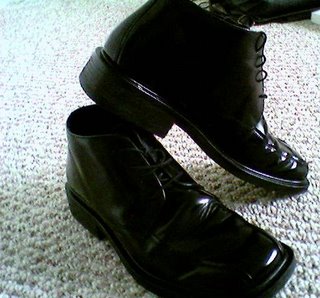


The Kenneth Cole boots that changed my life! They are great for either going to work or going out at night. Plus, all they require is a wipe down with some liquid polish. They are fairly comfortable, but I probably wouldn’t want to wear them everyday.

***

TornWordo wished to see both the front and back of the fridge door. For the front:
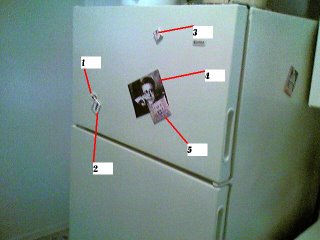


    Key:
    1) A Sticker of a rainbow kitten given to me by a friend from her super-special childhood sticker album;
    2) The magnet holding the sticker says, “Give us This Day, Our Daily Chile;”
    3) A magnet with San Pasqual sent by my mother post-divorce. She feared for my eating habits (see the open fridge door below) and hoped that the rotund saint would intervene.
    4) James Dean;
    5) Magnet with Jacqueline Kennedy having lunch with Queen Elizabeth II. While in Chicago last year, I purchased it at the Field Museum’s Jacqueline Kennedy exhibit.


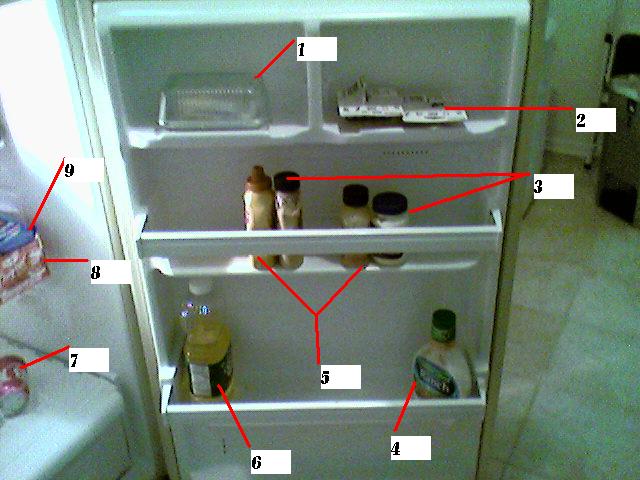
Now the sad part:
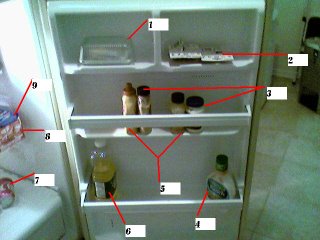


    Key:
    1) Butter (everything tastes better with butter);
    2) Batteries (I heard they keep longer if you toss them in the fridge);
    3) Two different containers of mayonnaise (I have an unhealthy obsession with white, creamy concoctions);
    4) Ranch dressing (see previous)
    5) Two different types of Dijon mustard. I tried to cut corners by buying the generic brand, but found it unsatisfying.
    6) A container of oil that already was in there when I moved in (Scared yet?);
    7) TaB;
    8) a case of yogurt (Strawberry and Blueberry);
    9) Pillsbury’s Oh-My-God-You-are-Too-Lazy-to-Even-Cut-Some-Dough-You-Lazy-Slug Chocolate Chip Cookies (with Walnuts).


Please don’t tell people how I live.

***

Vuboq’s request required some inventorying of my closet. After much consideration, I concluded that this must be the oldest piece of clothing in my possession:
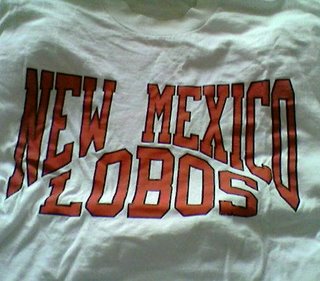


I obtained it for free during freshman-orientation in college (some fifteen years ago). During that same weekend, I also learned our school cheer: "Everybody's a Lobo -- Woof, Woof, Woof!" Hard to imagine why my university had such low school spirit, isn't it?

***
MEK asked to see my favorite vintage gay porn from my "research." How could I choose just one? So here is my “archive.”



One day, I really do intend to write about the ways that ideas about race, gender, and sexuality play out in same-sex sex porn. So, it’s not all just about GayProf being a horn-dog. It’s mostly about that, but not all about it.

***
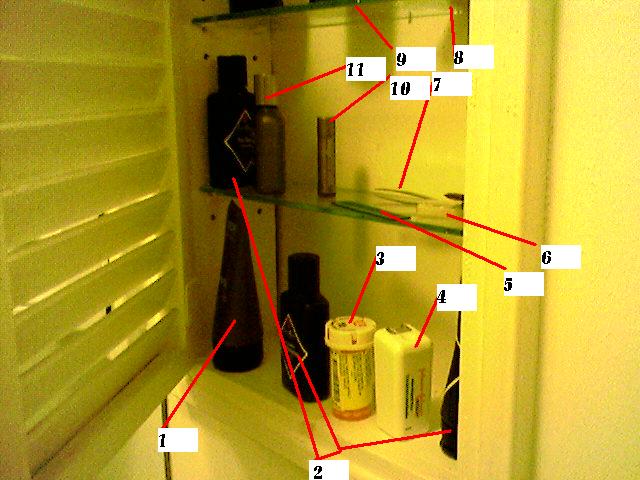
Elizabeth and Bigg, like many of my readers, seemed a bit too interested in GayProf's bathroom and bathroom habits. I am not sure what this says about the folk who visit the Center of Gravitas or its author, but I noticed a clear trend.
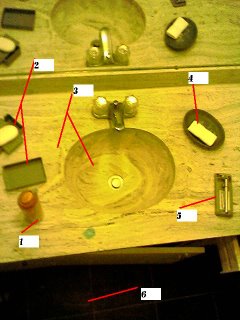


    The Tour:
    1) Shave cream
    2) face bar, chalk full of salicylic acid (in its own little dish)
    3) Sink and counter constructed of a material I had never seen before in my life. It’s kind of like a rubbery plastic. Or maybe it's a plastic rubber? Either way, this stuff is ugly and does not occur in nature. It also seems perfect for trapping stains for all eternity.
    4) Ivory soap, guaranteed to strip your hands of every drop of moisture
    5) razor (which, btw, outlasted my marriage as I owned it before I even met my liar ex (who told many lies));
    6) dark burgundy floor tiles. This is a decorating triumph! You want a floor that can absorb all light and make you feel truly claustrophobic, especially in a small space without any windows.


***

Elizabeth also wanted to know about the most useless kitchen gadget I own. That would be this:
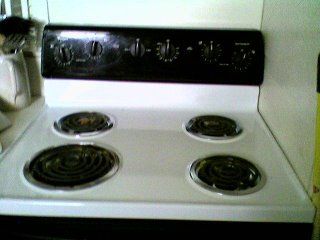


At one time, I knew the purpose of this object. Now, though, it just seems to take up a huge amount of space. Plus, if you turn the nobs on the top, those round thingys get really hot! That's just dangerous and crazy to have in your house!

***

Goblinbox wanted a look-see in my junk drawer:



    1)Plyers
    2)Screwdriver
    3)Hammer
    4)Nails
    5)Window sticker asking firemen to save my cat should terriorists set GayProf's apartment ablaze. I must imagine that this sticker is most effective if placed on your kitchen counter.
    6)Junk


***

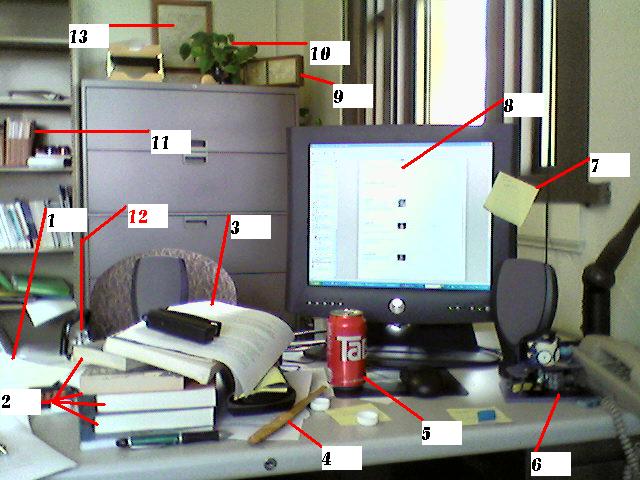
Brett and Chris both asked to see my work space. GayProf's office at the university:



    The Highlights:
    1) Ungraded student papers
    2) books on the history of African Americans in film (which has nothing to do with my current research or my current teaching plans)
    3) A riveting memo outlining the history building’s HVAC upgrades;
    4) wooden letter opener that a student gave me as a gift
    5) TaB
    6) Dib from Invader Zim toy
    7) Sticky note reminding me to send a file to a colleague of mine by May 1 (Yeah, that totally didn’t happen)
    8) State-owned computer displaying the comments for the previous post
    9) 1950's clock that shows the current time around the world. It reminds me of all the other places I would rather be than Texas.
    10) A plant that manages to live through my abuse
    11) My tenure files
    12) V.I.N.Cent. toy (GayProf will go on a date with any man who can name the film in which this robot appeared and the actor who voiced this robot without using Google)
    13) Historic map of New Mexico, The Land of Enchantment, don’t you know?


***

Brett also asked to see the view while seated on my toilet. If I have any Freudian analysts reading my blog, please contact Brett. He might wish to discuss his childhood experiences with toilet training. Regardless, his wish is my command:
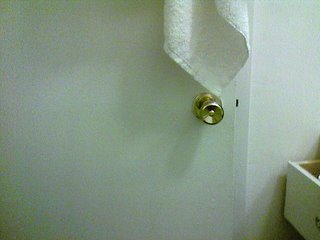


Though one of the first things that I see every morning (I eat my fiber religiously), the back of the bathroom door is not particularly interesting. If I were not going to Boston, maybe I would hang a picture or something. Eh.

***

Palochi inquired about the my dresser's top drawer. Like many readers, he seemingly hoped to find porn, lube, condoms, or something. He should have just asked to see the porn, lube, condoms, or something. GayProf has nothing to hide and lacks most forms of shame. Here, though, are the mundane contents of my top drawer:
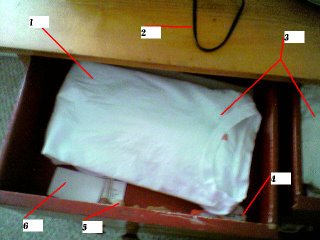


    Numbers 1 & 3) White undershirts;
    2) power cord for a DVD player;
    4) assorted keys to various friends’ apartments and houses. One of the bonus things about teaching summer school has been that I have been available to feed/water/rob all of my friends who left their cats/plants/homes for the summer.
    5) Cedar balls to keep away the bugs
    6) A few business cards from men that I have, um, met over the past few months.


***

Extra-greedy Da Nator asked for three pictures of something that made me sad, angry, and happy. Plus, she wanted commentary.

For sad and angry, I had to really think. Normally I don’t keep objects around that make me unhappy. Then I realized, I still had this:
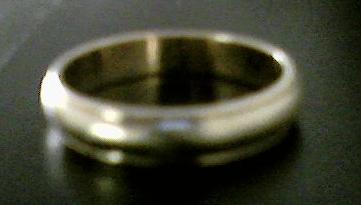


My wedding band makes me both sad and angry (Remember: Combining picture requests is not cheating. I am being efficient).

The ring makes me sad because, of course, not all of those eight years proved totally horrific. Some positive memories live on and I miss those times. I am also disappointed that my naïve and romantic vision of the relationship proved totally wrong. When I say “wrong,” I mean off by a long, long, mile.

The ring makes me angry because my liar ex told me many lies. Who could not be angry at a selfish individual who willingly lied to somebody who loved and trusted him?

I also have anger because I betrayed myself over and over again. I stayed in an eight-year relationship with somebody uninteresting, unremarkable, and unkind. He had all of the "un's." Few other individuals could be so defined by the lack.

Gone are the years I wasted on him. In some misguided effort to achieve security, I foolishly played the martyr. This makes me angry at myself. When did I hope to reap the reward for all that martyrdom? At our fiftieth anniversary? In heaven? When? Ugh – it’s a disappointing element in GayProf’s history. That’s a harsh-life lesson for you all.

Having been reminded that I still have this ring, I plan to pitch it into the Rio Grande on my up-coming trip to New Mexico. I figure the river that sustained generations of my family will easily eliminate the negative energy vested in this ring and help restore my own balance.

***

Now that we moved beyond that unpleasantness, let us see something that makes GayProf happy:



I love flowers. In this case, my apartment currently has a bouquet of Dutch Iris and Lilies. *Note the Nambé bowl in the background. Nambé is a product of New Mexico, don't you know?

***

Larry asked for my favorite Wonder Woman comic and Chad wanted my prized comic. It goes without saying that my prized comic would be, of course, a copy of Wonder Woman.

Still, the oldest Wonder Woman comic I have is from the late 1950s. To be honest, the Amazon Princess didn’t do well during that period. She spent an awfully large amount of time crying over Steve Trevor.

So, upon thinking about it, I decided my current favorite Wonder Woman comic in my possession would be this one:
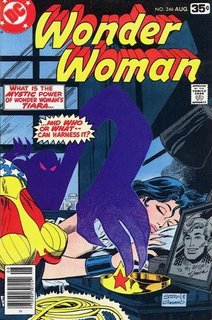


From the late seventies, this particular issue blended both camp and comic adventure. Not only did it focus on my favorite Wonder Woman tool, the golden tiara, it also had fun with the readers. Diana has a nosy neighbor, for instance, named Mrs. Kravitz. Likewise, it had the best thought-bubble ever to appear in a Wonder Woman comic:
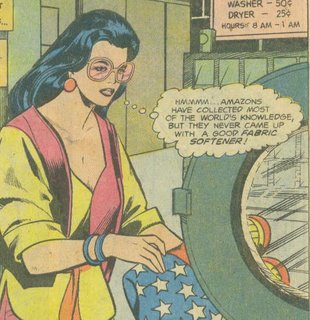


On a similar note, Bill asked for my favorite non-Wonder Woman comic. My blog might imply a greater knowledge of comics than I actually posses. Still, I have long had a love/hate relationship with Captain America. He is so over-the-top, it’s hard to take him seriously. Yet, he also symbolizes many of the worst elements of the United States: imperialism, notions of racial superiority, sexism, militaristic faith..He also first appeared around the same time as the greatest hero of all time (1942ish).

So, I own many Captain America from the sixties composed by Jack Kirby and Stan Lee. They made the Captain a bit more angsty (which is so unusual for a Kirby/Lee hero):
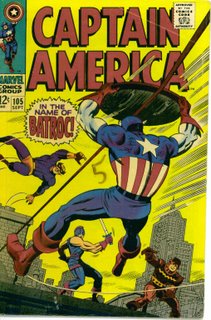


Plus, Cap seems to really, really, really, really miss Bucky. Perhaps he should not have let him die after all:
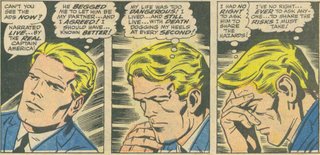


***

Finding the “queerest” object in my house for Wiccachicky prompted some thinking. I thought about cheating being efficient and tossing this in with one of the comics. Perhaps, though, that would have been a bit too efficient. In the end, I decided on this poster:



It’s a replica of Depression-era government sponsored play on the horrors of syphilis and how to obtain treatment. The naked male figure battles a snake, representing syphilis. Its ambiguous sexual content and male erotic figure just appealed to me.

***
Joe decided to look through my nightstand drawer (in a virtual sort of way):



He found:

    1) Two mid-century tie clips – One gold (shaped like a scepter), one silver. GayProf hates, hates, hates having his tie fly about all over the place.
    2)Box of shirt stays.
    3)Instructional manual for a watch that I don’t wear anymore
    4)Chicago Metra ticket (I am sure expired and of no value)
    5)Five Euro bill. GayProf likes to imagine that he will leave for Europe at any moment and, therefore, keeps some pocket change handy.
    6)Watch that I no longer wear.


ROG asked to see my feet. Look close and you can see they got caught in this photo just below the drawer. Okay, this time I am cheating. Who, though, wants to see my hairy Hobbitt feet? Nobody. Trust me.

***

My favorite toy, the 1978 NRFB Mego Wonder Woman doll, already appeared in the previous post. I hate to disappoint Perspective of Pete, though. My second favorite toy would be this:



My father has tremendous gifts in the industrial arts. In particular, he practiced woodworking as a hobby. He made and/or refinished multiple pieces of furniture. At about age 9 (I think), he made this wood catapult for me. I launched many a Star Wars action figure to their doom with it.

***

DykeWife and Earl both requested my car’s glove box:
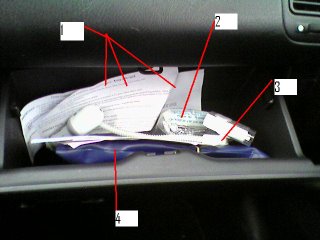


Contents:
1) Stack of expired Proof-of-Insurance forms
2)Emergency blanket. Living in Texas, one must assume a major snow storm will trap them in their car at some point -- or something.
3)Tuner that allows me to play music from my ipod on the car radio.
4)Owner’s manual

***

Earl further asked for a picture of my sleeping attire. When in bed, I sleep naked. Here is a picture of me, sans clothes, sleeping:



Oh, I also sleep in the dark.

***

“Hey, GayProf,” Kalvin stated, “Show us something that you are embarrassed to own.”

Okay:
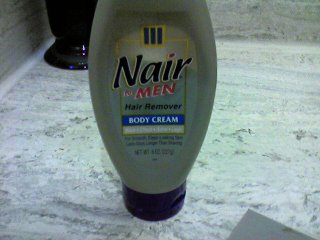


In my defense, I have never used it to remove pubic hair or chest hair. I don’t like the hairless look at all. Still, I have this small, but annoying, patch of hair on my upper back. That hair has to go.

Don't judge me.

***

MaggieMay inquired about which outfit I wear to feel like a “supha-stah.” Being an actual super-star, of course, I always feel special.

Oddly enough, though, one of my gym outfits pleases me at the moment:
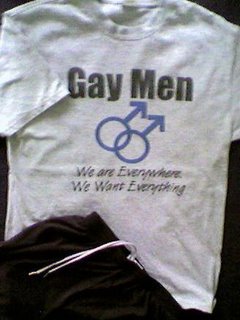


A gym-friend reported that somebody expressed concern that “the fags were taking over” after seeing me wear another pro-gay shirt. Being a contrarian individual, I had this shirt made just to wear to the gym. Many wicked hetero teens made adolescent queer boys feel unwelcome in gyms for years. I find it fair to now make those adult hetero men feel a wee bit tense, if possible. UnderArmour produced the matching black shorts, fyi.

***

Returning to GayProf’s bathroom, Brian wanted the inside of the medicine cabinet. I don’t keep many meds in there:
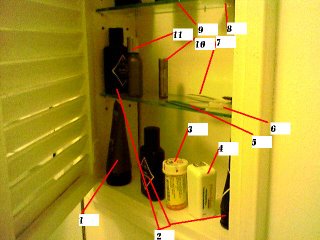


What I do keep:

    1) Hair goop
    2) Three different types of face goop, none of which has been used in over four months.
    3)Xanax
    4)Dental floss – Flossing is the key – THE KEY – to good dental hygiene
    5)Comb for goatee
    6) Scissors
    7) Tweezers
    8)Toothbrush (not pictured)
    9)Deodorant (not pictured)
    10)Lip goop
    11) Face goop that I do actually use (Clinique Post Shave Healer, fyi)


***

Mike Prov1 will probably not be surprised to see my favorite coffee mug:



Interestingly, I purchased this mug in Boston a few years ago. Now, it will return to its POS. By the way, though the blog implies it, I promise my entire apartment does not exist exclusively as a shrine to Wonder Woman. It’s more of a minor temple.

***

Marlan wanted my favorite underwear or jock. I don’t own a jock. Do they actually serve a purpose beyond fetish?

Choosing favorite underwear doesn’t occur to me much anymore. As I age, I tend to look for comfort more than anything. Kinda boring, but here are some Nordstrom’s undies that I like:


Well, these are my favorite until I can find adult versions of this:
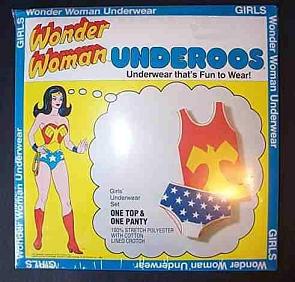


Moving on:

***

Lorriane, that cheeky girl, wanted to see where I toss my spare change:


It’s an upside-down lid for a tub of blank CD’s.

She also asked about the kitchen gadget that I could not live without. Well, I would have to say my 1960s Salton warming tray.
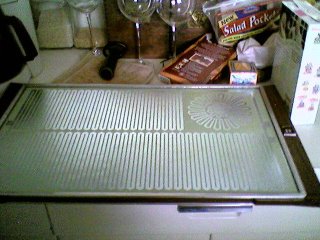


It’s huge! It screams, "I am a modern 1960s piece of kitchen history." Just look at that special daisy heating spot for coffee!

Total times I have used this object in the ten+ years since I bought it? One. Some might suggest, therefore, that it has no value. "Not so fast," say I.

At any moment, I could host a hot brunch buffett. Can you claim the same?

I could have many friends over and keep my mini-quiches warm and ready to eat. Well, if I knew how to cook.

Still, one can’t be the hostess with mostess without a Salton warming tray. You just can't!

***

Clean & Sober asked to see both my favorite Halloween costume and a childhood photo. Totally not cheating, I am combining those two things.

My Zorro outfit was my actual favorite childhood costume. Being the youngest child, though, my parents had grown somewhat bored with photographing our lives. Therefore, no visual record exists of that costume.

Instead, I do have a picture of me in my costume as a “hermit.” Tell me that wasn’t a childhood cry for help:


***
Dan asked for my home bookshelves. Unfortunately, I already packed those for my move to Boston. As a replacement, I offer one of my office bookshelves:
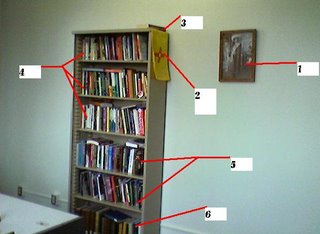


The List:

    1)Emiliano Zapata
    2)New Mexico Flag
    3)Undergraduate course catalog from 2003
    4) Books on Latino history
    5) Books on Queer history
    6)Overdue library books (shhh!)


***

Ancrene Wiseass asked about my oldest music recording. I still own the vinyl, but it currently resides in storage at my parents’ house. Therefore, here is a substitute picture of the CD:



Styx’s Paradise Theater won the prize of being my first album that I ever bought. I am not sure if I liked the cover more than the music. On one side of the LP, they had the theater during its grand days. On the other side, they had it in decay. I examined each inch of the pictures over and over. Even as a wee lad, I loved the notion of historical change over time.

***

The rest of you asked for some form type of picture of GayProf. Wiccachicky also asked about a picture of a scar. Interestingly, I do have a tiny scar in a pornographic zone, but that is a story for another time.

Being basically a mama’s boy (and proud of it!), I didn’t really injury myself that often. If you look closely at my forehead, though, you will see a small dent. What caused this flaw?

I was playing with my sister’s hairdryer. For reasons that only make sense to an eight-year old, I put the metal nozzle on my forehead. That sizzling noise indicated that I had branded myself. Yes, it's true. I have a tragic hairstyling-related scar.

For the rest of you, a current picture of GayProf on the couch where he spends most of his time in the apartment.



Thanks for playing.