Thursday, July 29, 2010

Please Don't Give

Months have passed and I am still having a hard time losing the extra pounds that I gained during the last holiday cycle. This has meant that, with the flexibility of summer, I am trying to maintain my regular gym schedule at least until I depart for an extended trip. My time at the local sports club involves a singular vision of trying to improve my gayish figure.

My steely cold determination was briefly interrupted the other day. Two kindly older men stealthily flanked me as I scanned my membership card. If I were still in TexAss, I’d fear that they were on a mission to save my soul. Given that I was in Midwestern Funky Town, I suspected that they were on a mission to save some whales.

“Would you like to make a donation of blood today?” the eldest one asked with a pleasantly grandpa-demeanor. See? Midwestern Funky Town is so nice. “Sorry,” I responded, “I would like to, but I’m gay and they won’t take my blood.”

No sooner had the words left my mouth than a sudden wave of “stop” swept across the gym reception area. You might have thought that I had reached into my gym bag for a rubber chicken, slapped them in the face with it, and then wet the floor. They didn’t have the look of a deer in headlights. They had the look of somebody who saw a deer driving a car while smoking a cigar. Something had just been said that made no sense at all to them.


Surely many people had declined the opportunity to donate blood through the day. I couldn’t have been unique in that way. For the first time, though, they were faced with a totally unexpected reason why I wouldn’t (actually can’t) donate. They looked at me nervously before regaining their composure.

“No, that’s not true!” they exclaimed in unison. “They want everybody to donate!” Many people do not know that there is a ban on men-who-have-had-sex-with-men (MSM for short) from donating their blood. Unless you donate blood (and you should), you don't need to really think about the blood ban or be informed about it. It did surprise me, though, that the volunteers for the Red Cross were as unaware. It was at this point that I realized I was going to have a queer education moment. Man, all I wanted to do was lose a few pounds before heading to Spain. Next thing you know, I have to wade into thorny questions of health policy.

One of the nice men brought out the guidelines for blood donation. “I’m sure you’ve been misinformed,” he said to me sweetly, “All you have to do is answer these questions.” He quickly skimmed through the list and, much to his surprise, found the bit that refuses blood donations from “a male who has had sexual contact with another male, even once, since 1977.” Now, I don’t like to brag, but I have had sexual contact with another male more than once in the era post 1977.


This measure is a hold over from the bad ol’ Reagan days. The Food and Drug Administration, reacting to some real cases of HIV infection from blood transfusion, developed these guidelines circa 1983. It’s hard to remember, but so little was known about the disease and the panic so great that the FDA’s decisions appeared sensible in the mid eighties.

Much has changed since that time. Testing and screening of blood has become much more advanced. Alas, the FDA refused to revisit the ban on gay donors this past June. It seems a darn shame to me as donating blood is one of the easiest forms of community service one can do. Trust me, I’d much rather have a needle in my arm for 10 minutes than spend hours picking up trash on some highway somewhere.

I first donated blood all the way back in high school. Back then, since I was deeply in the closet and not having sex with anybody else, I had no problem answering those questions. Once I came out of the closet and my consciousness was raised, so ended my blood donating days. If the ban were not in place, I'd be more than happy to start donating again (GayProf always plays safe and has himself tested regularly like all good little gay boys).


The FDA reasons that MSM are simply too great of a risk group. I understand the logic there and the FDA authoritatively tosses out some pretty grim statistics about the prevalence of HIV among gay men. There is a pesky problem, though, that HIV is also prevalent in other populations. African Americans accounted for over half of the new HIV diagnoses in this country for the past several years. Likewise, Latinos accounted for 18 percent of new cases. I shudder to think of the FDA announcing a policy that refused blood based on one’s racial background.

About a third (31 percent) of new HIV infections occur from “High Risk Heterosexual Contact” according to the CDC. Young heterosexual women, in particular, are being diagnosed with HIV at alarming rates. Every 35 minutes in this country a heterosexual woman is informed that she has tested positive for HIV. Many heterosexual women continue to naively imagine that “safe sex” for them only involves avoiding pregnancy. They might be surprised to learn that HIV infection was the leading cause of death for black women aged 25–34 years; the 3rd leading cause of death for black women aged 35–44 years; the 4th leading cause of death for Hispanic women aged 35–44 years. Overall, HIV infection is the 5th leading cause of death among all women aged 35–44 years and the 6th leading cause of death among all women aged 25–34 years.

Yo, stratighties -- Use a condom!


If the FDA was really interested in cutting down the odds of blood donations that might be HIV+, then they should start an active campaign targeting the population the least affected by HIV: lesbian-exclusive women. Imagine how differently the world would look if we depended upon lesbians for our nation’s blood supply. They could ask for everything from equal-pay-for-equal-work to a law requiring sensible shoes.

I won’t entirely fault the FDA and other agencies for taking measures that they imagine will reduce the risk of HIV infections in the nation. They also aren’t alone as the same standards are used by Canada and the EU (Yep, even Canada). It seems to me, though, that the ban on gay men provides a false sense of security and continues to erroneously construe HIV as being mainly a gay male issue. The policy also presumes that one’s safe-sex practices (among others) aren’t the real concern. Rather, it takes a short cut by implying that all man sex is scary and dangerous and hetero sex is a-okay (unless you pay for it).

Because acceptance of gay men and lesbians increased exponentially over the past decade, many people assume that the fight for our basic rights is basically over. It is important to bare in mind, though, that being treated as a second class citizen is not just about being denied rights for things you might want in your personal life (equal marriage, partner benefits, the ability to adopt human worm larvae). Second class citizens are also prevented from contributing to the collective whole, like serving in the military or participating in blood drives.

The volunteers were clearly a bit hurt to find out that I was right about the gay ban. To them, donating blood must have seemed like such an obvious social good that it couldn't possibly involve any political concern. It must have been like finding out that your favorite, sweet old aunt had secretly been sending money to the Ku Klux Klan for years.

Thursday, July 01, 2010

You're [Slightly Less of a] Wonder, Wonder Woman!

Many people have asked me about DC Comics’ announcement that Wonder Woman will be significantly altered, at least for the short term. When you shamelessly appropriate a beloved character as your personal avatar, it is hard not to have an opinion about such things. The horrible truth is that, despite the image from the blog, I am on the fringe of the truly loyal comic fans. I did read Wonder Woman (and other) comics as a child in the late 1970s. More recently, I have kept up with Wonder Woman, especially after her relaunch four years ago.

For those of you who don’t know, DC Comics has published Wonder Woman #600 to commemorate the company’s 75th anniversary. This is a tricky numbering system for the Amazon Princess as DC has decided to mysteriously count multiple volumes of the superheroine to get this nice round number, but whatever.

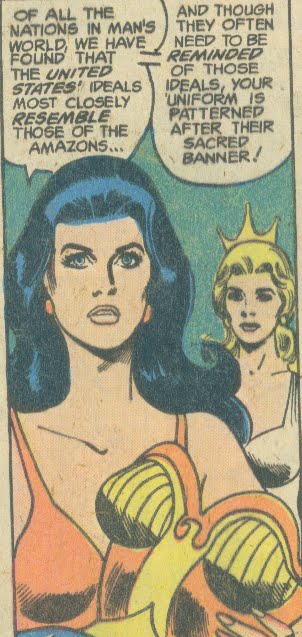
What is making the most news is that the new series accompanies a major costume change for Wonder Woman. I have to say, the new Wonder Woman leaves me a bit sad.


The new costume presents Diana as if she has been shopping the clearance racks at Hot Topic. Not to mention they had the nerve to bring back the horrible WW symbol. Goddess, how I hate that WW. Is she a superhero or a spokesperson for Whataburger?

See, I do have strong opinions. The eagle WW from the relaunch made perfectly good sense to me. Indeed, this is what I wear to the gym these days:


Everybody knows exactly who that symbol represents. The simple WW? Not so much.

Now I know that I am in danger of sounding like every run of the mill whiny and entitled comic fan out there. Certainly there are a lot of knee jerk reactions on the internets. Let me note that the new costume has its supporters, including none other than Lynda Carter. “She’s got an attitude, and if this is the new thing she wants to wear, well by God she’s going to wear it,” Carter stated in a recent interview, “And I like that. And I hope somewhere in the story someone mentions, where’s the old one? And she says, 'Get over it.'”

Despite the endorsement, however, the costume change is getting mostly negative reviews. Taking a look at on-line polls and (*shudder*) comic discussion threads, a clear majority despise the new look. Fox News, never one to lose the chance of sounding shrill, has hinted that the costume change smacks of anti-American attitudes at DC.

I appreciate that DC is in kinda a tough spot with Wonder Woman’s costume. Let’s face it, her original outfit looked like a red-white-and-blue Playboy bunny costume. One isn’t sure if you are supposed to salute her or give her your drink order.


Even so, I just don’t like the new outfit. Still, I read with interest that the outfit emerged because the new writer, J. Michael Straczynski, “wanted to toughen her up, and give her a modern sensibility.” That sounded promising. Well, until they released the cover image for Wonder Woman #603, which then made those ideas ring a bit hallow:


Apparently “toughening her up” means that Wonder Woman’s breasts are the size of her head. I reject that tossing on some tight leggings is somehow making this character more sensibly dressed if every panel is centered around her cleavage.

Rumors abound that they are trying the costume change as a means to possibly sell a movie character. Let me tell you, it ain’t going to work. When people think Wonder Woman, they think star-spangled panties.

What I find more interesting, though, is that the costume change has overshadowed discussions of other major changes to the character. I’m less concerned about what is in Diana’s closet than the fact that she is now going to be weaker than her previous incarnations (thus no longer making her the peer of Superman).

What is astounding about this turn of events is that it has all happened before (and, as Peter Pan would say, it will all happen again). Unlike Superman or Batman, Wonder Woman has had her basic premise reworked more times than Joan River’s forehead. Granted, DC has been more than willing to pull similar stunts with those characters. Remember when Superman “died”? Or that weird cyborg Superman? Or when Batman broke his back? Or when Batman “died”?

Nonetheless, there seems to be some key differences in how Superman and Batman are treated when compared to Wonder Woman. Comic writers often speak of the other two (and Marvel’s Spiderman) as the holy grail of the industry. They all yearn to take a crack at the helm of those books. Meanwhile, writing for Wonder Woman is treated as a chore equivalent to comic jury duty.

Sales figures for Wonder Woman are also abysmal. Superman and Batman’s names can support multiple comic titles at the same time. Yet, Wonder Woman struggles to even keep her single book afloat. I can’t help but thinking it’s because she is a girl in a male dominated industry.


I am distressed by the details announced to “reboot” Wonder Woman. In this version of Wonder Woman, Paradise Island (aka Themyscira) is totally destroyed and all the Amazons are slaughtered – again. I will leave it up to the Freudians in my audience to determine why the male writers of Wonder Woman so often feel the need to demolish the matriarchal Themyscira and kill off the Amazons.

So now Wonder Woman is raised in the United States without knowing her ancestry or learning Amazon ways of peace and love. She also, for seemingly no reason, is much less powerful than the island reared Diana. Maybe those fresh Caribbean breezes give her a little extra oomph. Who can say?

Male writers of Wonder Woman always seem to imagine that they are doing women a favor by taking powers away from Diana. It is a nice piece of reverse logic, especially given that the Amazon character started out with the exact opposite in mind.

As anybody who is obsessed with Wonder Woman most people know, the psychologist William Moulton Marston created Wonder Woman in 1941 as a conscious alternative to the male superheros who had sprung up during the Depression. He expressed concern that young girls lacked any significant role model and were always sidelined as merely a plot twist or an object that needed saving. “Not even girls want to be girls,” he wrote a year after he introduced Wonder Woman, “so long as our feminine archetype lacks force, strength, and power.” His big idea was to create a woman hero as strong as Superman, but with traits he believed to be “innate” to women (love, compassion, etc.). Even from her start, then, Wonder Woman existed as a gender contradiction. She was the fiercest warrior, but only in the name of peace. Oh, and since Marston loved the S&M in his personal life, Wonder Woman’s plots often involved bondage and ritual spanking.


Wonder Woman fit well for the war years. Women were stepping into new jobs for the war effort and they craved images of a strong woman who also contributed to the Allied cause.

But what about her costume? Well, it was sorta loosely modeled after a Greek warrior, but still recognized as skimpy even by comic standards. One of the first issues even addressed Diana’s thrifty use of cloth:


After World War II, Wonder Woman began to hit hard times. Marston, whose queer ideas about gender and sex had driven the book, died in 1947. Matters became worse when a psychiatrist named Fredric Wertham created a minor frenzy after publishing Seduction of the Innocent in 1954. Comics, he claimed, were at the heart of every social ill from drug addiction to rape. He charged Wonder Woman in particular with turning young girls into lesbians. “The homosexual connotation of the Wonder Woman type of story is psychologically unmistakable,” he wrote, “For boys, Wonder Woman is a frightening image. For girls she is a morbid ideal... The attractive Wonder Woman and her counterparts are definitely anti-masculine. Wonder Woman has her own female following. They are all continuously being threatened, capture, almost put to death. There is a great deal of mutual rescuing... In a typical story, Wonder Woman is involved in adventures with another girl, a princess, who talks about ‘those wicked men.’” Yeah, where did Wonder Woman get off thinking that she didn't need a man to rescue her? She ought to get back into the kitchen making chicken pot pies where she belongs.

Faced with public backlash, DC responded by subtly altering Wonder Woman. A 1950s or 1960s version of Wonder Woman usually contained as many panels of Diana crying her eyes out over Steve Trevor as doing any actual work. She also lost all of her women friends, just to make sure that nobody could accuse her of being anything other than 100 percent hetero. Finally, she basically stopped battling human (male) villains and instead fought more mythical creatures.


By the end of the 1960s, Wonder Woman was, well, dull. DC attempted an almost identical shift in Wonder Woman’s storyline as the one they announced on Tuesday. Starting in 1968, Diana renounced her Amazon superpowers, watched as Paradise Island transferred to another dimension (or sunk into the water, or something), and ditched her swim wear for a white jumpsuit and other “mod” clothing. Like DC’s reaction to their announcement Tuesday, DC writers in the 1960s expressed surprise that feminists (including Gloria Steinham) saw robbing Wonder Woman of her powers as a betrayal. Gee, why would making a character less powerful not be seen as a step forward for women? Oh, and did I mention that she gave up her position as a ranking officer in the military in order to open a dress boutique? Without her superpowers, Wonder Woman, or, er, Diana Prince had to learn martial arts from an absurdly stereotypical character a martial arts master improbably named “I Ching” (To say that Wonder Woman and other DC comics had some problems grappling with race is a bit like saying BP dribbled some oil on the gulf).

This jumpsuit-clad Wonder Woman proved so unpopular that the return of the star-spangled panties in issue #204 included a total bloodbath of anybody associated with the previous version of the character. Everybody had to die so that the old-glory hot pants could return.


The 1970s era is one of my favorite for Wonder Woman, and not just for obvious nostalgic reasons. There is a certain period when the book allowed itself to be a bit more campy. I liked, for instance, that Diana spent some quality time debating her laundry’s freshness.


Even after the jumpsuit fiasco, the 1960s would not be the last time that an alternate version of Wonder Woman appeared. A year before the beloved Lynda Carter series started, ABC aired a pilot for Wonder Woman starring the very blonde Cathy Lee Crosby. In this version, Diana Prince worked as a secretary for a CIA-type organization. She ultimately became involved in spy work herself, put on an outfit that had little resemblance to the comic version, and seemed to mostly follow the martial arts era comics (without superpowers). Most people found it hard to see this characterization as having much in common with the character they knew as the Amazon princess.


Today, DC is again cutting down Diana’s powers and changing her wardrobe in hopes of spurring interest in the character. It seems to me that the approach smacks of desperation.

From the outside, one does get the impression that DC really wants Wonder Woman to succeed. They consider her part of their “trinity” of the three most recognizable comic characters: Superman, Batman, and Wonder Woman. They have also brought in some well known talent over the past few years to write for the series, including Jodi Pocoult (whose stories never quite worked) and the much beloved comic writer Gail Simone. The latter had some hints of great ideas (The Return of Reform Island!), but it never quite came together. Who can then blame DC executives for making the current ploy to generate interest in Diana? Let’s face it, this is probably the most people have talked about Wonder Woman in years. Still, I really don’t think making Diana weaker is the answer (or killing off the Amazons – again).


I just can’t figure out why it is so hard for DC to find a decent story arc for Wonder Woman that would renew her appeal. As I wander through Target and other shops, I am struck by how much the aisles are adorned by the many Disney Princesses. It seems to me that DC is missing real opportunities to market Wonder Woman to a younger generation. If I were a parent, I’d have a real problem buying books and dvd’s from Disney that depicted women doing nothing but sitting around singing about their hopes to find a man who could rescue them. Wouldn’t it be much better to have a woman who is strong, independent, and super smart like Wonder Woman (who also happens to be a princess)? Even if she does dress like she should be spending her days at the beach rather than fighting crime, she still has a better overall message about women being the equal of any man. But, DC is never wise enough to ask GayProf to consult on Wonder Woman’s future.

Monday, June 28, 2010

Aging Gracefully

Greetings from the hot and steamy Midwestern Funky Town. With all the humidity, the town’s nickname might need to be modified as Midwestern Funk Town. We have had an unusually difficult summer already – Tornado warnings, violent storms, and unpleasant heat. I tell you, I did not move to a place where the state flower is an icicle just so that I could swelter in the summer.

The official start of summer also means that my birthday is upon us. Those of you who are old enough probably remember the day thirty-six years ago when the earth shook with goodness. As is always the case, I like to take time to consider where others were in their lifepaths at age 36.


    If I were Mary Richards at age thirty-six, I would have moved to Minneapolis six years ago. Love would be all around for another year.


    If I were Elvis Presley, I would be given the Grammy Lifetime Achievement Award this year.

    If I were Murphy Brown, I would enter rehab four years from now.

    If I were Jacqueline Bouvier Kennedy, I would have left the White House three years ago. It would be another three years before I married Aristotle Onassis.

    If I were Jesus at age thirty-six, I would have risen from the dead three years ago.

    If I were Cher, this would be the year that I starred in Come Back to the Five and Dime, Jimmy Dean, Jimmy Dean on Broadway. My acting career would skyrocket after that.


    If I were Marlo Thomas, this would be the year that I teamed up with Gloria Steinem to create the "Ms. Foundation for Women".

    If I were Bob Marley, I would be dead.

    If I were Oscar de la Hoya, this would be the year that I retired from boxing.

    If I were Oscar Wilde, this would be the year that I published The Picture of Dorian Gray. Is it a coincidence that at age 36 Wilde was fantasizing about the possibility of never aging? I think not.

    If I were James Dean, I would have been dead for twelve years.

    If I were Pancho Villa at age thirty six, I would be at the height of my power in northern Mexico and still serving as provisional governor of Chihuahua in the midst of the Mexican Revolution. Things would start to fall apart for me next year.

    If I were Elizabeth Montgomery, I would have been starring in Bewitched for five years. I wouldn’t give my last twitch for another three years.


    If I were Harvey Milk, it would be another 11 years before I became the first openly gay elected official in a major U.S. city.

    If I were a bottle of wine, somebody would pay a lot of money to drink me.

    If I were Saint Anthony of Padua, I would be dead.

    If I were James Baldwin, this is the year that I would publish Nobody Knows My Name.

    If I were Frida Kahlo, this would be the year that I painted “Roots.”


    If I were Diego Rivera, this would be the year that I painted my first mural “Creation” at the National Preparatory School in Mexico City at the expense of the Mexican federal government.

    If I were Anthony Perkins, I would star in the forgettable Pretty Poison. It would have been eight years since I originated the character of Norman Bates.


    If I were Franklin D. Roosevelt, I would be serving as the Assistant Secretary of the Navy. This would also be the year that I would first meet Winston Churchill. It would be another 14 years before I would be elected President of the United States.

    If I were Princess Diana, I would be dead.

    If I were Kate Jackson, this would be the year that I started filming Scarecrow and Mrs. King.


    If I were Farrah Fawcett, this is the year that I would win critical acclaim for my off-Broadway performance in the play Extremities.

    If I were Jaclyn Smith, this is the year that I would star in Sidney Sheldon’s Rage of Angels, thus starting my reign as the Queen of the Made-for-T.V.- Movie.

    If I were either of my parents, I would already have three children. The youngest would be eight years old.

    If I were Dolly Parton, I would star in The Best Little Whorehouse in Texas this year. It would include my performance of “I Will Always Love You.”


    If I were Dorthea Lange, this would be the year that I accompanied my husband to Taos, New Mexico. It would be another four years before I broke out of the crushing boredom of domestic life to become one of the most famous photographers of the Depression era.

    If I were Nina Otero-Warren, this would be the year that I became the superintendent of public schools in Santa Fe County.

    If I were Barack Obama, I would be serving my first term in the Illinois Senate.

    If I were Paul Lynde, I would be filming Bye Bye Birdie.

    If I were Marilyn Monroe, I would be dead.

    If I were Pearl Bailey, this would be the year that I starred in the Broadway musical House of Flowers.

    If I were Manuel Armijo, I would serve as mayor of Albuquerque while enjoying my wealth from sheep trading.

    If I were Walt Whitman, I would publish the first edition of Leaves of Grass this year.

    If I were Cleopatra VII, this would be the year that Octavian launched a Roman invasion against my kingdom in Egypt.


    If I were Betty White, I would be filming the sit-com Date with the Angels. It would be another 15 years before I appeared as Suann Nivens on The Mary Tyler Moore Show. Twenty seven years would pass before I would play Rose Nylund on The Golden Girls. It would be 52 years before I would star in Hot in Cleveland.


    If I were Miguel Otero, Junior, I would be serving as the Probate Clerk of San Miguel County, New Mexico. It would be another two years before I became the first Mexican American governor in the United States.

    If I were Arizona Governor Jan Brewer, I would be remarkably unkind.

    If I were Captain Kirk, this would be my last year commanding the U.S.S. Enterprise on its five year mission “to explore strange new worlds; to seek out new life and new civilizations.” Unless I was the Captain Kirk from the poorly written recent film, in which case I would have skipped over all the hard work of earning that rank eleven years ago.


    If I were William Shatner, I would have been playing Captain Kirk for one year.

    If I were Captain Picard, I would be serving as first officer of the U.S.S. Stargazer. It would be another 23 years before I took command of the Enterprise.

    If I were Patrick Stewart, I would have been a member of the Royal Shakespeare Company for ten years. It would be another eleven before I accepted the role of Captain Picard.


    If I were Popé, it would be another nine years before Spain’s religious authorities would arrest me for practicing “sorcery.”

    If I were Truman Capote, it would be another five years before I published In Cold Blood.

    If I were Octaviano Larrazolo, this would be the year that I moved to Las Vegas, New Mexico. It would be another 33 years before I became the first Mexican American elected to the U.S. Senate for the state of New Mexico.

    If I were GayProf, it would have been three years since I moved to Midwestern Funky Town. My blog, The Center of Gravitas, would be five years old.


    If I were Reies López Tijerina, this would be the year that I devised the Alianza Federal de Mercedes while living in Albuquerque.

    If I were Wonder Woman, I would age another 2,455 years before joining Patriarch’s world to fight crime.


Thursday, June 24, 2010

Meow, Woof, and Everything In Between

You know, I just can’t think about Arizona anymore. Did you see the story about that school mural? The fine city of Prescott, Arizona demanded that artists “lighten” the skin color of a Latino student depicted in a scene about riding bikes. Yes, it has now reached the point where the [white] people of Arizona don’t want to even see Latinos in public. Some may snicker, but I am beginning to suspect that Arizona’s elected officials arrived in town via hot-tub machine from 1882.

Believe it or not, I don’t like to spend all my days thinking about racism, sexism, homophobia, and other forms of institutional inequality. People on the political right often imagine that the contrary is true for people on the left. They should know that it is actually a real drag to have to constantly be addressing issues of unfairness. Believe me – I am a creative guy. I can think of other ways to occupy my time. I’d much rather be thinking about puppies! Or kittens!

Indeed, I really have been thinking of puppies and kittens. It has been about a year since I lost my beloved and loyal little cat. While no new pet could replace him, I am ready for another animal companion.

Sure, I have companionship from friends and even a gentleman caller from time to time. Let’s face it, though, animals give a type of friendship that humans really can’t muster. They are always loyal, honest, and dependable. They are also much easier to share a house with than a boyfriend. Cats might have a habit of crawling into the dishwasher, but you don’t have to argue with them about the right way to load it. Likewise, dogs might tear up you favorite slippers, but they won’t wear them without asking. Of course, unlike humans, cats and dogs might be tempted to feast on your remains should you die in the middle of the night. Well, unlike most humans at least.

The problem that I am facing is that I am uncertain which animal I want my new roommate to be. Normally when I am faced with this type of dilemma, I turn to the sacred texts of Diana of Themyscira. In this rare instance I found no useful instruction. We are told that Diana can communicate with the animals telepathically, but she rarely seems to keep a pet around. I guess being an international spy, Amazon warrior, and sometime dress-boutique owner keeps you too busy for animal companions. The exception seems to have been that wonky gorilla subplot that I never really understood.


I have long been on the record as being bi-animal. I grew up with dogs (mostly a long-lived terrier mix). As an adult, my faithful cat was the most stable living creature in my life. Anybody who claims that cats aren’t affectionate has clearly never lived with a cat. Or at least a cat that liked them.

Right now I am weighing which type of animal is best suited for my life. Dogs and cats each have their own unique advantages and disadvantages. As I am out driving, I do find myself slowing as my eye catches sight of a spry Airedale being walked by her owner. Previously the only thing that slowed my speed like that was hot shirtless male jogger.


Dogs are certainly more willing to devote themselves to you 100 percent of the way. Several of my friends also have dogs who could enjoy a play date. On days like this, when the sun is shining in Midwestern Funky Town, having a dog to walk sounds so pleasant. Canines are great as an active companion. They will go with you on rides, walks, jogs, and jewelry heists.

Then again, the sun shining in Midwestern Funky Town is a novelty. Taking a dog out to trudge through the frozen tundra twice a day sounds much less appealing. Not to mention that finding rentals that accept dogs can be nearly impossible. The landowner of my current cottage has said she would be willing for me to get a dog – for a price. And, let me tell you, her price suggests that she ain’t no dog lover.

Cats have lots of advantages over dogs. They are much more self reliant and don’t require as much hand holding, or, er, paw holding as dogs. One can take a long weekend and a cat will be able to tend to its own needs. Should I decide to rent an apartment in the future (and the shoveling of snow sometimes makes that seem like an attractive option), cats are much better suited to make that adjustment. Unlike dogs, cats purr. I could also name my new cat Pyewacket and live out my fantasy of being Kim Novak.


There is still quite a bit of time for me to decide between a cat or a dog. This summer will involve some lengthy travel for me. So, obviously, I don’t want to get an animal until I will be more permanently based in MFT. Once I am settled in the Fall, though, I will have much time to devote to a kitten or a pup as NERPoD will be totally in bed and I will be free from teaching thanks to the generosity of a research foundation funding NERPoD: The Sequel.

In the meantime, I have received plenty of input into which animal my friends think I should adopt. It seems that the people who surround me have a lot invested in the type of animal that their friends choose.

Maybe it is just human nature to try and convince other people to make the same decisions that we have made in our lives. Or maybe people feel that they will be disloyal to their own pets if they don’t act as an advocate. Whatever the case, I am a bit surprised by the depth of opinion. Forget the debate over health care. Never mind the divide between Republicans and Democrats. Evangelical Christians and Fundamentalist Muslims are the best of friends compared to what really divides the world. Dog people and cat people are totally nuts. The gangs from West Side Story should have been named the Kitty-Kats and the Poodles. When they face off, somebody is sure to lose a pint of blood.

To listen to dog or cat people, there is only a choice between happiness and misery. People who hate cats (who seem unfairly plentiful) put forward a barrage of arguments. They will say things like, “A cat will destroy your furniture” or “Cats just aren’t fun” or “Cats steal the breath of small children.”

Then again, never in all the places that I have lived have I met so many people who are fearful of dogs. I don’t mean indifferent, but actually terrified. They are some of the biggest dog detractors. They say things like, “Dogs bite people” or “When I think of dogs, I think of Nazis using them in concentration camps.” Apparently they missed those reruns of Lassie.


It is interesting that people have such strong feelings about cats and dogs. After all, it’s humans who engineered both of them to be our companion animals. Perhaps no other creature on earth has been more genetically manipulated by humans than dogs. Well, dogs and Gregor Mendel’s evil mutant bees. Over thousands of years, we have created particular dog breeds to do almost any task from herding, hunting, and guarding. No wonder people feel so attracted to dogs. We warped their DNA to appeal to us.

On the other hand, humans only ever asked one thing from cats: kill, kill, kill. As long as they ate their weight in rodents, humans were more than happy to have cats around. Some people suggest cats are only semi-domesticated as they really can live just fine without humans.


Despite what one might think, there are more pet cats in the United States than dogs. The tricky bit, though, is that there are more dog owners than cat owners. Cat people have a peculiar habit of not being able to stop at just one. Even my local animal shelter really pushes you to adopt two (or more) cats at a time. It’s funny that humans are less likely to give dogs, who are pack animals, another dog companion. Yet with cats, who are solitary creatures, we push them into little mini colonies.

None of this makes me any closer to a decision. Maybe I’ll listen to Farmer John on that Beekman show and end up with some goats.

Thursday, May 27, 2010

Ethnic Studies is for Everyone

Arizona’s legislature and governor recently decided to try to end ethnic studies within the state’s public schools. While it might be easy to ridicule Arizona (fun, too), we should be careful about assuming that the Grand Canyon state is anomalous in these efforts. It is merely one piece of an increasingly reactionary right-wing effort to control education curriculum. Far-right members of the Board of Education in Texas also recently attempted to alter that state’s “social studies” standards with a similar philosophy as Arizona: Students shouldn’t learn anything about this nation’s past that might make them feel bad.

One of the more astounding elements in the Texas changes is that they sought to downplay Thomas Jefferson’s role within the curriculum because of his critique of Christianity. That’s deep, man. How much more conservative can Texas get? When you start thinking that one of the slave-holding, elite “founding fathers” was just “too liberal” you know you’ve crossed into a new horizon of crazy. I imagine that the only place further to the political right you could go next would be to start arguing that George III wasn’t such a bad guy after all. Next thing you know, the Texas school board will be suggesting that the U.S. war for Independence was just some socialist conspiracy, what with their demands for a government that derives its just powers from the consent of the governed.


Leaders in Arizona couched their animosity to ethnic studies as really being about defending the ideals of the nation. Tom Horne, the architect of Arizona’s measure, pulled off a neat rhetorical trick that the right has found so useful these days. He posited that programs initiated to combat institutional racism are, in fact, the “real racism.” “The most offensive thing to me, fundamentally, is dividing kids by race,” Horne stated to the New York Times. Tucson’s ethnic studies programs (where Latino/a children make up 56 percent of the students enrolled) particularly irked Horne. He claimed that existing Mexican-American classes “are teaching a radical ideology in Raza, including that Arizona and other states were stolen from Mexico and should be given back.” Of course, Horne never bothered to actually attend any of these classes or find out their daily content. Nope. Why worry about things like that when you are ceratin you are right?

Really Horne gives ethnic studies teachers/professors too much credit. As I often say, I can’t convince my students of the need to use the spell checker before they submit their assignments, much less alter their political views about the nation (nor is that my goal).

Horne wants a new curriculum that depicts his fairytale version of the nation with an education focused on the “individual” How one can talk about a nation only through individuality seems to be a paradox to me, but what do I know?


Now, I haven’t been involved in Arizona’s ethnic studies programs, so I am as ignorant as Horne to their particular content. It would be foolish to comment about it without more first hand knowledge. So, the rest of this post is not about the Arizona public schools in particular.

I do know ethnic studies programs broadly, though, and can imagine that Horne is operating off of some pretty outdated notions of Chicano Studies. Most Chicano/a Studies programs would indeed encourage students to question the intent and results of the U.S. Mexican War. In doing so, they aren’t offering a radical reinterpretation of historical events, but instead offering students opportunities to think critically about hotly contested issues that were, in fact, alive in the nineteenth century (even Abraham Lincoln believed the U.S.’s rationale for the war to be dubious). But when was the last time that you heard any Latino/a scholar, politician, or activist invoke Chicano nationalism (the idea that the U.S. is unredeemable and Chicano/as should break off to form a separate nation)? That form of Chicano nationalism has dropped out of the popular discourse so much that I have to explain the very idea to my students when we reach the sixties and seventies. Otherwise they assume “Chicano nationalists” were deeply patriotic toward the U.S. So, you might say that Horne and his ilk are battling the Ghost of Chicano Past.


These recent moves in Texas and Arizona suggest that the far right is looking to win votes by appealing to people’s worst intentions. Apparently hating the gays isn’t the vote getter that it used to be for the GOP, so they are reverting back to the tried-and-true in U.S. history: exploiting anxieties about racial difference.

All of this comes at the same time that there has been a lot of hand wringing at Big Midwestern University about the future of its own ethnic studies programs. The omnipresent budget crisis that exists across academia has led some to suggest that ethnic studies programs are unnecessarily costly. This is somewhat absurd given that ethnic studies programs’ operating costs aren’t even a drop in the bucket of the whole university. Nonetheless, cuts must be made somewhere. Proposals have ranged anywhere from eliminating Chicano/a Studies and other ES programs entirely to creating a monolithic ethnic studies program that will “include everybody.” While most scholars (and anybody who thinks for more than five minutes) discount the idea that we now live in a “post-racial nation,” some are nonetheless suggesting that individual ethnic studies programs have passed their prime. Previous arguments that the individual units each provide much needed and distinct service to the campus by providing diversity no longer hold. The message has been clear: The ethnic studies programs must adapt to the current model of consumer student demands or die. BMU wants to see students in seats. With all of these attacks on ethnic studies programs, we may well ask, have ethnic studies programs become anachronistic?


Readers won’t be surprised to learn that I think it is premature to dig a grave for ethnic studies. Besides, when the time comes, ethnic studies would much rather be cremated.

Ethnic Studies Programs still address key needs within the nation’s schools and universities. Rather than shirking from these attacks or going on the defensive, it may well be worth the effort for ethnic studies programs to reevaluate their core missions and goals. For my part, I’ll talk specifically about Latino Studies.

No single history or literature class can cover everything about the United States in great detail. Added into that is the fact that many (most?) U.S. history professors and teachers continue to omit any mention of Laitno/as at all in their course content. Specific courses on ethnic groups permit us to consider unique experiences within the U.S. They provide basic knowledge that all citizens in the U.S. can use. Had he taken a Latino Studies course, for instance, Vaughn Ward, the Republican congressional candidate from Idaho, might not have made the huge gaffe of declaring Puerto Rico a separate country.

As many attempted to point out in the Arizona case,“heritage” students do find education more rewarding and personally relevant if they are able to engage with materials related to their own sense of cultural and racial identity. Ethnic studies units provide support and a fundamental knowledge about the histories, experiences, and artistic expressions of groups that are not often discussed.


It is a mistake, though, to assume that ethnic studies programs can (or do) only serve “ethnic” students. Horne and others erroneously imagined that the existing Chicano/a studies programs excluded non-Latino/a students (which they did not). On the contrary, regardless of a student’s personal racial identity, ethnic studies programs provide a cultural and intellectual competence to think critically about this increasingly diverse nation. Race-studies units work in partnership with women’s studies and LGBTQQ studies to provide alternative perspectives on the history and experiences of various groups within the United States.

Much to Horne’s dismay, ethnic studies programs reveal that this country wasn’t (isn’t) always a fair place. Certainly the nation has given Horne a good ride, a nice standard of living, and political access. Had he learned more about ethnic studies, though, he would learn that his individual experience cannot be translated to an entire nation’s worth of people. Racism, homophobia, sexism, and other forms of social inequalities have prevented the country from living up to its self proclaimed goals. Indeed, he might even ask the historical question, “If the U.S. is a land of such opportunity and egalitarianism, just why did Chicano/a activists ever advocate breaking off from it?” Chicano/a activists in the sixties and seventies developed cultural-historical narratives that were therapeutic at the time, but as mythical as Horne’s imagining of a race-blind U.S. He could condemn Chicano/a activists if he likes, but their experiences and strategies are nonetheless part of U.S. history.

Providing exposure to the unique experiences of ethnic groups remains a key element of ethnic studies programs. To expand their usefulness and explain their value to those seeking to trim the budget, ethnic studies programs will need to establish themselves as providing key support for students in a variety of careers. While politicians and scholars are losing sleep about the future of ethnic studies programs, professionals in health, law, education, and marketing are already well aware of the potential value of ethnic studies. These are fields that see first hand the rapid transformation of this nation and the emergence of Latinos as the nation’s largest minority. These are also fields that are desperate for professionals who have the cultural competence to enhance their services to diverse populations.

To end, I’ll say that I am always surprised when folks like Mr. Horne accuse professionals in ethnic studies of being irrationally angry or “hating America.” Where do I hear people saying that we should hate the government? It seems to me that these days that message is much more likely to come from the right wing Tea baggers. They tend to ignore that the current government was elected by a hefty majority of voters or that their radical views are far outside of the mainstream.

Ethnic studies, women’s studies, LGBTQQ studies, disability studies, and others do remind us that the nation has lots more work to do before it can claim to be governed by the consent of the people. People on the right are mistaken, however, if they imagine that these units are fueled by anger. On the contrary, these units actually have a tremendous optimism that the future can be better than the past for everybody in the country. Pointing out institutional inequities isn’t the end game for ethnic studies. Ethnic studies programs also interrogate the variety of strategies that various groups have employed to battle and transform institutional inequalities. Scholars in those fields have faith that learning from the hard work of previous generations will ultimately lead to the nation becoming the egalitarian republic it pledges to be.

Wednesday, May 19, 2010

Amazon Sisters are Doing it for Themselves

Join me today for the final section of "Inside the Blogging Studio with Bourgeois Nerd." If you are just tuning in, and surprised to find out that this blog has new content, do read Part I and II

***

Bourgeois Nerd (BN): What do you think your blog audience is? I get the impression that yours is much more diverse than mine. It’s harder to tell, since I don’t get the kind of comment feedback you do, but I’m definitely very much a gay man blog, whereas you have more women and straight people.

GayProf (GP): I have been really lucky that some mighty cool people have stopped by to read my blog. Some of the people that I have met (either virtually or in RL) through the blog have been absolutely the best (with just a few exceptions).

Over time, I think CoG’s readers have shifted a bit. Now that most of my posts tend to be about the academic world, my audience has predictably shifted to more professors and such. In the start, though, I had very few academics reading the blog. I think it depends on the content that you are producing. Your "Skimpy Sundays" probably draws a particular crowd of **ahem** fashionable men.

My truly loyal readers are my legions of fellow Amazons. Great Hera! What would I do without them?

BN: There is a very thriving academic blogosphere. It’s actually been around since I started reading blogs; academic blogs were among the first ones I read.

Are there any bloggers you wish you could be?


GP: You, darling, of course.

BN: Stop! You make me blush. (Go on!)

But, seriously, who do you admire? For me, there’s my big blog brother Scott, of course (and even if I knew he would beat me up if I didn’t include him, I’d still say that). There’s also Eric over at Sore Afraid. He writes the most beautiful, lyrical, dryly funny long-form pieces about his life and ruminations on language, gay culture, religion, and family. Plus, he’s hunky, smart, and well-traveled. Chris Sims is an incredible comics blogger; he makes me laugh almost every day; Joe Jervis and Andy Towle; and, of course, there’s you, my Amazon Sister! Who doesn’t want to be GayProf, though?


GP: You are wise to try and emulate me.

Gosh, if I have to start naming all the fantastic bloggers out there, I know that I will accidentally miss somebody. I have really enjoyed seeing Tenured Radical and Historiann develop a whole different dimension to their academic careers through their blogs. A few times in meetings, I have heard colleagues reference Tenured Radical on a particular issue. That suggests to me that her blogging has an impact. Like a Whisper and Angry Black Bitch are really great at thinking about questions of social justice in the news.

Tornwordo, VUBOQ, and Someoninatree are some of the more personal blogs that I still keep up with as much as I can. Dorian at Postmodern Barney remains the undisputed queen of gay comic bloggers, I am pretty sure. Down and Out in Denver is a newer blog that has some sly wit.

All these many years later, I still, still, still miss the Ninth Circle of Helen. She was fabulous.


See? It’s just too hard to narrow down the list because there are so many people out there rocking the blogosphere.

BN: You once commented that you could be “nostalgic for what I had for breakfast this morning.” Light-hearted self-deprecating hyperbole that it is, I actually really identify with that statement, because I sometimes feel I’m one big walking pit of nostalgia. I’m nostalgic for things I didn’t experience or was even alive for. Do you think nostalgia is intrinsic to nerdiness? Do you think this inclination had something to do you’re your becoming a historian?

GP: Breakfast this morning was so great. The coffee was just the right temperature. I had a banana that was perfectly ripe. Such a breakfast will never happen again. **Sigh**.


Actually, I think becoming a professional historian is a good cure for romanticizing the past. I mean, I don’t really want to go back to an era where my sexuality would have resulted in my being sent to jail or given electroshock therapy.

BN: This extreme nostalgia is one of the reasons I’m obsessed with memory, why I find books so important. To lose memory is to lose a world. Books are the only way to capture an individual’s thoughts and feelings and point of view, even if only in a limited, edited way. You’re in the business of reconstructing memory. When you’re working on NERPoDs, do you feel like you’re resurrecting people and times? Do you regret that you can only do pale shadows, because you’re limited to what was written and recorded?

GP: I think NERPoD and NERPoD: The Sequel are both creating a type of memory more than they are recovering memories. It seems to me that making arguments about the past helps us to think about our modern concerns. So, even though I am writing history, it is always a product of the present.

In terms of the actual (now dead) people, I would like to think that they would see themselves in the things that I write. They were people who were trying to figure out how to deal with race and racism in a remarkably hostile nation. I doubt that they imagined any historian would really care about their lives 150 years later. Their goals were more immediate: How do I feed my folk when ravenous Texans keep snatching my land away from me?


BN: Do you ever feel like a “bad gay”? I feel like I’m “missing” certain things. Yes, yes, yes, gay life isn’t and shouldn’t be nothing but a sea of hedonism, parties and sex and debauchery. This is stereotype, and not how all, or even most of us, live, or should live. But, you know, I wouldn’t mind some hedonism.


GP: Don’t dream it, be it!

I feel like I’m a great gay! Though, more sex with other gay men is always welcome.

BN: I think gay people should be able to be who they are, whether it’s a screaming queen or a boring-ass suburban like me. It’s good we’ve moved away from stereotypes. But I feel we’ve thrown the baby out with the bath water. Suburban conformity shouldn’t be a goal, simply a choice. And the whole fetishizing of “straight-acting” and “masculinity” is maddening, especially when it turns on those who do conform to old stereotypes. There are people out there who are genuinely effeminate: there are show queens, there are drag queens, there are queens who just love Ethel Merman and Cher, and they’re just as much a part of this community as any gay couple with 2.3 adopted children and two SUVs in the driveway. To deny them is folly. Straight people aren’t going to accept us if we purge ourselves of the “bad” images and act like good little drones; many straight people will never accept us at all. If we are accepted, it must be for all of us, not just those who can “pass.”

GP: After all these many years, we still haven’t learned the lessons in the sacred text Free to Be You and Me. A hungry nation calls out, “Marlo Thomas, where are you in our hour of need?”

It seems to me that the whole nation has taken a slow veer towards the conservative side. The queer community isn’t alone in valorizing the nuclear family. Over the past decade, I have been saddened by the number of straight people I have met who unquestioningly adopt some pretty retrograde gender notions in their marriages and families. During the 1990s, it felt like there were more people critiquing assumptions about relationships and being quite critical of narrow ideas about "family."

Nowadays the nuclear family has become a type of competitive sport. Middle-class folk are on a mission to raise the “perfect, genius, super special” children. It disheartens me that people define their identity through these types of familial relationships.


I am also disappointed that the gay marriage debate hasn’t prompted a wider discussion about whether “traditional” marriage is really working for the majority of people. Given the ever escalating divorce rate, I would sorta think it isn’t.

It seems to me that queer folk are actually quite involved in negotiating the terms of their relationships that are markedly different than their hetero counterparts. Many gay men, for instance, openly reject monogamy as a hallmark of a stable relationship. That discussion, though, gets lost in the effort to make sure that everybody imagines that gay relationships are “the same as” straight relationships.


This is a strategy that most civil rights groups adopt at some point or another. Certainly some members of the African American community at the turn of the twentieth century or members of the Latino community in the 1940s and 1950s openly advocated for an adoption of “middle class" values and practices as a means to obtain equality in the nation. So too are some gay men and lesbians putting out the idea that if everybody was the same, then we wouldn’t be different

It’s not that I oppose gay marriage. For some people, that type of relationship really is the best suited for their personality. We also have to fight the fight given it was handed to us by the radical right. Maybe, though, my own experience has made me more skeptical about marriage’s overall value and durability. I always say, the best thing about legalizing gay marriage would be gay divorce.


BN: You said it, GayProf! I’m a product of a rather traditional middle-class upbringing, and I’m more than proud of it, but it should be an option, not a diktat. I think it’s great that many gay couples negotiate non-monogamous relationships, and hate when other gay people especially tut-tut such things.

Well, I think this blog conversation has run its course. I must say, I enjoyed it immensely! We definitely have to do it again.


GP: It has been my pleasure. Now, let's break out the cocktail shaker and dance, dance, dance.