 Many people have asked me about DC Comics’ announcement that Wonder Woman will be significantly altered, at least for the short term. When you shamelessly appropriate a beloved character as your personal avatar, it is hard not to have an opinion about such things. The horrible truth is that, despite the image from the blog, I am on the fringe of the truly loyal comic fans. I did read Wonder Woman (and other) comics as a child in the late 1970s. More recently, I have kept up with Wonder Woman, especially after her relaunch four years ago.
 For those of you who don’t know, DC Comics has published Wonder Woman #600 to commemorate the company’s 75th anniversary. This is a tricky numbering system for the Amazon Princess as DC has decided to mysteriously count multiple volumes of the superheroine to get this nice round number, but whatever.
What is making the most news is that the new series accompanies a major costume change for Wonder Woman. I have to say, the new Wonder Woman leaves me a bit sad.

The new costume presents Diana as if she has been shopping the clearance racks at Hot Topic. Not to mention they had the nerve to bring back the horrible WW symbol. Goddess, how I hate that WW. Is she a superhero or a spokesperson for Whataburger?
See, I do have strong opinions. The eagle WW from the relaunch made perfectly good sense to me. Indeed, this is what I wear to the gym these days:

Everybody knows exactly who that symbol represents. The simple WW? Not so much.
Now I know that I am in danger of sounding like every run of the mill whiny and entitled comic fan out there. Certainly there are a lot of knee jerk reactions on the internets. Let me note that the new costume has its supporters, including none other than Lynda Carter. “She’s got an attitude, and if this is the new thing she wants to wear, well by God she’s going to wear it,” Carter stated in a recent interview, “And I like that. And I hope somewhere in the story someone mentions, where’s the old one? And she says, 'Get over it.'”
Despite the endorsement, however, the costume change is getting mostly negative reviews. Taking a look at on-line polls and (*shudder*) comic discussion threads, a clear majority despise the new look. Fox News, never one to lose the chance of sounding shrill, has hinted that the costume change smacks of anti-American attitudes at DC.
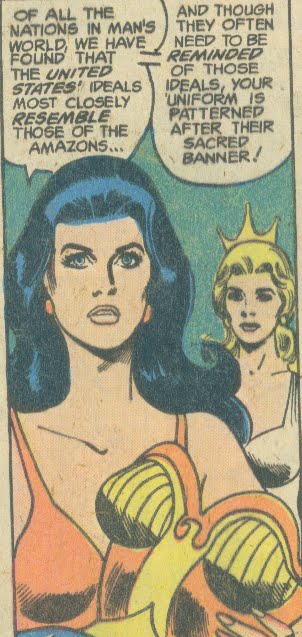
I appreciate that DC is in kinda a tough spot with Wonder Woman’s costume. Let’s face it, her original outfit looked like a red-white-and-blue Playboy bunny costume. One isn’t sure if you are supposed to salute her or give her your drink order.

Even so, I just don’t like the new outfit. Still, I read with interest that the outfit emerged because the new writer, J. Michael Straczynski, “wanted to toughen her up, and give her a modern sensibility.” That sounded promising. Well, until they released the cover image for Wonder Woman #603, which then made those ideas ring a bit hallow:

Apparently “toughening her up” means that Wonder Woman’s breasts are the size of her head. I reject that tossing on some tight leggings is somehow making this character more sensibly dressed if every panel is centered around her cleavage.
Rumors abound that they are trying the costume change as a means to possibly sell a movie character. Let me tell you, it ain’t going to work. When people think Wonder Woman, they think star-spangled panties.
What I find more interesting, though, is that the costume change has overshadowed discussions of other major changes to the character. I’m less concerned about what is in Diana’s closet than the fact that she is now going to be weaker than her previous incarnations (thus no longer making her the peer of Superman).
What is astounding about this turn of events is that it has all happened before (and, as Peter Pan would say, it will all happen again). Unlike Superman or Batman, Wonder Woman has had her basic premise reworked more times than Joan River’s forehead. Granted, DC has been more than willing to pull similar stunts with those characters. Remember when Superman “died”? Or that weird cyborg Superman? Or when Batman broke his back? Or when Batman “died”?
Nonetheless, there seems to be some key differences in how Superman and Batman are treated when compared to Wonder Woman. Comic writers often speak of the other two (and Marvel’s Spiderman) as the holy grail of the industry. They all yearn to take a crack at the helm of those books. Meanwhile, writing for Wonder Woman is treated as a chore equivalent to comic jury duty.
Sales figures for Wonder Woman are also abysmal. Superman and Batman’s names can support multiple comic titles at the same time. Yet, Wonder Woman struggles to even keep her single book afloat. I can’t help but thinking it’s because she is a girl in a male dominated industry.
I am distressed by the details announced to “reboot” Wonder Woman. In this version of Wonder Woman, Paradise Island (aka Themyscira) is totally destroyed and all the Amazons are slaughtered – again. I will leave it up to the Freudians in my audience to determine why the male writers of Wonder Woman so often feel the need to demolish the matriarchal Themyscira and kill off the Amazons.
So now Wonder Woman is raised in the United States without knowing her ancestry or learning Amazon ways of peace and love. She also, for seemingly no reason, is much less powerful than the island reared Diana. Maybe those fresh Caribbean breezes give her a little extra oomph. Who can say?
Male writers of Wonder Woman always seem to imagine that they are doing women a favor by taking powers away from Diana. It is a nice piece of reverse logic, especially given that the Amazon character started out with the exact opposite in mind.
As

Wonder Woman fit well for the war years. Women were stepping into new jobs for the war effort and they craved images of a strong woman who also contributed to the Allied cause.
But what about her costume? Well, it was sorta loosely modeled after a Greek warrior, but still recognized as skimpy even by comic standards. One of the first issues even addressed Diana’s thrifty use of cloth:

After World War II, Wonder Woman began to hit hard times. Marston, whose queer ideas about gender and sex had driven the book, died in 1947. Matters became worse when a psychiatrist named Fredric Wertham created a minor frenzy after publishing Seduction of the Innocent in 1954. Comics, he claimed, were at the heart of every social ill from drug addiction to rape. He charged Wonder Woman in particular with turning young girls into lesbians. “The homosexual connotation of the Wonder Woman type of story is psychologically unmistakable,” he wrote, “For boys, Wonder Woman is a frightening image. For girls she is a morbid ideal... The attractive Wonder Woman and her counterparts are definitely anti-masculine. Wonder Woman has her own female following. They are all continuously being threatened, capture, almost put to death. There is a great deal of mutual rescuing... In a typical story, Wonder Woman is involved in adventures with another girl, a princess, who talks about ‘those wicked men.’” Yeah, where did Wonder Woman get off thinking that she didn't need a man to rescue her? She ought to get back into the kitchen making chicken pot pies where she belongs.
Faced with public backlash, DC responded by subtly altering Wonder Woman. A 1950s or 1960s version of Wonder Woman usually contained as many panels of Diana crying her eyes out over Steve Trevor as doing any actual work. She also lost all of her women friends, just to make sure that nobody could accuse her of being anything other than 100 percent hetero. Finally, she basically stopped battling human (male) villains and instead fought more mythical creatures.

By the end of the 1960s, Wonder Woman was, well, dull. DC attempted an almost identical shift in Wonder Woman’s storyline as the one they announced on Tuesday. Starting in 1968, Diana renounced her Amazon superpowers, watched as Paradise Island transferred to another dimension (or sunk into the water, or something), and ditched her swim wear for a white jumpsuit and other “mod” clothing. Like DC’s reaction to their announcement Tuesday, DC writers in the 1960s expressed surprise that feminists (including Gloria Steinham) saw robbing Wonder Woman of her powers as a betrayal. Gee, why would making a character less powerful not be seen as a step forward for women? Oh, and did I mention that she gave up her position as a ranking officer in the military in order to open a dress boutique? Without her superpowers, Wonder Woman, or, er, Diana Prince had to learn martial arts from
This jumpsuit-clad Wonder Woman proved so unpopular that the return of the star-spangled panties in issue #204 included a total bloodbath of anybody associated with the previous version of the character. Everybody had to die so that the old-glory hot pants could return.

The 1970s era is one of my favorite for Wonder Woman, and not just for obvious nostalgic reasons. There is a certain period when the book allowed itself to be a bit more campy. I liked, for instance, that Diana spent some quality time debating her laundry’s freshness.

Even after the jumpsuit fiasco, the 1960s would not be the last time that an alternate version of Wonder Woman appeared. A year before the beloved Lynda Carter series started, ABC aired a pilot for Wonder Woman starring the very blonde Cathy Lee Crosby. In this version, Diana Prince worked as a secretary for a CIA-type organization. She ultimately became involved in spy work herself, put on an outfit that had little resemblance to the comic version, and seemed to mostly follow the martial arts era comics (without superpowers). Most people found it hard to see this characterization as having much in common with the character they knew as the Amazon princess.

Today, DC is again cutting down Diana’s powers and changing her wardrobe in hopes of spurring interest in the character. It seems to me that the approach smacks of desperation.
From the outside, one does get the impression that DC really wants Wonder Woman to succeed. They consider her part of their “trinity” of the three most recognizable comic characters: Superman, Batman, and Wonder Woman. They have also brought in some well known talent over the past few years to write for the series, including Jodi Pocoult (whose stories never quite worked) and the much beloved comic writer Gail Simone. The latter had some hints of great ideas (The Return of Reform Island!), but it never quite came together. Who can then blame DC executives for making the current ploy to generate interest in Diana? Let’s face it, this is probably the most people have talked about Wonder Woman in years. Still, I really don’t think making Diana weaker is the answer (or killing off the Amazons – again).

I just can’t figure out why it is so hard for DC to find a decent story arc for Wonder Woman that would renew her appeal. As I wander through Target and other shops, I am struck by how much the aisles are adorned by the many Disney Princesses. It seems to me that DC is missing real opportunities to market Wonder Woman to a younger generation. If I were a parent, I’d have a real problem buying books and dvd’s from Disney that depicted women doing nothing but sitting around singing about their hopes to find a man who could rescue them. Wouldn’t it be much better to have a woman who is strong, independent, and super smart like Wonder Woman (who also happens to be a princess)? Even if she does dress like she should be spending her days at the beach rather than fighting crime, she still has a better overall message about women being the equal of any man. But, DC is never wise enough to ask GayProf to consult on Wonder Woman’s future.


