 So much media ink has been spilled over gay men in the past month that I am starting to feel like a sack of trade goods. I mean, not literally me, but the me as a gay man. We are the current hot commodity, and this leaves me both pleased and annoyed. The media has been debating the “authentic” gay men’s experience in the light of marriage and adoption laws. Why are they so interested in us? Why have gay men become the central subjects of news-magazines, feature films, and academic texts?
 Don’t get me wrong. After generations of neglect and/or scorn, it’s not altogether a horror to finally have some attention. What makes me nervous, though, is that actual living, breathing gay men don’t usually get attention. It’s not a celebration of gay men’s accomplishments or contributions to history. Rather, we have become one of the central icons of the cultural and political divides that plague the U.S.
We have become an exotic and commercially precious commodity. The Right Wing depends on a hatred of us to get votes. They believe zealous Christians prefer to burn us at the stake rather than have decent healthcare or education for their children. Guess what? It works for the Right Wing too.
The Left looks to us as a means to prove their own liberalness. With a sympathetic wink, they claim to understand our oppression. Everybody seems to want a memento from us. In the traffic jam of domestic politics, gay men live in fear of being run over.
Nowhere did this tension become more apparent than the endless discussions of Brokeback Mountain and the Oscars. Many others have already spent time dissecting the conflicting images within the film, so I won’t dwell on the actual film. Rather, I am interested in the response and discussion of the film.
Brokeback Mountain appealed to many people (queer or not), because it condemned U.S. homophobia. I am not surprised, therefore, that many queer folk are quick to defend the film. Likewise, their disappointment at its loss makes sense. For many straight folk, Brokeback Mountain generated the shock of realization that not all men who have sex with men hook up in bars or pride parades.

The problem being that, despite all of its hoopla, Brokeback Mountain was not a product of gay men. The original story, the screenplay, the direction, and the acting all came from self-identified heterosexuals. Brokeback Mountain demanded our approval without actually bothering to include any of us in its creation. What, if anything, does it mean that the most salient images of gay men did not develop out of our community? How do we respond to heterosexual imagery of gay oppression? Gay men have been left with the precarious problem that their fiction has become our reality.
I don’t claim to have anything particular insightful to say about the above questions. I am trying to work out my own ambivalence and, perhaps animosity, over the ways that the mainstream media seems poised to appropriate our hard fought battles for recognition. It’s not that I think that heterosexual folk don’t have important things to say about queer sexuality. Nor do I claim that there is an essential “gay identity” that can only be authentically produced by particular queer individuals.
Still, I am concerned that we queer folk are being pushed out of the discussion of our own lives. We didn’t need Brokeback Mountain to discover that being gay in the U.S. isn’t a pleasure cruise. Even the sex in Brokeback seemed dubious to me. It smacked of what heterosexuals imagine gay sex to be like.
The narrative arc of Brokeback Mountain hardly appears unique to those who have read any gay short-fiction or gay history. Let’s consider the life story of an actual man who had sex with men in the past.
In 1901 a man who adopted the pseudonym Claude Hartland published a memoir of his sexual and romantic relationships with other men in the rural U.S. (for more context on Hartland, see Jonathan Ned Katz's Love Stories: Sex Between Men Before Homosexuality). With surprising candor, Hartland gave his readers a glimpse into the sexual escapades of a youthful queer boy in turn-of-the-century America. One such passage included his first sexual experience. A young male visitor spent the night at his parent’s farm home somewhere around 1886:
I could hear my heart beating and it seemed that the blood would burst from my face. He then unfastened my clothing and his own and brought his organs and body in close contact with mine. I was simply wild with passion. All that pent-up desire of years burst forth at that moment. I threw my arms around him, kissed his lips, face and neck, and would have annihilated him if I could. The intense animal heat and friction between our organs soon produced a simultaneous ejaculation, which overstepped my wildest dream of sexual pleasure.
In a similar passage, Hartland recounted his night with a “handsome” minister who also stayed at his parent’s home:
I was convinced by his poor attempt at snoring that he was not asleep, I gently placed my arm around his great manly form. This was enough. He turned toward me, placed his arms around my neck, pressed his lips against my own and – forgot to snore. For once I had met my match. We slept but little more, and the next morning when my brother asked him how he had rested, he glanced at me and said “I never spent a more pleasant night.”
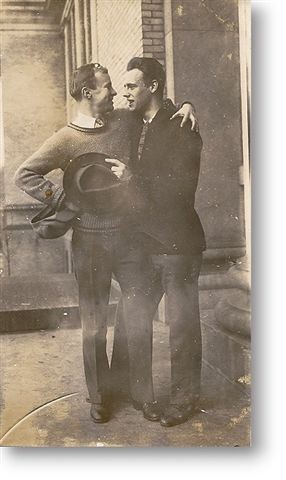 Yet, these lively and seemingly celebratory visions of sex with other men did not mean that Hartland escaped the homophobia of his era. Rather, Hartland claimed to write his book as a warning. He offered it to medical experts so they could check “the progress of the malady” and “relieve such sufferers as myself, and preventing the existence of others yet unborn.” As one of those sufferers who was as yet unborn, I am glad that his text failed.
Here, though, is an actual historical text that suggests the realities of homophobia in turn-of-the-century U.S. Unlike Brokeback Mountain, this text developed from actual experiences of a real-life queer man. His life and loves, though, has never made it onto the silver screen.
As queer folk we need to be more attentive about claiming our actual past and understanding how historical oppression informs our current lives. If Brokeback's goal was to inform a straight audience about the perils of being queer in the U.S., we need to be certain that actual queer folk's experiences get documented next time around. Hartland’s mixed feelings of erotic satisfaction and self-doubt proves a more important story for us than why Jack can’t quit Ennis.