Showing posts with label It's a Drag to Watch Movies with GayProf. Show all posts
Showing posts with label It's a Drag to Watch Movies with GayProf. Show all posts
Tuesday, May 24, 2011
Always a Bridesmaid, Never a Feminist
This summary is not available. Please
click here to view the post.

Monday, April 25, 2011
Missing Minority
 Those of you who have followed the slow release of data from the Census Bureau (and who hasn’t!) know that the nation’s demographics have shifted considerably over the past ten years. The Midwest, once the metaphorical and population “center” of the nation, is hemorrhaging people faster than Sarah Palin’s campaign team. Part of that change, of course, is the combination of Midwestern urban decay, failing infrastructure (Why pay taxes?), and mass relocations to "sunbelt" areas in the southwest. Another contributing factor, though, is the rapid growth of Latino populations in the border states. Census officials estimated that there were 45.5 million Latinos and Latinas in the United States as of 2009. This represents an almost 29 percent increase from the 2000 Census report of 35.3 million Latino/as.
What has surprised me is that our national entertainment industry has been remarkably slow to reflect this new reality. Latina/os might be the largest minority, but you would be hard pressed to find substantial representations on either broadcast or cable television. Some networks, including Oprah’s OWN, Lifetime, or FX, have zero (0) recurring Latino characters or hosts in all of their 24/7 programming. Those that do exist on other networks are sadly retreads of some pretty worn out stereotypes. Latinos remain relegated to the supporting cast. This is true despite the fact that various corporations have become increasingly hungry to grab a slice of the Latino economic pie.

It strikes me that the most visible characters currently on the air are Latinas. Yet, this is not necessarily good news. Two major roles define the options for Latinas on television: the sex bomb and the steely enforcer. The first has deep roots in this country. Since way back in the nineteenth century, mainstream representations of Latinas have most often presented them as tempting “tamales” who turn out to be “too hot to handle.” Latina women became convenient metaphors that legitimated multiple racialized assumptions as the U.S. contemplated war with its neighboring republic. Latinas were construed as always sexually available to Euro American men even as they were simultaneously presented as duplicitous, scheming, and dangerous. Euro-American travel writers first circulated these types of images to suggest that "immoral" Mexico needed a U.S. invasion to satisfy God’s supposed plan of manifest destiny (You can read about this and many other fascinating elements of nineteenth-century Chicano history when you purchase a copy of NERPoD from a fine on-line book retailer near you).
Such images live on in the conniving and fickle character played by Eva Longoria on Desperate Housewives; Colombian-born Sofía Vergara’s “trophy wife” role on Modern Family; and even Naya Rivera’s role on Glee. The last character, Santana López, hits many of the hallmarks of the stereotype. López uses her sexuality, often presented as irresistible to the white men around her, to satisfy her ambitions or as part of a larger scheme. At the same time, she can be depended upon to enact the “loca” traits that make her untamable. Quick tempered and cruel, López shows she is always ready for a fight. This includes a recent episode where she claimed to have razor blades hidden throughout her hair (!). Perhaps the revelation of her same-sex love interest will redeem this character, or at least steer her from being a twenty-first century incarnation of “wicked Felina.”

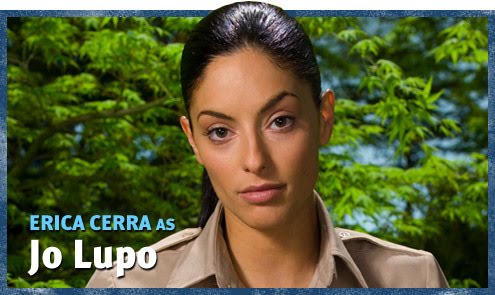
Another less noticed, but still identifiably stereotypical role, appears in the police-procedure genre. Many shows, like Law and Order, Eureka, or the doomed Detroit 187 feature the tough Latina enforcer. While I can’t say for sure, it seems like this version of Latina can find some of its roots in Aliens (1982). That film introduced the memorable character Private Jeanette Vásquez, a tough-as-nails marine. Here was a Latina character who got to do things on screen that had previously been reserved almost exclusively for men, including handling some really big guns. She also met her demise memorably in an altruistic blaze of fire, ultimately hugging a grenade rather than being taken by the titular aliens. Reportedly, the Vásquez character left such an impression on Gene Rodenberry that he intended the security officer on Star Trek: The Next Generation to be a comparable Latina figure (which was later dropped when he cast blond Denise Crosby for the role, contributing to Star Trek’s long history of failing to include Latino/as in the future – but that is another entry).

What I call the “Vásquez type” presents Latinas as figures who bend traditional gender conformity through their military/police skills. They are often presented as invaluable to the white leads in solving crimes, battling aliens, or generally kicking ass. They know their way around a gun, wear their hair in a sensible bob or poneytail, and can more than handle themselves in battle. All of that is nice . . . but these Latina figures are also always ancillary to the main white characters. If they provide the muscle, than it is up to their white (usually male) partner to provide the problem solving skills which truly stops the criminals/aliens/mayhem. Representations of their personal lives range from non-existent to deeply troubled. While generally I appreciate their rejection of gender conformity, it can nonetheless becomes a racial marker that only serves to highlight the more authentic masculinity of the (white) male lead and/or the more alluring femininity of the (white) women around them. Latinas become characters who have not quite mastered the mainstream gender rules, and therefore remain outside of society.
Keep in mind that those are the most positive options currently seen on television. Most of the time, television networks prefer to imagine that Latinos don’t exist at all. Even shows set in geographic areas with significant Latino populations manage to sideline those inhabitants or simply turn them into background “color” that spices up the main white characters’ lives. As I have talked about elsewhere, the USA show Burn Notice takes place in Miami but manages to only grant roles for Cubans as either victims (usually women) or as villains (either men or women). Whatever the case, both are easily dispatched after one episode.
For obvious reasons, I am the most sensitive about this phenomena when programs are set in New Mexico. My home state, as everybody knows, has always had a non-white majority population. Recently, the census bureau also revealed that Latinos are now the largest ethnic group in the land of enchantment. Making a show set in New Mexico without showing Latinos is like making a show set in Washington, D.C. without showing idiots. Nonetheless, that is exactly what happens in USA’s In Plain Sight or the critically acclaimed AMC show Breaking Bad. The first, which centers of the blond lead, has a token Latino character who is a Dominican baseball player. Apparently the USA network could only imagine Latinos as recent immigrants, thereby ignoring the Latinos actually residing in the state whose families have been there for generations.
Breaking Bad, also set in Albuquerque, does little better. Like in Burn Notice, Latinos zest up the drab background by providing Spanish-language music, low-rider cars, or colorful expressions. When they aren't providing the literal and metaphorical salsa, they appear as threats to the main white leads. These roles as side characters serve to contrast the normalcy of the two middle-class white characters. Latinos, as dangerous drug dealers, represent an upending of the “quiet” life of the white school teacher and his former student. The series lead, we are told, had no choice but to enter the drug underground. He begins manufacturing meth in a noble attempt to provide for his family after his imminent death from cancer. Latino drug dealers, on the other hand, are shown to be motivated only by greed and violence with few redeeming characteristics. They are almost always recent arrivals in the country.

I am disappointed that television programming has failed to understand or represent the variety of Latino/a experiences in the United States. This is even more troubling when we consider that many (most?) of the nation’s other citizens probably depend on television as the only venue through which they get to know the United States' largest minority. For the most part, it seems that television executives consider Latinos too much of a political hot potato to represent fairly. When they do make an appearance, they enforce the notion that Latinos (and a multi-cultural society in general) threatens to upend the national status quo through their supposedly hyper sexuality and unquenchable thirst for violence.
Some of this might change when media monopoly Comcast launches its new English-language Latino network in 2012. I’m not holding my breath, though.
Thursday, March 31, 2011
The Detective
 Some evenings ago, I had finished with a hard day of accomplishing nothing on NERPoD: The Sequel (Which reminds me, have you ordered your copy of the original NERPoD from your favorite on-line bookseller? All the really cool bloggers have already read it. Why haven’t you?). This meant that I needed some form of entertainment to distract me. My mindless channel surfing stopped at the start of The Detective (1968). Now here was a film that would allow a lot of self-justification for watching the idiot box. I knew of this film from Vito Russo’s classic Celluloid Closet (and the later HBO documentary of the same name), but had never watched it in its entirety. Parking on the couch to watch this wasn’t me blowing off the evening. Rather, I was assessing a critical primary source that would shed light on past notions of sexual difference. Hey, it’s tough work, but somebody has to do it.
 For those who have never heard of The Detective (and I’m going to guess most people have not), it was one of the first explicit representations of gay men at the local picture palaces. The year 1968 had brought significant changes and challenges to the nation. The Civil Rights movement was dealt a serious blow by the death of Martin Luther King, Jr; LBJ served his last year in office; Pierre Trudeau became Canada’s Prime Minister; Andy Warhol got in the way of radical feminist Valerie Solanas’ bullets; and Hawaii Five-O premiered on television (for the first time). That last one alone sent many people into an existential crisis from which they never recovered.
The year 1968 also brought an end to the draconian censorship of the Movie Production Code. Moviegoers demanded that films start reflecting the bleak and turbulent times. In place of the censorship Code, which sought to keep everything squeaky clean for all audiences, films started having a letter rating (G, PG, R, and X) that parents could totally ignore when considering which films were appropriate for their families.
Twentieth Century Fox rode that new rating train all the way to the bank with their highest grossing picture that year, The Detective. None other than Frank Sinatra occupied the titular role. The movie, based on a novel by Roger Thorpe (the man who later brought you Die Hard (more or less)), included topics like marital infidelity, corruption, civil rights movements, anonymous sex, and, of course, homosexuality. They probably couldn’t have included any more salacious story lines unless they made it a flat-out porno.

The start of the film lets us know that this ain’t no Doris Day flick. New York Detective Joe Leland (ol’ blue eyes) arrives at a crime scene. Upon entering the upscale apartment, he casually observes that the victim was a “male Caucasian, nude laying on the floor. Penis cut off, laying on the floor of the living room.” Leland’s partner, a novice African-American policeman, nearly hurls his cookies onto the floor. In contrast, Leland has seen it all and casually asks Quincy, or, er, Jack Klugman to wrap up the penis in newspaper to keep people from accidentally kicking it around the floor.

The audience is left asking, who could have perpetuated such a gruesome crime? Well, it was a number of years too early for people to imagine that Bobbit story.
We start to get clues about what might have transpired as Leland tours the deceased’s apartment: Nude, greco-roman male statutes in every corner? Check. Unknown drugs in the medicine cabinet? Check. Semen stained sheets? Check. A pile of barbells and a half-gallon jug of mineral oil? Check and check! Even Scooby-Doo could have pieced together that this man was as queer as Fred’s ascot. The Detective is that subtle.
But this was post code! No longer did movie makers need to hint broadly about the sexual identity of its dead characters through objets d`art. The Detective spelled it out plain and cold: “Junior over there was a homosexual” remarks the medical examiner. Just how the doctor determined this posthumously is never revealed, but he assures Leland such an end is typical for men of his persuasion. When asked about the cause of death, he glibly replies “Lover’s quarrel, that’s how they settle it.. . . Twenty years and they still disturb the hell out of me.” Who can blame him? Most of my man dates usually follow the trajectory of drinks; then dinner; then a movie; then sex (possibly slathered in mineral oil); and then a bloody death match on the livingroom floor. If I come out alive and with my member intact, I hope he calls me again.

One doesn’t need an extra eye to see the homophobia dripping out of the film. It is for this reason that The Detective has been rightly disparaged by generations of queer scholars and moviegoers. The film makers promised, and delivered, the first celluloid glimpse at “gay” life. Following the chairman-of-the-board through his investigation gave a voyeuristic glimpse at all the joints that gay men apparently inhabited: gyms, boarding houses, the docks, and orgies in semi-trucks. Or, as I think of it, Tuesday. Each time they encounter a gay person, an ancillary character comments on how “sickening” it is to normal men like him.
To make a long, convoluted story shorter, Nancy Sinatra's father thinks that he finds his man, Felix Tesla, at a sketchy boarding house. The suspect fits with what sixties mainstream society imagined for gay men. In other words, he was totally drugged out . . . or nuts . . . or both. It didn’t really matter. Listening to his contorted speech patterns, it’s hard to believe this man was lucid enough to ride a city bus much less have an extended relationship with a prominent millionaire. But, whatev’s.
Tesla arrives at the police station for intensive interrogation, which does result in some of my favorite campy movie dialog ever. When questioned about life with the victim, Tesla proclaims, “He was a bitch!” Oh, honey, I’ve been there. The rest of the scene played out more peculiarly as Frank Sinatra more-or-less seduces his suspect. A gentle touch here, an oblique reference to a gay bar there, questions about the victim’s body (“soft, like a girl’s” btw).
 Before you can say “police coercion” Leland has his suspect singing like Billie Holiday. You can guess what happens next. Yep, the gay man goes immediately to the electric chair and fries faster than a bucket of chicken. All the cops and politicians are delighted. The detective wins a big promotion and everybody enjoys some stiff brown drinks. A happy ending in heteroville. Well, except . . .
Turns out maybe Tesla wasn’t so guilty after all. Through an unrelated investigation, the detective discovers that another man has jumped to his death at a local race track. The newly deceased? A closeted gay man who had been involved in some mighty shady deals in the city. Apparently the director couldn’t let a full twenty minutes of celluloid lapse without having a gay man facing some type of peril: dismembered, strangled, beaten up, threatened with a gun, threatened with imprisonment, electrocuted, or just clumsy on a ledge. Like all gay men, The Detective lets us know that the most recently departed deserved his fate. He helped a crew of politicians and real estate brokers embezzle millions of dollars, all at the expense of the poor. Yet, this was not what set him over the edge, literally. He just couldn’t handle his deep, deep desire for some man love. I mean, committing outrageous acts of fraud and theft are one thing, but kissing another man? Somebody has to die.
Leland uncovers a taped confession that outlines the closeted man’s torment. Oh, you know the type. He had “experimented” in college, but since then had become 100 percent heterosexual. Think an accountant version of Ted Haggard. To prove his new found straightness, he even married the glamorous Jacqueline Bisset. Hey, if you’re going to get a beard, go top of the line is what I say. Trouble was that sometimes he just needed somebody in bed who was, shall we say, a bit more hairy. He turned up at a local gay bar and went home with the millionaire. And, as we were told early on, the inevitable happened when two gay men connect: murder. Sinatra emotes some remorse over turning Tesla into a human flambé, but not enough so that he can’t end with a sanctimonious speech about city corruption.

All in all, the movie leaves you with the impression that gay men are self-hating, drug addled, murderous embezzlers who keep the mineral oil industry afloat. Yet, in watching the film I was surprised to see that it also contained a (very modest) counter vision of gay men. The police contemptuously questioned the victim’s beard, or er, occasional “date” to parties. She defended the victim. “I knew he was gay," she said without apology, "but he was civilized and he a bit of wit, which is more than I can say for most people.” Though most of the police rough up the gay men whom they encounter at the docks, Leland reminds them to “take it easy. These people aren’t murderers.” Of course, that line would have been more convincing if the film hadn’t already presented gay men as only murderers. Later in the film, he tells Tesla “I believe in live and let live.” Of course, that line would have been more convincing if he didn’t later send Tesla to die in the electric chair.
Perhaps The Detective can be understood as exploiting the contradictory attitudes about sex and sexuality swirling around during the 1960s. On one hand, the film didn’t shy away from pointing out that gay men actually existed and were out having a good time. Well, at least until they died in some gruesome way. When they did die, it was usually their own fault or at each other’s hands. Those depictions of gay men, though, have to be placed into the larger context of the way the film presents other forms of sexual behavior. The Detective didn’t just delve into gay men as the only symbol of sixties sexual corruption. In an ancillary plot, Leland's own marriage falls apart when it’s revealed that his wife likes to have anonymous sex with strangers whom she meets at bars (Don’t ask). The increased sexual freedom of the era costs Leland personally and left him disillusioned.

Leland thereby comes off less as a crusader for social justice than as a libertarian who has himself been victimized by the sexual revolution. The film reassured audiences that good straight white men, like Leland, always fight for the less fortunate and provide stability in a world run amok. His mild defense of gay men served to make him appear more generous and “by-the-book,” unlike the crooked cops who surrounded him. He was a hetero patriarch that audiences were supposed to embrace. It ignored that such straight cops were often the ones harassing anybody who dared to break the social mores.
Wednesday, October 06, 2010
Reality Bites
 Recent news about the status of gays in this country can be chilling to say the least. These stories range from the frustratingly absurd, like Republicans blocking the repeal of “Don’t Ask, Don’t Tell,” to the heartbreaking, including revelations of torment and bulling in individual lives. In the midst of these stories, the Gay and Lesbian Alliance Against Defamation (GLAAD) recently reported that the number of fictional gays and lesbians being represented on scripted television increased slightly (up to a still paltry 3.9 percent of all characters from the previous year’s 2.6). It draws into question, if there are more images of queer folk on television than ever before, how does this reconcile with the lack of GLBTQ equality in the United States?
Certainly I do marvel at how much attitudes have changed since I first came out in the early nineties. At the time, the best one could hope for on television was a “very special” episode where a never-before-seen friend reveals that he or she is gay to the protagonist. The rest of those stories tend to be devoted to watching how that central character came to terms with the revelation. While these types of episodes did usually have a core message about “tolerance,” they more often served to emphasize just how “charitable” the main character was deep down. Once established, we would never see or hear mention of that gay friend ever again.
By the early nineties, fledgling attempts at “reality” television marked a sudden departure in representations of gay people. MTV’s The Real World and other similar shows began to show gay people with actual lives and concerns themselves, often times that had little to do with the straight people who surrounded them. This opened the flood gates to making at least one gay person de rigueur for any new reality program. Scripted television has likewise come along a bit in terms of adding gay men and lesbians as supporting characters. Yet, those shows tend to only make queer people accessible if they are white and safely locked in suburbia (That, though, is another blog post entirely). Despite these changes, “reality” television (which is usually anything but its namesake) remains the touchstone for gay representation. We would do well well to consider some recent forms of this entertainment.

My students these days have never known an era of television without gay and lesbian representations (transgender people, on the other hand, remain almost totally invisible – But that is a subject for another post). It is jarring to me when they mention that Queer Eye for the Straight Guy (which I still tend to think of as “new”) was something that they enjoyed while in middle school. If Queer Eye represented a type of breakthrough in terms of the number of gay people in any given show, it also set the stage for remaking reality representations of those same people. Gone were the notions that GLBTQ people had independent lives that were worth learning about for their own sake. Instead, we found that reality television had come to depend upon representing our community (particularly gay men) as having value only in as much as they either entertained or served straight people. The show avoided delving into any of the leads actual lives and instead defined them by the job they performed for a socially inept straight man. In the end, I suppose it was better to help dress a straight man than be beat up by one.

Over the summer, a number of new and noteworthy reality shows launched featuring gay men and lesbians as the central stars. Each owes more than a little debt to Queer Eye. The producers of these new shows clearly sought to attract both a core queer audience as well as a more mainstream hetero viewership. They walk a tightrope between providing representations of gays who appeal to insider camp sensibilities while making sure that they also don’t threaten the hetero status quo.
On the Road with Austin and Santino reconciles those seemingly contradictory goals perfectly. The show centers on two former reality show contestants on a cross-country road trip together. Personally, I have adored the titular Austin Scarlett since he captured my imagination during the first season of Project Runway. Scarlett proved his talents by crafting impeccable fashion, including a memorable dress made out of corn-husks. I always felt that he was robbed of his spot in the final three (seemingly because the producers wanted a contestant who would provide more backstage drama). Aside from his glamorous persona, Project Runway highlighted his strong work ethic. While other designers went out drinking, Scarlett puritanically stayed in his hotel room to be well rested for the next day’s work. He also expressed a self-awareness that his nonconformity would provide inspiration to younger viewers who might be feeling harassed. I like that.

In his new program, Scarlett joined with his real-life friend Santino Rice for a Greek-inspired odyssey across the United States. Along the way, they stop in small towns, locate a specific heterosexual woman who needs a fashionable frock, and, after an appropriate amount of assurances that she truly “deserves” their services, they present the teary-eyed woman with the fruits of their labor. All in all, it is a pretty formulaic make-over show. To distinguish itself, the show looks to wring humor out of the notion that Austin and Santino are “fish out of water” in the small towns that they visit. In addition to the dress making, Austin and Santino frequently participate in the town’s local activities (like riding horses, fishing, or babysitting). The show implicitly juxtaposes Austin and Santino’s dilated personas against the austere town folk who surround them. Executive producer Rich Bye has commented on the reactions that some town people have had, noting “They would have been less surprised if an alien beamed into their store. They just kept staring. They didn't say a word.”

The show thereby makes gayness something that is always removed or set outside of the supposedly heterosexual towns that they visit. If Austin and Santino arrive to temporarily add some glamour and urbanity to the dull grey towns that they visit, then the town is also assured that they will just as quickly exit so that things will return to “normal.” Any hint that Austin or Santino might challenge local views of queer sexuality are avoided.
Many of the episodes center on the two preparing a dress for either a wedding or an anniversary. In an era where marriage equality dominates political discussions about queer life, it is striking that neither Austin nor Santino ever note the inability of gay men to celebrate comparable milestones legally. Instead, they happily work away to satisfy the needs of their heterosexual clients without complaint. While we occasional get hints of the affection the two have for each other, we also never learn much about their own romantic interests or ambitions. The show implicitly subjugates queer desires in order to highlight the supposedly more valuable heterosexual relationships on the show.
Perhaps I can come to understand why Lifetime, a network that started by targeting an audience of [heterosexual] women, would create such a representation of gay men. But the gay network Logo’s decisions about Rupaul’s Drag University leave me almost entirely baffled. I have previously written that I am a fan of RuPaul’s Drag Race. That show excelled because it presented an impressively diverse cast that reflected a wide range of drag performers (even if I remain concerned that the show also discriminates against contestants with non-English accents). So when Logo announced Drag University as the new companion series, I expected that it would center on established drag queens mentoring young gay men who desired a career in drag. Wrong!

The show actually focuses on “biological” women being tutored by the established drag queens. Prof. Susurro has an excellent assessment of the show’s positives. I agree with her totally (after all, she starts and ends the post by agreeing with me). The show does provide an unusual opportunity to see mostly working class women claiming the spotlight. In good Judith-Butler fashion, the show also utilizes drag as a means to highlight how all gender roles are artifices that can be manipulated at will (regardless of the anatomy of the performer). It also provides a strong emphasis on claiming femininity as a source of power. "Ultimately, DragU is a comedic send up of a genre I find largely detrimental to both the female viewers and female participants," Prof. Susurro notes, "While it is nothing deeper or more meaningful than light entertainment, it does it with the kind of diversity and attention to people’s needs that rings decidedly hollow in shows that claim to take these things seriously." All of that is great for me.
At the same time, though, the show also makes the drag queens into little more than exposition for the straight women’s transformations. Much attention is given to the straight women’s ambitions and personal relationships (I am also more than a bit disturbed by how many of the contestants report that they are participating in the show to please their man rather than for their own enjoyment, but that is another entry entirely). The drag queens, meanwhile, apparently have no lives outside of the work room. They are given only enough airtime to sprinkle the screen with glitter and sassy one-liners before literally being cast to the sidelines while straight women take over the stage.
The phenomena of queer helpers improving the lives of deserving heteros isn’t the exclusive territory of gay men, either. Out-lesbian trainer Jackie Warner has been given a new reality program on the network Bravo. In place of her first show, which emphasized Warner’s grappling with personal and professional commitments, the new show relegates Warner to the sidelines as she trains a group of straight women and men (and one gay man, who is set up as the comic relief on the program) to lose some weight. Warner acts as a combination of therapist and cheerleader to the show’s central figures.

Shows like Austin and Santino, Drag U, and Warner’s program suggest the compromises that have been made to get queer representation onto reality television. Queer people are acknowledged as important members of society, but only to the extent that they can provide valuable services to the dominant heterosexual community. Any explicit desires for civic and social equality are muted in favor of a narrative of mutual cooperation and humorous shenanigans. Queer people become hetero helpers, monitoring their fashion sense and opening the gates to their own happiness.

Maybe the only summer reality program that sought a more balanced view of queer life appeared on the obscure network Planet Green. The Fabulous Beekman Boys charts the foibles of two elite New York gay men who purchase a rural farm. The show’s link to the network’s supposed environmental message is tenuous at best. Nonetheless, of the new queer reality programs Beekman manages to show queer figures as a bit more complex and multifaceted than the others (even if its cast is exclusively white). This includes the two leads, Brent and Josh, (whose bickering defines the show), a gay goat herder (who is really attached to his charges) and another gay couple (who own the local hotel), along with a number of straight people who surround the life on the farm. Beekman allows [white] gay men to be the actual story of the reality program rather than as a plot device.
Even here, though, the show could not resist putting the queer figures into the service of hetero hegemony. One episode focuses on a straight couple using the farm as the site of their wedding. We mostly see Brent’s devoted efforts to preparing the event and insuring its perfection. Unlike the other reality programs, which tend to pretend that marriage is not a political issue, at least Beekman included commentary by Josh that noted his inability to have his relationship to Josh legally sanctioned. The two had pledged that the first wedding on the farm would be theirs, but apparently Brent sorta forgot about that when he saw the size of the bride’s deposit check. In the end, even Josh set aside his political position and came to the aid of the happy straight couple. Queer people might be treated like second-class citizens, but that doesn't mean we aren't gracious hosts.

It’s hard to consider whether these queer images represent actual real people or clownish characters who spend every waking moment wondering how they can spruce up previously depressing heterosexual enclaves. I grant that it is a type of improvement after decades of media images that presented queer sexuality as something to fear and destroy. If the trade off for my sexuality not landing me in jail or sent for electroshock therapy is being forced to sew couture, then hand me that bobbin. Nonetheless, these images also tend to present queer people as frivolous and less fully human than their hetero counterparts. These shows subsume their stories, political needs, and personal desires (including, ironically, their sexual desires given that their sexuality defines their roles on these shows). Instead queer people have been relegated to being decorators and decorative objects for heterosexual escapist fantasies.
Saturday, September 05, 2009
Burning and Itching
 Huh – It turns out, based on the number of Google hits that I am getting, that a great number of you have “crazy colleagues.” At least one of you seems to have a colleague with a spider in hir hair. Who knew?
Of course, the new semester is upon us. This can mean only one thing: the end of the television summer season.
Longtime readers know that GayProf has two, sometimes overlapping, criteria for watching a television show: a) Does it have camp value and/or b) Does it have a hunky male lead. Usually “b” is the prime mover for me. What can I say? I am shallow, but pretty.
Longtime readers also know that I tend write volumes on television shows. Today is no different. Come to think of it, I am surprised that I have any longtime readers at all.
Given that “b” decides most of my viewing habits, you might imagine that my television selections are often quite low brow. You might also imagine that I watch these shows while in my underwear. You really shouldn’t have such dirty fantasies about GayProf.
More than any other, the basic cable network "USA" has cornered the market on summer-fluff. To borrow Kate Jackson’s comments about Charlie’s Angels, the scripts at USA are so thin that if you tossed one in the air, it would take a week to hit the floor. Something about one of its most popular shows, Burn Notice, seems to bother me.

For those who have higher standards than I do, let me give you Burn Notice’s basic premise. Michael Westen, the lead character played by the hunky Jeffrey Donovan (Remember: “b”), once worked as a spy until he was “burned” (essentially framed for a variety of crimes he did not commit – Or did commit, but it was okay because he committed those crimes on behalf of the good ol’ USA (the nation, not the network – I think)). The show’s major narrative focuses on Michael’s efforts to restore his good name and thus return to the spy world. Until he can do that, he takes on odd jobs of fighting crime within a colorful Miami locale.

The show’s appeal depends upon some fairly standard fantasies about power and heroics. Westen possesses a seemingly unending array of secret talents and abilities. He easily defeats whole armies of gunmen with well-timed punches and carefully crafted verbal zingers. Within fifty minutes, you have a guaranteed serving of [largely vigilante] justice.
So, what’s my problem with Burn Notice? The show veers into some problematic realms in terms of race and gender. Mostly it has to do with its valorization of white-straight men as the best and only hope for the future of the nation. Michael Westen’s heroism can only be construed through the vulnerability of his “clients.” Who are those clients? Disproportionately, they are women and racial minorities (and even especially women of color).
Am I arguing that real white-straight-men never fight on behalf of social justice or that we should never see such a representation? No, obviously not. Nor am I suggesting that executives and producers at USA network are participating in an intentional conspiracy to assure the dominance of the white race. I really have no idea if they are members of the Republican party.
We aren’t talking about real life. We are talking about representations. Who ends up as the main “hero” and who best fits the role of “victim” are entirely shaped by gender and race. And for the USA network, white heterosexuality rules. Let me give you another example. Even though USA’s show In Plain Sight is set in New Mexico, a non-white majority state, the lead character is still a remarkably blond Euro American. Indeed, that show has no Latino characters who are actually from the area (One Latino character does appear, but his origins are clearly not from NM).

Minority roles, when cast at all in USA shows, are most often relegated to side characters who need a good, white character to either save or defeat them (Though it is interesting to note that USA seems to like to cast minority actors to play white characters. Real-life Arab-American Tony Shalhoub plays the titular Monk and Latino James Roday (né James Rodríguez) stars in Psych. More could probably be written about those instances at some later point).
GLBTQ folk basically don’t exist at all on USA. According to the most recent GLAAD report, USA ranked 7 out of 10 in terms of cable networks. Although I will at least grant that Burn Notice mostly avoids the passive-aggressive homophobia found in its sister show Psych.
By making the white-straight-male lead an almost invincible hero in an all-white pantheon, Burn Notice and similar USA shows uphold the notion that white-straight-men are not at all the beneficiaries of institutionalized inequities. Nor is white straight manhood ever figured as a direct exercise of privilege and power. Rather, white-straight-male heroes make “noble sacrifices” to save minorities, women, or weaker white men from less scrupulous (most often foreign in the case of Burn Notice) foes. Being a white-straight-man is a type of burden because only they have the necessarily abilities to solve all the nation’s problems, including those created by other white men.
A typical Burn Notice episode will open with Michael’s newest client describing hir problems. If a woman character, she often does it through tears and with a quaking voice. Michael reassures hir; his mother (played by the seemingly downgraded Sharon Gless) offers them a place to stay; and Michael snaps to work with his team. His clients frequently report that they have been trying to solve their problem for years, but Michael usually has everything tied up over the period of a long weekend. Once the bad guys are secured in jail (or dead), Westen shows his beneficence by never accepting any actual payment for his work. It’s just the cost of being a white-male straight hero.

One typical episode focused on a Latina character, let’s call her “Marta,” who solicited Westen’s help to defeat the evil “South-American” Rufino Cortez. The bad-man Cortez evicted poor Marta’s entire family in order to sell their property to a greedy U.S. corporation. With the team emotionally invested in weak Marta’s problem, Westen devised a plan to defeat Cortez.
After a hard year of dispossessing peasants, Latin-American wannabe dictators apparently like to do nothing better than vacation in Miami. This proves to be a real time saver for Westen. The show, of course, ends with Rufino’s death and, apparently, a swift reordering of the entire political structure of the nameless Latin-American country in question. Marta and similar characters, beyond having a problem that Michael can solve, only appear when the audience needs more exposition. They are otherwise totally powerless in their own lives.
Even women and minorities who one might expect to be Michael’s peers, such as a Latina police officer (“Sophia”) who appeared in the second season, end up being fairly useless. Sophia was so inept at her job that she actually became a stalking victim of the man that she apparently spent years trying to arrest (!). She then had to appeal to Westen to not only help her arrest the drug dealer, retain her job, but also secure her own personal safety. Always chivalrous, Westen even allows her to take credit for the arrest.

Some might suggest that the main character Fiona Glenanne offers a woman character who is potentially Michael’s equal. Fiona, we are told, is an Irish national originally trained by the IRA. She does therefore have elements that push against some traditional gendered stereotypes. Fiona’s expertise on guns and explosives can even surpass Michael Westen’s. She also frequently holds her own in regular fist fights and, on a rare occasion, has rescued the male characters in the show.
Yet, her character’s basic premise is still mired in some pretty traditional gender ideas. Michael’s motives are rooted in lofty ideals and a sense of U.S. patriotism. In contrast, Fiona’s greatest ambitions center on building a romantic relationship with Michael. She actually finds it impossibly difficult to understand his noble aspirations to serve his country. Indeed, we are informed that she only joined the IRA to avenge the death of her sister, not out of any deeper political or nationalist ideology. So, while Michael and Fiona complete the same jobs, her motives are still rooted in traditionally feminine ideals: emotion, family, and an ultimate desire for heterosexual marriage. Michael uses his skills for justice. Fiona uses her skills to help her man. Oh, and by the way, Fiona herself became one of Michael’s “clients” in the end of this past season.

In this way, producers of Burn Notice get to have it both ways. On one hand, they can handle serious social issues like domestic abuse, human trafficking, and the drug trade. On the other hand, they get to divorce those problems from the bigger social structures that keep inequalities in place or from thorny questions about racism, sexism, or U.S. imperialism. They are treated as case-by-case problems that can be solved through the timely intervention of the right white-straight man. In this way, the show ignores the seriously hard work that goes into fighting for social justice. Far from being the work of individuals, it takes entire communities to fight for change.
Burn Notice is hardly unique in this formulation. All sorts of shows have been built around the good white guy who helps the Other. Maybe no other show took this premise to its greatest extreme than the eighties sci-fi clunker Quantum Leap. In that instance, the white-straight-male hero literally coopted the bodies of [white] women, men of color, and (in one memorable episode) a quasi-gay naval cadet. Quantum Leap often literally rewrote the history of civil rights in this nation. Rather than being a product of the hard work of minorities against a disinterested white straight majority, Quantum Leap proposed that white straight men even created the first impetuses for social justice. What minorities really needed was to get a little white-straight man in them before they could really improve their lives. Without white straight men to help them, women, minorities, and gays would have been forever degraded.

It is quite something to be living in a moment when the nation is willing to elect an African American man to lead the nation, but television networks are still frightened about casting a minority to lead an hour-long drama. Perhaps USA should change its slogan to“White Characters Welcome, All Others Enter Through the Back."
Thursday, May 14, 2009
Boldly Going Where We Have Been Before
 Star Trek’s latest incarnation warped into theaters this past week. Praised by critics, fans, and newbies alike, the film is more than successful in relaunching the venerable franchise. If you care about such things, spoilers are ahead.
Long time readers know that GayProf has been a die-hard trekker since he was GayFifthGrader. While I have never worn the ears, I will confess to having attended a Star Trek Convention shortly before becoming a teenager. My knowledge of the Trek “universe” would likely frighten the uninitiated. I have opinions on things that you don't want to know, like which was the "best" Enterprise.
Producers of the new Trek worked hard to lower expectations from die-hard fans before this film’s release. They noted it would be impossible to retain continuity with the original series and therefore weren’t going to bother. Instead, the film offers an “alternate time line” approach. All the adventures chronicled on the sixties television show, according to this

To make a long story short, a really pissed off Romulan mucked up the time line after an elderly Spock failed to prevent a super nova from destroying Romulus in the future. Of course, now that young Spock knows what will happen one hundred years in the future, he could work to prevent the destruction of Romulus in his old age. If successful, then the pissed off Romulan would not need to travel back in time and muck up the time line. This would then create a temporal paradox, but possibly erase the new time line and restore the first time line chronicled in the sixties t.v. show. Confused? Believe it or not, that’s considered a boilerplate narrative for the franchise.
Let’s be clear: I actually liked the new movie. While the actor playing Spock lacks Leonard Nimoy’s commanding voice (or presence), all the other actors filled the roles quite well. Watching Karl Urban mimic Deforest Kelley even bordered on the eery at times. Besides, after all of the disasters that were the Next Generation films, it was refreshing to see a Trek movie that wasn’t a total embarrassment. And yet. . .

You don’t keep coming back to CoG for sunshine and lollipops. Even though I like something, that doesn’t mean that it can’t be better. Or that I don't have a rambling blog post about it. I am inclined to criticize something I like even more than something that was simply “okay.” Just imagine what type of parent that I would be!
The biggest problem with the “updated” Trek is that it’s not very updated at all. Because Trek has become such a part of the nation’s cultural landscape, we tend to take for granted the many revolutionary innovations it ushered in when it premiered in 1967. Even in the midst of the Cold War, the Star Trek universe (occasionally) promised an end to capitalism and explicitly rejected the accumulation of wealth as a symbol of one’s social worth. It also presented a future peace for earth and an end to national borders. In the middle of the various civil rights movements in the U.S., the show offered an egalitarian future where racism was solved. The show even pledged an end to sexism – Well, sort of.

Despite the show’s credentials, its utopian ideals were obviously always filtered through the social lens of the era it was filmed. Limitations that could be partially justified in the late sixties no longer seem as dismissible in 2009.
As I have complained about in another post, Latinos only appeared as ancillary figures in the Star Trek universe. Aside from attending the convention, I will also confess to having written my own Trek fiction while in middle school. Though I haven’t thought about it in years (and those pages are thankfully lost forever), I do remember feeling the absence of Latino characters so strongly in the Original Series that I created a Latina captain in my fictional accounts. In those stories, she communicated to her crew entirely in Spanish. Given that I wasn’t actually raised in a bilingual household, it was an interesting choice on my part (and I can’t imagine what the Spanish-text even looked like. It’s funny what we internalize, isn’t it?).
Latinos aren't the only group that apparently doesn't exist in the 23rd Century. Producers of Star Trek also explicitly rejected adding any openly gay characters.
Hmm – Limited spots for Latinos and no openly gay people? The bridge of the Enterprise looks a lot like the Obama administration.
I won’t bore you with those complaints – again. This time, I want to talk more about gender in the Trek universe.
When Gene Roddenberry first filmed a pilot for the show, he did have a revolutionary idea for 1967: The second in command of the Enterprise would be a woman (known only as “Number One”). This first version of the show had Captain Christopher Pike commanding the famed ship along with the "logical" Number One as First Officer. That first episode showed Number One making life and death decisions and playing with really big guns. Alas, the network executives didn’t like the notion that an uppity woman would take over command of the ship whenever Captain Pike was in peril (They were even less pleased that Roddenberry was having an affair with Majel Barett, the actor who played “Number One”).

Thus, after a complete rewrite, Roddenberry’s ambitions for women on the show had been significantly altered. Kirk appeared as Captain and women were demoted to “more traditional roles,” such as yeomen or nurses. Instead of taking over command and making decisions for the crew, women on-board the Enterprise took the Captain’s messages and made him coffee. Majel Barett, no longer First Officer, assumed a role as Nurse Chapel who spent her days mooning over Spock and handing out aspirin.

Significantly, the show also “sexed up” the women’s uniforms. In place of Number One’s sensible turtle neck and slacks in the first pilot, women officers squeezed into ultra-mini skirts, go-go boots, and beehive hairdos. All of that, I am sure, was real practical for working in space.

Still, even with all those deletions, the show did push for an inclusive universe rarely seen on television to that point. The characters of Uhura and Sulu allowed actors-of-color to play characters that (mostly) avoided racial stereotypes. Most other representations of Asian men on television presented them as either meek flower gardeners or as treacherous (but easily defeated) villains. Lt. Sulu, in contrast, figured as an equally valued crew member.

Comparably, Nichelle Nichols portrayed Lt. Uhura, the most prominent woman on the original series (FYI: Nichols was the keynote speaker at that convention I attended – I got to ride in an elevator with her!). Uhura broke sixties-era boundaries by being a Black-woman bridge officer. Her character offered a much needed corrective to the usual assortment of maids that most African-American women had to play in sixties film and television. For once, a Black woman on television appeared to have more on her mind that scrubbing toilets, making pancakes, or ensuring that the house had a fresh pine scent.

Of course, Uhura’s role as a commanding officer was still heavily proscribed. Instead, her assignment was more-or-less presented as one of a space-receptionist who staffed an intergalactic switchboard. Uhura had little to say beyond “Hailing frequencies open.” Nichelle Nichols found the role boring and contemplated quitting the series after the first season. None other than Martin Luther King, Jr. intervened in that decision. King, who claimed to be a fan of the show, convinced Nichols to stay on board despite her limited role. He argued (apparently convincingly) that her mere presence on the bridge made an important statement about racial politics in the U.S.
 Nichols stuck it out through the rest of the show, an animated series, and six films. Through it all, she always advocated for a more elaborate role for Uhura. In particular, she hoped for an opportunity for Uhura to take command of the ship (which she did in one episode of the Saturday-morning cartoon (but only after all the men on board became slaves to an all-woman planet who sought to drain them of their essence (don’t ask)).
The relaunch of the series therefore presented some significant problems to reforming a pretty dated character. Out of the eight main characters on the original series, Uhura was the only woman and one-of-two characters of color (Not even having a Mexican-born producer was apparently enough to add a Latino character to the latest film). Sadly, I have a fairly harsh assessment of Uhura’s new incarnation.
The new Uhura was given a bit more in the way of professional credentials. Rather than being somebody whose greatest accomplishment was mastering the use of a hold button, Uhura is now a skilled linguist. In the opening scenes with her, she also shows significant promise. Uhura deftly ignores the boorish Kirk, his clumsy passes, and a crude joke about blow jobs. It seemed possible that Uhura would be a significant equal of the Enterprise bridge crew. Then things kinda go off track.

Returning to the sixties model, Uhura mostly kept out of the way of the men on board, who clearly had important things to do. Her skills as a linguist were rendered moot as the Romulans jammed all the communications anyway. The difference between Uhura and one of the blinking bridge consoles thereby became minimal. She contented herself by looking pretty and flipping her long, straight hair as often as possible. While each of the men had some profound action sequence, Uhura’s major duty in life focuses on cheering Spock up. She does that task mostly by making out with him.
The implicit premise behind the egalitarian diversity of the original series was that each of the crew members was professionally respected as the best at their particular job. The new film inverted that professionalism by having Uhura be the only crewmember who has an affair with her instructor and her commanding officer, Spock. Apparently Starfleet forgot to write rules and regulations about sexual misconduct among officers (If Trek producers really wanted to push the envelope, they could have had cadet Kirk having an affair with his instructor and commanding officer, Captain Pike!).
The producers' clumsy decisions forever clouds Uhura’s representation of a professional Black woman. I am willing to not tred into the obvious stereotype of women-of-color’s bodies being always available for white men. Nonetheless, Uhura’s success on the Enterprise becomes irrevocably linked to her affair with Spock.

Indeed, the character of Spock even acknowledges this potential when Uhura complains that she was not assigned to Starfleet’s perpetual flagship, the Enterprise. It is her romantic relationship with Spock that initially sends her to another commanding officer to avoid the appearance of “favoritism,” but it is that same romantic relationship that allows her to insist that Spock return her to his command. Uhura becomes a bizarre combination of Spock’s available lover and space-mammy all rolled into one ultra-mini skirt (Which, along with knee-high boots, reappeared on the women in this Star Trek).

I don’t object to either Uhura or Spock having romantic relationships per se. Indeed, the original series suggested that Spock did have romantic entanglements while a young officer. The problem with this incarnation, though, is that Uhura becomes defined only by her relationship to Spock. In contrast, Spock’s relationship to Uhura is one of many elements of his history and character that we get to see on film. Lots of celluloid is spent charting Spock’s goals, childhood experiences, relationships with the other crew, and even his old-age shenanigans. Uhura’s needs or ambitions, meanwhile, are never explored. We are even unsure whether she wanted to be on board the Enterprise for the sake of her career or just so that she could whisper sweet nothings into Spock’s pointed ears.
Add onto that the fact that the only other woman in the film with any significance is Spock’s mother and we start to see some serious (and Freudian) problems here. After forty years, one would have hoped that Star Trek would allow more roles for women than as the mothers or lovers of the male leads. Turns out, not so much.

According to some reports, Paramount executives understood that Star Trek (and science fiction in general) has had a poor record for attracting adult women as audience members. They therefore charged the current Trek producers to solve that problem. How did they tackle this issue? Astoundingly they suggested their solution came from consulting their wives about what women wanted in a film. Yeah, ‘cuz asking your spouse over morning bagels is just as good as, you know, hiring a professional woman onto the writing/producing team. Wow, they really did master time travel and returned us all to 1967!
The new Trek makes it clear that the job of saving the universe rests exclusively with men, preferably white men. Indeed, Starfleet values white, male leadership so much that Kirk gets to skip up the ranks from Academy Cadet to Captain of his own Starship all in one go! Let me tell you, if I was on the Enterprise and had actually earned the rank of Ensign, Lieutenant, Lieutenant-Commander, or Commander, I would push for a mutiny against the woefully unqualified “Captain” Kirk.
Unlike 1967, it is no longer revolutionary to just acknowledge the presence of people-of-color or women. They can’t be the tokens who promise future inclusion, but then step aside when the “real” decisions need to be made. This new Star Trek only sneaked around questions of gender and racial equality. In the end, it is still a “boy’s” franchise that no longer wants to think about contemporary problems of racism and sexism.
Subscribe to:
Posts (Atom)


