Thursday, October 28, 2010

What to Wear, What to Wear: Part VI

Autumn is passing rather quickly for me. Such is the advantage of a research leave. I have taken full advantage of it by traveling, traveling, traveling. The only downside is that my gym schedule has been thrown totally out of whack. Erratic time at the gym brings on the ever present threat of an expanding waistline. I just hope by the end of my leave I'm not going to need a crane and Richard Simmons to get me out of my house.

For the time being, I have temporarily returned to MFT (before leaving again next week for Midwestern Metropolis). With an upcoming party on my social calendar, I must face my age-old question of what costume to wear for Halloween. As you all known, I often aim for great ideas, but end up appearing in a disappointing result:

    What I aim for:
    Robin Hood --


    He stands as a classic symbol for the fight for economic justice by stealing from the rich to give to the poor.

    What I end up with:
    Treasury Secretary Timothy Geithner --


    He stands as a classic symbol of incompetence and greed by stealing from the poor to give to multinational corporations. I suppose Obama thinks that he is doing a "heck of a job."

    ***
    What I aim for:
    Father Charles Coughlin --


    For some people, the mere sight of any Catholic priest is enough to send them running to hide in the basement. Father Coughlin took it to a whole other level by finding new ways to abuse his access to the media. Coughlin started his famed radio program in Royal Oak, Michigan by appealing to working people during the Great Depression. He soon learned that he could play upon their real concerns and fears to promote his unhinged, conspiratorial racist beliefs. By the end of the decade he would be known for his antisemitic tirades and valorization of Adolf Hitler and Benito Mussolini. Few other costumes could capture "evil" quite so well.

    What I end up with:
    Glenn Beck --


    For some people, the mere sight of any white, conservative, overweight, straight man is enough to send them running to hide in the basement.Beck frightens small children to be sure, but we’ve seen it all before. Beck’s radio and television program exploits the fears of working people during this economic crisis to foster his unhinged conspiracy theories and accusations that President Obama has “a deep-seated hatred for white people or the white culture"(Yes, he actually said that). In the end, though, his buffoonery will result in him slipping into historical obscurity having been shamed and discredited.

    ***

    What I aim for:
    Nichelle Nichols --


    Lt. Uhura might not have had much to do on the bridge of the Enterprise back in the 1960s, but Nichols gave the role class and dignity. That was no small task given that her basic function involved mastering the use of an intergalactic hold button. She broke both gender and racial boundaries by portraying a bridge officer with real command credit.

    What I end up with:
    Zoë Saldaña --


    Lt. Uhura might not have had much to do on the bridge of the Enterprise back in 2008, but Saldaña managed to make the role totally retrograde by going along with the idea that Uhura’s chief function should be to either cheer up or make out with Mr. Spock (or making out with Mr. Spock to cheer him up).

    ***

    What I aim for:
    Gordon Bethune --


    I’m not one to celebrate CEO’s, trust me. Nonetheless, even the most ardent critic has to give credit to Bethune for dramatically changing the fortunes and service on Continental Airlines during the 1990s. When he assumed control of the airline in 1994, it had already filed for bankruptcy twice and looked to be heading there again. He had an astounding philosophy that customer satisfaction and employee contentment were critical to the success of any business (Basically heresy today).

    What I end up with:
    Jeff Smisek --


    We can credit the demise of Continental Airline’s quality with Smisek's (or, as I think of him, Sleazek's) decision to merge with United Airlines, the airline that most often finishes dead last in every measure of customer satisfaction and employee contentment. Sleazek also brought the philosophy of nickle-and-dimeing his customers to death for everything from food to baggage fees. But, hey, why do you need happy customers when you are part of a greedy new airline monopoly? Of course, special thanks should go to the Obama administration for catering once again to the interests of corporations over the needs of consumers.

    ***
    What I aim for:
    Cylon --


    In the re-imagined Battlestar Galactica, the lumbering metal cylons existed as muscular killing machines. Not since the adventures of Odysseus had the lack of depth perception seemed so terrifying. From the ever-satisfying “voom, voom” sound that they made to their rotating swiss-army-knife arms, these were some richly satisfying robots.

    What I end up with:
    Twiki --


    As a youngster, I adored all robots in popular film (B-9 from Lost in Space, R2-D2, V.I.N.Cent., C-3PO (especially C-3PO)). Yet, Twiki almost always got on my nerves. And that’s funny, because his head was shaped exactly like a penis. That usually appeals to me.

    ***
    What I aim for:
    Feminist Activist


    Having recently perused the Halloween offerings for women (Drag is always an option...), I am struck by how much this holiday has suddenly demanded that women dress like prostitutes – both literally and figuratively. When manufactures are pushing costumes labeled “Sexy Ghostbuster” or “Army Seductress,” you know we need a feminist intervention.

    What I end up with:
    Sarah Palin


    Alas, I would end up looking like a woman who has reaped all the benefits of feminist activism (such as access to politics, being able to manage both a career and a family, media interest), but who nonetheless supports a party and politics that seeks to undermine women in multiple ways.

    ***

    What I aim for:
    Lady GaGa --


    Being somewhat contrarian, I have been slow to jump aboard the GaGa train. Still, I give the woman credit for capturing the nation’s imagination. Not since Elton John has a musical artist said so much with eyewear.

    What I end up with:
    Toni Basil --


    Don’t get me wrong, the song and video for “Hey Mickey” probably shaped my sense of gender and sexuality in ways that only years of therapy will uncover. Still, if you know this reference you are probably too old to be parading around town in any costume.

    ***

    What I aim for:
    A wet mop --


    Say what you will, but we all need a mop from time to time. They serve a much needed service to keep our households clean and fresh.

    What I end up with:
    Tea-Party Senate Candidate Joe Miller --


    I might be willing to degrade myself, but turning out looking like Miller would just make me cry. Let’s not forget that this is the man who said the United States should draw a page from East Germany when thinking about its border with Mexico (Yes, he really said that). I can’t help but think that the wet mop would likely be a more informed and thoughtful candidate.

    ***
    What I aim for:
    Wonder Woman --


    Could there be a better ideal for me to aspire to attain? She is smart, strong, bold, and brave. Granted, her costume might require a corset and enough spirit gum to build a space shuttle, but isn’t it worth it?

    What I end up with:
    A Hot-Topic Refugee --


    Alas, not only are her clothes dreadfully uninspired, she ended up being poorly written and juggling more continuity problems than the last season of Lost. If that wouldn't make her a disappointing choice for a costume, I also wouldn't be able to get the epic boob job required to reach that 42 DD.

Wednesday, October 13, 2010

Bully, Bully

Like many people, I have been haunted by the recent revelations of bullying of GLBTQ youth in schools and universities. These tragedies have shocked people, I think, because there has been a presumption that somehow homophobia had been “solved” in our society. Indeed, before these news stories broke, both hetero and queer friends commented to me that they had faith in the future because the younger generation was immune from the hangups of the bad ol’ days. “It’s not like when we were kids” was a common refrain. Having spent several years in TexAss and hearing from students there, I knew that the picture was not quite as rosy as everybody hoped.

Having previously blatantly plagiarized borrowed liberally been inspired by Dan Savage’s humor, I was drawn to his “It Gets Better Campaign.” This project collects videos from queer people across the world who want to offer words of hope to young people. If you haven’t done so, spend some time watching these stories and learn about how they lived through the bullying and found a better life.


It probably won’t surprise anybody, but my gravitas found shape in some pretty grim experiences as a young person. Growing up in a Latino/Irish Catholic family during the 1980s meant that I heard clearly and frequently that being gay was not an acceptable option. Compounding that was my father’s alcoholism and abusive tendencies, which were themselves compounded by his irregular income. Having enjoyed a pretty solid middle class existence through elementary school, my entrance into middle school coincided with my family becoming broke, erratic, and unpredictable. For the next ten years we would be perpetually wondering if our utilities would be shut off again or how ends would be met. We walked on eggshells in the hopes that my father wouldn't have an outburst. To say that my home life was not a supportive and safe environment is a bit like saying the Titanic had some minor design flaws.

I can’t pinpoint one particular incident when the school bullying started, but it is worth noting that we are not talking about an occasional scuffle or a few harsh words from time to time. It was a daily eight-hour marathon of intense harassment starting in the seventh grade. I became a master of time management having been able to pace my walk to the bus stop so that it was only a minute or two from the time that the bus would arrive (as I was certainly going to be tormented, probably beat up, if I dared to show up too early). For those who have never been fortunate enough to take a school bus, let me tell you how lucky you are. They are basically rolling sardine cans of torture. The bus driver is usually too focused on keeping the thing on the road (and probably nursing a hangover) to intervene in what is transpiring in the rear of the bus.


At one point, a new driver did try to impose order on the bus by instituting a seating chart. The “cool” kids (and being “cool” and being a bully often went hand and hand in middle school) protested against such an arrangement. “There is a fag on this bus,” one of them told the bus driver, “and we shouldn’t be forced to sit with him.” My face flushed as I tried to meld with my current seat. “Well,” the bus driver said, “what you will learn when you get older is that the fags are the ones driving the fancy sports cars while you are driving a bunch of brats around in a bus.” As empty as that sounds in retrospect, that was the closest thing to a defense that any adult offered me during the entire time that I was in middle school.


Not soon after the seat reassignments, I remember exiting the school bus one day and suddenly feeling something damp hit my cheek. Then something else wet hit my face immediately after. The intense New Mexico sun was already burning holes in the asphalt, even at 8 in the morning, so it couldn’t be rain. As I looked around quickly, I realized what was happening. The other boys in the school were spitting on me. The door to the bus closed and it drove away as I was surrounded by hacking and spewing. I pushed my way through the crowd and went to the restroom to try and washout the gobs of phlegm that were enmeshed in my hair. I considered myself lucky that none of them followed me to the boy’s room, as it was a place where I was usually guaranteed a beating and therefore avoided it at all costs during other circumstances. That pretty much sums up my middle school life: literally spat upon. Friends became a concept totally alien to me as I had zero (not a single one).


At home, I learned to avoid my father until he was safely passed out for the night. During the day, I avoided anywhere that was public, including the lunch room. To be honest, I didn’t really have money for lunch anyway. The library became a refuge where I read silently. Most of the rest of the students, it seems, had no interest in books. Reading offered not only an immediate escape, but I also had sense enough to know that education might just be a long-term salvation and perhaps the key to that promised sports car.


The library seemed like an ideal hideout until the school librarian asked me not to return anymore because my silent reading bothered her. With such an astounding adult staff, it’s a real mystery why my middle school continues to be considered one of the worst in Albuquerque to this day. After being booted from my haven, I spent my lunch time roaming the school grounds with my eyes firmly fixed on my shoes and not speaking to anybody.

High school promised a change. Well, it seemed like it might offer a change at least. The school was extremely large (my graduating class had 1,200 people) and there were assurances/expectations that I would find my niche. . . or at least one friend. Those hopes were quickly dashed on day one. Things couldn’t have been worse as I had the very bad luck to be assigned P.E. as my first class of the day. Without skipping a beat from middle school, I was instantly surrounded by another group of bullies (or occasional bullies) who asked me on that first day, “Are you a faggot, Faggot?” It made me wonder what it was about me that they had so quickly noticed. It was the first moment that they had ever laid eyes on me and yet they were already singling me out as the target of ridicule and harassment. It would be years before I was willing to really admit my sexuality to myself, but these folks were dead certain of it. When the first day ended, I remember going immediately to my room and crying. My mother diagnosed my tears as a product of being overwhelmed by the change. I knew, though, that I was more overwhelmed by the lack of change.


The bulling continued for all of that year, especially in P.E. No matter the sport we were supposed to play, my tormentors found unique and novel ways to use the equipment against me. Field hockey, which we played on a freezing patch of mud, became a venue where they would intentionally send the ball my way so that they could “legitimately” smack me around with their sticks. Volleyball, which I had until that point always imagined as a nonviolent and potentially fun sport, offered opportunities for them to spike the roughly covered ball directly into my face at full force. And those were my “teammates.” Tennis left me covered with welts from being pummeled with a barrage of yellow balls. “Dodge Ball” could only have been invented by a sadistic, homophobic jerk.


Some of you might be asking, wasn’t there a teacher assigned to this class? Were you just a bunch of little animal things let out without any supervision? Of course, the class did have a teacher of record: a relatively young man named Coach Sánchez who also happened to be in charge of the football team. Let me tell you, he either ignored the abuse I faced or tacitly approved of it. In that entire year, I remember him intervening just once. A group had clustered around me and had forgone any pretense that impending injury was just a result of athletic mishap. He disbanded the group and then roughly pushed me to a corner and asked, “Why do I have to defend you? It’s not my job. I have forty other students in this class. They're picking on you because it’s your own fault.” He was actually angry that I was “allowing” myself to become the subject of torment. I had heard of blaming the victim, but this gave me a new vantage point into that sociological concept.

It was at that precise moment that Coach Sánchez mysteriously burst into flames and melted into a bizarre waxy spot on the basketball court. Well, that’s what would have happened if I had strange mental powers at the time. Perhaps it is a good thing that I hadn’t developed those . . . yet.

Since Coach Sánchez apparently took the film Tea and Sympathy as the basis for his pedagogy, the rest of the year progressed with me living in constant fear and dread. Needless to say, his singular intervention only increased the torment. “Hey, fag” one of my tormentors told me as he pushed me against the gym lockers (the locker rooms were rarely supervised by teachers of coaches. Wasn’t that nice?), “Do you want Sánchez to take care of you? Does he know that you want to stare at his dick? Fag.” That showed how ignorant the bully really was. If I wasn’t clear in my own my mind about my sexual desires, I knew for sure that I had absolutely no attraction to Coach Sánchez (And, in retrospect, is that really what he imagined two gay people did together? Just stared at each other’s penis? Idiot.).

My freshman year continued to be painful and intensely lonely. During health class that year, my teacher informed us that having gay sex was a one-way ticket to death by AIDS. Listening to him made one think that a date with another man would start with dinner and a show and end in bodybags and morticians. I delved deeper into reading and was grateful that at least the highschool library stayed open during lunch.

My story didn’t include the nice ways that the media presents stories of queer youth on television. No open-minded and understanding adult appeared to save me from the bullies or offer much assurance at all that being queer was actually a good thing. No peer reached out a helping hand or words of kindness. Nor did my hidden fantasies, informed heavily by the media, come true with a white knight appearing on the horizon to rescue me. In the end, there was only me left to figure out what to do. I know that I would have been so relieved and comforted had the "It Gets Better" campaign existed when I was young. Even the assurances of strangers would have made a big difference.

True to the current campaign’s name, things did get better for me. Much better. Thank the goddess, New Mexico only required one year of P.E. I also slowly and consciously began to work on my own social skills and to actively learn how to make friends. It might seem strange, but after many years of being almost mute in public, it was tough to figure out how to hold basic conversations. Rightly or wrongly (Healthily or unhealthily?), I also learned to totally compartmentalized the chaos at home as well. I also started working which brought me into contact with people who were already in college. My real path to queer salvation didn’t occur until I entered university too, but I did manage to find a place for myself by the end of highschool.

Today, I might still be waiting on that sports car, but I have a pretty darn good life. My job is cushy and rewarding. I have lots of friends who adore me. Plus, I can be as out as I possibly can be, including in the classroom.

I am angry that my young GLBTQ brothers and sisters continue to suffer the same types of harassment that I endured. The bullying, isolation, and despair that GLBTQ teenagers experience in this country is tied directly to the ways that our lives are discounted in our larger society. It is a discounting that starts right at the top. President Barack Obama says that he thinks queer people should have some rights, but not equal rights and that heterosexual institutions need to be “protected” [apparently from us].
Keep in mind we are supposed to consider him our ally. What else can young people conclude but that queer people are less valuable? It seems to me that school grounds are simply enacting the inequalities that exist throughout our society. Indeed, recent news stories reveal that young immigrant youths are also being tormented and tortured on their school grounds. I would argue that it is a similar symptom of the way this country has demonized others and sent the message that certain people in our society are open targets.

I suppose the traditional ending to these types of recollections should include a wise and informed gesture to the idea that these are the things that made me who I am. Or, for those of us who were raised Catholic, we are to marvel that the challenges which did not kill us actually made us stronger. Well, if that were true, shouldn’t I have developed those strange mental powers by now? With all the shit that I went through, I should at least be able to levitate a table or something.

Wednesday, October 06, 2010

Reality Bites

Recent news about the status of gays in this country can be chilling to say the least. These stories range from the frustratingly absurd, like Republicans blocking the repeal of “Don’t Ask, Don’t Tell,” to the heartbreaking, including revelations of torment and bulling in individual lives. In the midst of these stories, the Gay and Lesbian Alliance Against Defamation (GLAAD) recently reported that the number of fictional gays and lesbians being represented on scripted television increased slightly (up to a still paltry 3.9 percent of all characters from the previous year’s 2.6). It draws into question, if there are more images of queer folk on television than ever before, how does this reconcile with the lack of GLBTQ equality in the United States?

Certainly I do marvel at how much attitudes have changed since I first came out in the early nineties. At the time, the best one could hope for on television was a “very special” episode where a never-before-seen friend reveals that he or she is gay to the protagonist. The rest of those stories tend to be devoted to watching how that central character came to terms with the revelation. While these types of episodes did usually have a core message about “tolerance,” they more often served to emphasize just how “charitable” the main character was deep down. Once established, we would never see or hear mention of that gay friend ever again.

By the early nineties, fledgling attempts at “reality” television marked a sudden departure in representations of gay people. MTV’s The Real World and other similar shows began to show gay people with actual lives and concerns themselves, often times that had little to do with the straight people who surrounded them. This opened the flood gates to making at least one gay person de rigueur for any new reality program. Scripted television has likewise come along a bit in terms of adding gay men and lesbians as supporting characters. Yet, those shows tend to only make queer people accessible if they are white and safely locked in suburbia (That, though, is another blog post entirely). Despite these changes, “reality” television (which is usually anything but its namesake) remains the touchstone for gay representation. We would do well well to consider some recent forms of this entertainment.


My students these days have never known an era of television without gay and lesbian representations (transgender people, on the other hand, remain almost totally invisible – But that is a subject for another post). It is jarring to me when they mention that Queer Eye for the Straight Guy (which I still tend to think of as “new”) was something that they enjoyed while in middle school. If Queer Eye represented a type of breakthrough in terms of the number of gay people in any given show, it also set the stage for remaking reality representations of those same people. Gone were the notions that GLBTQ people had independent lives that were worth learning about for their own sake. Instead, we found that reality television had come to depend upon representing our community (particularly gay men) as having value only in as much as they either entertained or served straight people. The show avoided delving into any of the leads actual lives and instead defined them by the job they performed for a socially inept straight man. In the end, I suppose it was better to help dress a straight man than be beat up by one.


Over the summer, a number of new and noteworthy reality shows launched featuring gay men and lesbians as the central stars. Each owes more than a little debt to Queer Eye. The producers of these new shows clearly sought to attract both a core queer audience as well as a more mainstream hetero viewership. They walk a tightrope between providing representations of gays who appeal to insider camp sensibilities while making sure that they also don’t threaten the hetero status quo.

On the Road with Austin and Santino reconciles those seemingly contradictory goals perfectly. The show centers on two former reality show contestants on a cross-country road trip together. Personally, I have adored the titular Austin Scarlett since he captured my imagination during the first season of Project Runway. Scarlett proved his talents by crafting impeccable fashion, including a memorable dress made out of corn-husks. I always felt that he was robbed of his spot in the final three (seemingly because the producers wanted a contestant who would provide more backstage drama). Aside from his glamorous persona, Project Runway highlighted his strong work ethic. While other designers went out drinking, Scarlett puritanically stayed in his hotel room to be well rested for the next day’s work. He also expressed a self-awareness that his nonconformity would provide inspiration to younger viewers who might be feeling harassed. I like that.


In his new program, Scarlett joined with his real-life friend Santino Rice for a Greek-inspired odyssey across the United States. Along the way, they stop in small towns, locate a specific heterosexual woman who needs a fashionable frock, and, after an appropriate amount of assurances that she truly “deserves” their services, they present the teary-eyed woman with the fruits of their labor. All in all, it is a pretty formulaic make-over show. To distinguish itself, the show looks to wring humor out of the notion that Austin and Santino are “fish out of water” in the small towns that they visit. In addition to the dress making, Austin and Santino frequently participate in the town’s local activities (like riding horses, fishing, or babysitting). The show implicitly juxtaposes Austin and Santino’s dilated personas against the austere town folk who surround them. Executive producer Rich Bye has commented on the reactions that some town people have had, noting “They would have been less surprised if an alien beamed into their store. They just kept staring. They didn't say a word.”


The show thereby makes gayness something that is always removed or set outside of the supposedly heterosexual towns that they visit. If Austin and Santino arrive to temporarily add some glamour and urbanity to the dull grey towns that they visit, then the town is also assured that they will just as quickly exit so that things will return to “normal.” Any hint that Austin or Santino might challenge local views of queer sexuality are avoided.

Many of the episodes center on the two preparing a dress for either a wedding or an anniversary. In an era where marriage equality dominates political discussions about queer life, it is striking that neither Austin nor Santino ever note the inability of gay men to celebrate comparable milestones legally. Instead, they happily work away to satisfy the needs of their heterosexual clients without complaint. While we occasional get hints of the affection the two have for each other, we also never learn much about their own romantic interests or ambitions. The show implicitly subjugates queer desires in order to highlight the supposedly more valuable heterosexual relationships on the show.

Perhaps I can come to understand why Lifetime, a network that started by targeting an audience of [heterosexual] women, would create such a representation of gay men. But the gay network Logo’s decisions about Rupaul’s Drag University leave me almost entirely baffled. I have previously written that I am a fan of RuPaul’s Drag Race. That show excelled because it presented an impressively diverse cast that reflected a wide range of drag performers (even if I remain concerned that the show also discriminates against contestants with non-English accents). So when Logo announced Drag University as the new companion series, I expected that it would center on established drag queens mentoring young gay men who desired a career in drag. Wrong!


The show actually focuses on “biological” women being tutored by the established drag queens. Prof. Susurro has an excellent assessment of the show’s positives. I agree with her totally (after all, she starts and ends the post by agreeing with me). The show does provide an unusual opportunity to see mostly working class women claiming the spotlight. In good Judith-Butler fashion, the show also utilizes drag as a means to highlight how all gender roles are artifices that can be manipulated at will (regardless of the anatomy of the performer). It also provides a strong emphasis on claiming femininity as a source of power. "Ultimately, DragU is a comedic send up of a genre I find largely detrimental to both the female viewers and female participants," Prof. Susurro notes, "While it is nothing deeper or more meaningful than light entertainment, it does it with the kind of diversity and attention to people’s needs that rings decidedly hollow in shows that claim to take these things seriously." All of that is great for me.

At the same time, though, the show also makes the drag queens into little more than exposition for the straight women’s transformations. Much attention is given to the straight women’s ambitions and personal relationships (I am also more than a bit disturbed by how many of the contestants report that they are participating in the show to please their man rather than for their own enjoyment, but that is another entry entirely). The drag queens, meanwhile, apparently have no lives outside of the work room. They are given only enough airtime to sprinkle the screen with glitter and sassy one-liners before literally being cast to the sidelines while straight women take over the stage.

The phenomena of queer helpers improving the lives of deserving heteros isn’t the exclusive territory of gay men, either. Out-lesbian trainer Jackie Warner has been given a new reality program on the network Bravo. In place of her first show, which emphasized Warner’s grappling with personal and professional commitments, the new show relegates Warner to the sidelines as she trains a group of straight women and men (and one gay man, who is set up as the comic relief on the program) to lose some weight. Warner acts as a combination of therapist and cheerleader to the show’s central figures.


Shows like Austin and Santino, Drag U, and Warner’s program suggest the compromises that have been made to get queer representation onto reality television. Queer people are acknowledged as important members of society, but only to the extent that they can provide valuable services to the dominant heterosexual community. Any explicit desires for civic and social equality are muted in favor of a narrative of mutual cooperation and humorous shenanigans. Queer people become hetero helpers, monitoring their fashion sense and opening the gates to their own happiness.


Maybe the only summer reality program that sought a more balanced view of queer life appeared on the obscure network Planet Green. The Fabulous Beekman Boys charts the foibles of two elite New York gay men who purchase a rural farm. The show’s link to the network’s supposed environmental message is tenuous at best. Nonetheless, of the new queer reality programs Beekman manages to show queer figures as a bit more complex and multifaceted than the others (even if its cast is exclusively white). This includes the two leads, Brent and Josh, (whose bickering defines the show), a gay goat herder (who is really attached to his charges) and another gay couple (who own the local hotel), along with a number of straight people who surround the life on the farm. Beekman allows [white] gay men to be the actual story of the reality program rather than as a plot device.

Even here, though, the show could not resist putting the queer figures into the service of hetero hegemony. One episode focuses on a straight couple using the farm as the site of their wedding. We mostly see Brent’s devoted efforts to preparing the event and insuring its perfection. Unlike the other reality programs, which tend to pretend that marriage is not a political issue, at least Beekman included commentary by Josh that noted his inability to have his relationship to Josh legally sanctioned. The two had pledged that the first wedding on the farm would be theirs, but apparently Brent sorta forgot about that when he saw the size of the bride’s deposit check. In the end, even Josh set aside his political position and came to the aid of the happy straight couple. Queer people might be treated like second-class citizens, but that doesn't mean we aren't gracious hosts.


It’s hard to consider whether these queer images represent actual real people or clownish characters who spend every waking moment wondering how they can spruce up previously depressing heterosexual enclaves. I grant that it is a type of improvement after decades of media images that presented queer sexuality as something to fear and destroy. If the trade off for my sexuality not landing me in jail or sent for electroshock therapy is being forced to sew couture, then hand me that bobbin. Nonetheless, these images also tend to present queer people as frivolous and less fully human than their hetero counterparts. These shows subsume their stories, political needs, and personal desires (including, ironically, their sexual desires given that their sexuality defines their roles on these shows). Instead queer people have been relegated to being decorators and decorative objects for heterosexual escapist fantasies.

Wednesday, September 29, 2010

He Vuelto

I have returned. Actually, I returned, left, and then returned again. For those who aren’t currently stalking me and/or are honoring their restraining orders, I spent a considerable amount of time in Spain. Then, after an unexpected amount of work to do on the Never Ending Research Project of Doom (it lives up to its name), I took off again for fading-Midwestern-resort. It is all part of my mission to deliver my message of peace and love across patriarch’s world.

Being away from the bloggy has let me see what an important safety valve it can be for my gravitas. If I don’t vent it periodically it becomes really toxic. Eventually it leaks right into the ground water. I think a local fifth grade class might never have another happy thought for the remainder of the school year.

Let’s talk first about the (much more fabulous) trip to Spain first. My time in Spain happened to overlap with Michelle Obama’s time there as well. So this means that your First Lady and your queen were in Spain at the same time. Okay, I’ve been saving that joke for a long time.

I’ve mentioned previously that I was not raised in a bilingual household. My mother, being Irish American, spoke English during her childhood. My father’s parents, meanwhile, made the decision not to pass on Spanish to their children in the hopes that it would ease them into the mainstream U.S. There aren’t many things that I would argue about with my grandparents, but that is the big one (and my grandfather later expressed a good amount of regret about the idea). So, all this is to say that I am far, far, far, far, far from competent in Spanish and need to constantly take lessons just to maintain the basics. Thus, I thought, why not try classes in Spain for a change of pace? I heard that the language was popular there.


I can’t help but wonder why so many people in the United States are actively hostile to learning languages other than English. It’s not just that they see it as hard work (which it is), but they actually disdain the idea entirely. Not only that, many actually don’t want other people speaking different languages either. Perhaps this is some bizarre legacy of the British empire that the entire Anglophone world struggles to correct. Shortly before I left for my trip, I was out with some acquaintances when one of them noted that he wouldn’t want to travel anywhere that English wasn’t the main language. Gee, that only rules out 91 percent of the world where people grow up speaking a language other than English at home. Why do some Americans see such a parochial outlook as “okay?” Or recognize that it only limits their own options?


If many U.S. nationals disdain learning languages, they aren’t receiving much encouragement from their universities to change their mind. Languages and Literatures department are often some of the least funded units on campus and carry a radically heavy load of non-tenure-track instructors (who are paid next-to-nothing for their services). Many universities (including my own alma matter) even allow students to “opt out” of learning a foreign language by substituting something else instead (like computer programming). It pains me that one of the Ph.D. programs that I am involved with at Big Midwestern University currently has zero (0) language requirements for students studying the U.S. Apparently this nation maintains the fiction that it has never had populations who spoke Spanish, Japanese, Mandarin, Italian, Russian, German, Dutch...

Many Americans, as a result, just don’t want to even try to learn another language. Even while I was in Spain, a fellow student from the United States quite bizarrely refused to speak Spanish when outside of class. It’s easy to criticize (fun too), but why would you travel thousands of miles to work on a language that you only would use in academic settings?

This isn’t to say that I find working in languages other than English easy. Trust me – It is more than humbling to go from debating the finer points of enlightenment philosophy in your native language to discussing whether the ball is blue or orange in a new language. Plus, I have always had a lot of phobia about Spanish given that many people expect me to speak the language well (which I don’t). Taunts from my youth still haunt me. Nonetheless, to me it is almost as if I am performing a feat of magic when I communicate in another language. I say what I want and people actually respond! Magic!


Europe (except the UK) really seems to have much better attitudes about language learning than the U.S. Almost every person in my class who was from Europe learned Spanish as a third language. Given we border a Spanish-speaking country and a half a French-speaking country, it is really inexcusable that mastering another language isn’t taken as a serious intellectual challenge in the U.S.

This isn’t to say everything in Europe is perfect, of course. No matter where you go in the world, people of color are disproportionately stuck doing the shitty jobs. Spain certainly didn’t differ in that way. Likewise, Spain is in the thralls of heated anti-immigrant hysteria not terribly different than the U.S. and France. Every person I encountered was as frustrated with their government as most people in the U.S. are with our own.


It also seems to me that Bob Barker has apparently never visited Spain for every dog I saw on the streets had clearly not been neutered to help control the unwanted pet population. I hadn’t seen that many balls swinging in the breeze since I stumbled into that Toronto bathhouse. What? This isn’t a family blog.

Despite its many problems, though, the ordinary people on the street just didn’t feel as stressed out and angry as people in the U.S. appear these days. Perhaps it was my experience in Spain that made my second trip to fading-Midwestern-resort feel all the more jarring. A gentleman caller of mine happened to win an all expense paid weekend at Gargantuan Hotel and invited me to join him. To be honest, such vacations aren’t usually my ideal. Much of the appeal of fading-Midwestern-resort is its location in a quaint Midwestern town. Since I already live in a quaint Midwestern town, this seemed less of a selling point to me. I prefer urban destinations (Chicago, Philadelphia, my beloved Boston, etc) or to return to Paradise Island.

Fading-Midwestern-resort is also a place that is clearly shunned by the gays and minorities, probably because the rich, white, straight people who normally vacation there clearly don’t want them around. Why would gays vacation in cities where they don't have equal rights? Why subsidize a hateful economy with our hard earned cash? At the very least, I want any vacation to have at least one functioning gay bar. It is a sign of civilization and its absence made fading-Midwestern-resort feel even more archaic. Gentleman-caller convinced me nonetheless because, even though there weren’t any gay bars, the winning expense allotment would more than generously provide for a number of Manhattan Cocktails. In the end, maybe that’s all I really need.


What struck me about the two trips being so close together is the clear level of white, entitled anger that permeated fading-Midwestern-resort. The vacationing people on the island were a) clearly quite well off financially and b) supposed to be enjoying a leisurely holiday. Nonetheless, it seemed like every time I turned around all I heard was people obsessing about how they thought Obama had done them wrong and how this country was “on the road to socialism.” They were also numerous, numerous anti-immigrant statements. This occurred despite the fact that the very resort that was catering to them at that very moment clearly depended on immigrant labor. It was astounding to me that an entire island’s worth of people who are so fortunate (especially in a region with the highest unemployment) could continue to demand more and more of the pie. They have everything that they could possibly want and yet it simply wasn’t enough. Much to my horror, they also managed to say that every African-American waiter who served them “looked like Obama.” I find it unlikely that I will ever return to fading-Midwestern-resort.

It did make me wonder, though, if the lack of desire to learn another language is a symptom of the same problem that now plagues our political discussions. Are so many people in the U.S. simply unwilling to learn another point of view or perspective?

Thursday, July 29, 2010

Please Don't Give

Months have passed and I am still having a hard time losing the extra pounds that I gained during the last holiday cycle. This has meant that, with the flexibility of summer, I am trying to maintain my regular gym schedule at least until I depart for an extended trip. My time at the local sports club involves a singular vision of trying to improve my gayish figure.

My steely cold determination was briefly interrupted the other day. Two kindly older men stealthily flanked me as I scanned my membership card. If I were still in TexAss, I’d fear that they were on a mission to save my soul. Given that I was in Midwestern Funky Town, I suspected that they were on a mission to save some whales.

“Would you like to make a donation of blood today?” the eldest one asked with a pleasantly grandpa-demeanor. See? Midwestern Funky Town is so nice. “Sorry,” I responded, “I would like to, but I’m gay and they won’t take my blood.”

No sooner had the words left my mouth than a sudden wave of “stop” swept across the gym reception area. You might have thought that I had reached into my gym bag for a rubber chicken, slapped them in the face with it, and then wet the floor. They didn’t have the look of a deer in headlights. They had the look of somebody who saw a deer driving a car while smoking a cigar. Something had just been said that made no sense at all to them.


Surely many people had declined the opportunity to donate blood through the day. I couldn’t have been unique in that way. For the first time, though, they were faced with a totally unexpected reason why I wouldn’t (actually can’t) donate. They looked at me nervously before regaining their composure.

“No, that’s not true!” they exclaimed in unison. “They want everybody to donate!” Many people do not know that there is a ban on men-who-have-had-sex-with-men (MSM for short) from donating their blood. Unless you donate blood (and you should), you don't need to really think about the blood ban or be informed about it. It did surprise me, though, that the volunteers for the Red Cross were as unaware. It was at this point that I realized I was going to have a queer education moment. Man, all I wanted to do was lose a few pounds before heading to Spain. Next thing you know, I have to wade into thorny questions of health policy.

One of the nice men brought out the guidelines for blood donation. “I’m sure you’ve been misinformed,” he said to me sweetly, “All you have to do is answer these questions.” He quickly skimmed through the list and, much to his surprise, found the bit that refuses blood donations from “a male who has had sexual contact with another male, even once, since 1977.” Now, I don’t like to brag, but I have had sexual contact with another male more than once in the era post 1977.


This measure is a hold over from the bad ol’ Reagan days. The Food and Drug Administration, reacting to some real cases of HIV infection from blood transfusion, developed these guidelines circa 1983. It’s hard to remember, but so little was known about the disease and the panic so great that the FDA’s decisions appeared sensible in the mid eighties.

Much has changed since that time. Testing and screening of blood has become much more advanced. Alas, the FDA refused to revisit the ban on gay donors this past June. It seems a darn shame to me as donating blood is one of the easiest forms of community service one can do. Trust me, I’d much rather have a needle in my arm for 10 minutes than spend hours picking up trash on some highway somewhere.

I first donated blood all the way back in high school. Back then, since I was deeply in the closet and not having sex with anybody else, I had no problem answering those questions. Once I came out of the closet and my consciousness was raised, so ended my blood donating days. If the ban were not in place, I'd be more than happy to start donating again (GayProf always plays safe and has himself tested regularly like all good little gay boys).


The FDA reasons that MSM are simply too great of a risk group. I understand the logic there and the FDA authoritatively tosses out some pretty grim statistics about the prevalence of HIV among gay men. There is a pesky problem, though, that HIV is also prevalent in other populations. African Americans accounted for over half of the new HIV diagnoses in this country for the past several years. Likewise, Latinos accounted for 18 percent of new cases. I shudder to think of the FDA announcing a policy that refused blood based on one’s racial background.

About a third (31 percent) of new HIV infections occur from “High Risk Heterosexual Contact” according to the CDC. Young heterosexual women, in particular, are being diagnosed with HIV at alarming rates. Every 35 minutes in this country a heterosexual woman is informed that she has tested positive for HIV. Many heterosexual women continue to naively imagine that “safe sex” for them only involves avoiding pregnancy. They might be surprised to learn that HIV infection was the leading cause of death for black women aged 25–34 years; the 3rd leading cause of death for black women aged 35–44 years; the 4th leading cause of death for Hispanic women aged 35–44 years. Overall, HIV infection is the 5th leading cause of death among all women aged 35–44 years and the 6th leading cause of death among all women aged 25–34 years.

Yo, stratighties -- Use a condom!


If the FDA was really interested in cutting down the odds of blood donations that might be HIV+, then they should start an active campaign targeting the population the least affected by HIV: lesbian-exclusive women. Imagine how differently the world would look if we depended upon lesbians for our nation’s blood supply. They could ask for everything from equal-pay-for-equal-work to a law requiring sensible shoes.

I won’t entirely fault the FDA and other agencies for taking measures that they imagine will reduce the risk of HIV infections in the nation. They also aren’t alone as the same standards are used by Canada and the EU (Yep, even Canada). It seems to me, though, that the ban on gay men provides a false sense of security and continues to erroneously construe HIV as being mainly a gay male issue. The policy also presumes that one’s safe-sex practices (among others) aren’t the real concern. Rather, it takes a short cut by implying that all man sex is scary and dangerous and hetero sex is a-okay (unless you pay for it).

Because acceptance of gay men and lesbians increased exponentially over the past decade, many people assume that the fight for our basic rights is basically over. It is important to bare in mind, though, that being treated as a second class citizen is not just about being denied rights for things you might want in your personal life (equal marriage, partner benefits, the ability to adopt human worm larvae). Second class citizens are also prevented from contributing to the collective whole, like serving in the military or participating in blood drives.

The volunteers were clearly a bit hurt to find out that I was right about the gay ban. To them, donating blood must have seemed like such an obvious social good that it couldn't possibly involve any political concern. It must have been like finding out that your favorite, sweet old aunt had secretly been sending money to the Ku Klux Klan for years.

Thursday, July 01, 2010

You're [Slightly Less of a] Wonder, Wonder Woman!

Many people have asked me about DC Comics’ announcement that Wonder Woman will be significantly altered, at least for the short term. When you shamelessly appropriate a beloved character as your personal avatar, it is hard not to have an opinion about such things. The horrible truth is that, despite the image from the blog, I am on the fringe of the truly loyal comic fans. I did read Wonder Woman (and other) comics as a child in the late 1970s. More recently, I have kept up with Wonder Woman, especially after her relaunch four years ago.

For those of you who don’t know, DC Comics has published Wonder Woman #600 to commemorate the company’s 75th anniversary. This is a tricky numbering system for the Amazon Princess as DC has decided to mysteriously count multiple volumes of the superheroine to get this nice round number, but whatever.

What is making the most news is that the new series accompanies a major costume change for Wonder Woman. I have to say, the new Wonder Woman leaves me a bit sad.


The new costume presents Diana as if she has been shopping the clearance racks at Hot Topic. Not to mention they had the nerve to bring back the horrible WW symbol. Goddess, how I hate that WW. Is she a superhero or a spokesperson for Whataburger?

See, I do have strong opinions. The eagle WW from the relaunch made perfectly good sense to me. Indeed, this is what I wear to the gym these days:


Everybody knows exactly who that symbol represents. The simple WW? Not so much.

Now I know that I am in danger of sounding like every run of the mill whiny and entitled comic fan out there. Certainly there are a lot of knee jerk reactions on the internets. Let me note that the new costume has its supporters, including none other than Lynda Carter. “She’s got an attitude, and if this is the new thing she wants to wear, well by God she’s going to wear it,” Carter stated in a recent interview, “And I like that. And I hope somewhere in the story someone mentions, where’s the old one? And she says, 'Get over it.'”

Despite the endorsement, however, the costume change is getting mostly negative reviews. Taking a look at on-line polls and (*shudder*) comic discussion threads, a clear majority despise the new look. Fox News, never one to lose the chance of sounding shrill, has hinted that the costume change smacks of anti-American attitudes at DC.

I appreciate that DC is in kinda a tough spot with Wonder Woman’s costume. Let’s face it, her original outfit looked like a red-white-and-blue Playboy bunny costume. One isn’t sure if you are supposed to salute her or give her your drink order.


Even so, I just don’t like the new outfit. Still, I read with interest that the outfit emerged because the new writer, J. Michael Straczynski, “wanted to toughen her up, and give her a modern sensibility.” That sounded promising. Well, until they released the cover image for Wonder Woman #603, which then made those ideas ring a bit hallow:


Apparently “toughening her up” means that Wonder Woman’s breasts are the size of her head. I reject that tossing on some tight leggings is somehow making this character more sensibly dressed if every panel is centered around her cleavage.

Rumors abound that they are trying the costume change as a means to possibly sell a movie character. Let me tell you, it ain’t going to work. When people think Wonder Woman, they think star-spangled panties.

What I find more interesting, though, is that the costume change has overshadowed discussions of other major changes to the character. I’m less concerned about what is in Diana’s closet than the fact that she is now going to be weaker than her previous incarnations (thus no longer making her the peer of Superman).

What is astounding about this turn of events is that it has all happened before (and, as Peter Pan would say, it will all happen again). Unlike Superman or Batman, Wonder Woman has had her basic premise reworked more times than Joan River’s forehead. Granted, DC has been more than willing to pull similar stunts with those characters. Remember when Superman “died”? Or that weird cyborg Superman? Or when Batman broke his back? Or when Batman “died”?

Nonetheless, there seems to be some key differences in how Superman and Batman are treated when compared to Wonder Woman. Comic writers often speak of the other two (and Marvel’s Spiderman) as the holy grail of the industry. They all yearn to take a crack at the helm of those books. Meanwhile, writing for Wonder Woman is treated as a chore equivalent to comic jury duty.

Sales figures for Wonder Woman are also abysmal. Superman and Batman’s names can support multiple comic titles at the same time. Yet, Wonder Woman struggles to even keep her single book afloat. I can’t help but thinking it’s because she is a girl in a male dominated industry.


I am distressed by the details announced to “reboot” Wonder Woman. In this version of Wonder Woman, Paradise Island (aka Themyscira) is totally destroyed and all the Amazons are slaughtered – again. I will leave it up to the Freudians in my audience to determine why the male writers of Wonder Woman so often feel the need to demolish the matriarchal Themyscira and kill off the Amazons.

So now Wonder Woman is raised in the United States without knowing her ancestry or learning Amazon ways of peace and love. She also, for seemingly no reason, is much less powerful than the island reared Diana. Maybe those fresh Caribbean breezes give her a little extra oomph. Who can say?

Male writers of Wonder Woman always seem to imagine that they are doing women a favor by taking powers away from Diana. It is a nice piece of reverse logic, especially given that the Amazon character started out with the exact opposite in mind.

As anybody who is obsessed with Wonder Woman most people know, the psychologist William Moulton Marston created Wonder Woman in 1941 as a conscious alternative to the male superheros who had sprung up during the Depression. He expressed concern that young girls lacked any significant role model and were always sidelined as merely a plot twist or an object that needed saving. “Not even girls want to be girls,” he wrote a year after he introduced Wonder Woman, “so long as our feminine archetype lacks force, strength, and power.” His big idea was to create a woman hero as strong as Superman, but with traits he believed to be “innate” to women (love, compassion, etc.). Even from her start, then, Wonder Woman existed as a gender contradiction. She was the fiercest warrior, but only in the name of peace. Oh, and since Marston loved the S&M in his personal life, Wonder Woman’s plots often involved bondage and ritual spanking.


Wonder Woman fit well for the war years. Women were stepping into new jobs for the war effort and they craved images of a strong woman who also contributed to the Allied cause.

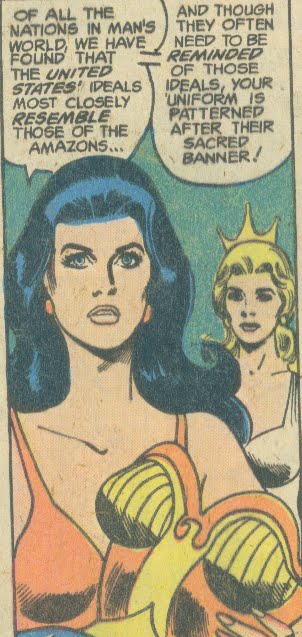
But what about her costume? Well, it was sorta loosely modeled after a Greek warrior, but still recognized as skimpy even by comic standards. One of the first issues even addressed Diana’s thrifty use of cloth:


After World War II, Wonder Woman began to hit hard times. Marston, whose queer ideas about gender and sex had driven the book, died in 1947. Matters became worse when a psychiatrist named Fredric Wertham created a minor frenzy after publishing Seduction of the Innocent in 1954. Comics, he claimed, were at the heart of every social ill from drug addiction to rape. He charged Wonder Woman in particular with turning young girls into lesbians. “The homosexual connotation of the Wonder Woman type of story is psychologically unmistakable,” he wrote, “For boys, Wonder Woman is a frightening image. For girls she is a morbid ideal... The attractive Wonder Woman and her counterparts are definitely anti-masculine. Wonder Woman has her own female following. They are all continuously being threatened, capture, almost put to death. There is a great deal of mutual rescuing... In a typical story, Wonder Woman is involved in adventures with another girl, a princess, who talks about ‘those wicked men.’” Yeah, where did Wonder Woman get off thinking that she didn't need a man to rescue her? She ought to get back into the kitchen making chicken pot pies where she belongs.

Faced with public backlash, DC responded by subtly altering Wonder Woman. A 1950s or 1960s version of Wonder Woman usually contained as many panels of Diana crying her eyes out over Steve Trevor as doing any actual work. She also lost all of her women friends, just to make sure that nobody could accuse her of being anything other than 100 percent hetero. Finally, she basically stopped battling human (male) villains and instead fought more mythical creatures.


By the end of the 1960s, Wonder Woman was, well, dull. DC attempted an almost identical shift in Wonder Woman’s storyline as the one they announced on Tuesday. Starting in 1968, Diana renounced her Amazon superpowers, watched as Paradise Island transferred to another dimension (or sunk into the water, or something), and ditched her swim wear for a white jumpsuit and other “mod” clothing. Like DC’s reaction to their announcement Tuesday, DC writers in the 1960s expressed surprise that feminists (including Gloria Steinham) saw robbing Wonder Woman of her powers as a betrayal. Gee, why would making a character less powerful not be seen as a step forward for women? Oh, and did I mention that she gave up her position as a ranking officer in the military in order to open a dress boutique? Without her superpowers, Wonder Woman, or, er, Diana Prince had to learn martial arts from an absurdly stereotypical character a martial arts master improbably named “I Ching” (To say that Wonder Woman and other DC comics had some problems grappling with race is a bit like saying BP dribbled some oil on the gulf).

This jumpsuit-clad Wonder Woman proved so unpopular that the return of the star-spangled panties in issue #204 included a total bloodbath of anybody associated with the previous version of the character. Everybody had to die so that the old-glory hot pants could return.


The 1970s era is one of my favorite for Wonder Woman, and not just for obvious nostalgic reasons. There is a certain period when the book allowed itself to be a bit more campy. I liked, for instance, that Diana spent some quality time debating her laundry’s freshness.


Even after the jumpsuit fiasco, the 1960s would not be the last time that an alternate version of Wonder Woman appeared. A year before the beloved Lynda Carter series started, ABC aired a pilot for Wonder Woman starring the very blonde Cathy Lee Crosby. In this version, Diana Prince worked as a secretary for a CIA-type organization. She ultimately became involved in spy work herself, put on an outfit that had little resemblance to the comic version, and seemed to mostly follow the martial arts era comics (without superpowers). Most people found it hard to see this characterization as having much in common with the character they knew as the Amazon princess.


Today, DC is again cutting down Diana’s powers and changing her wardrobe in hopes of spurring interest in the character. It seems to me that the approach smacks of desperation.

From the outside, one does get the impression that DC really wants Wonder Woman to succeed. They consider her part of their “trinity” of the three most recognizable comic characters: Superman, Batman, and Wonder Woman. They have also brought in some well known talent over the past few years to write for the series, including Jodi Pocoult (whose stories never quite worked) and the much beloved comic writer Gail Simone. The latter had some hints of great ideas (The Return of Reform Island!), but it never quite came together. Who can then blame DC executives for making the current ploy to generate interest in Diana? Let’s face it, this is probably the most people have talked about Wonder Woman in years. Still, I really don’t think making Diana weaker is the answer (or killing off the Amazons – again).


I just can’t figure out why it is so hard for DC to find a decent story arc for Wonder Woman that would renew her appeal. As I wander through Target and other shops, I am struck by how much the aisles are adorned by the many Disney Princesses. It seems to me that DC is missing real opportunities to market Wonder Woman to a younger generation. If I were a parent, I’d have a real problem buying books and dvd’s from Disney that depicted women doing nothing but sitting around singing about their hopes to find a man who could rescue them. Wouldn’t it be much better to have a woman who is strong, independent, and super smart like Wonder Woman (who also happens to be a princess)? Even if she does dress like she should be spending her days at the beach rather than fighting crime, she still has a better overall message about women being the equal of any man. But, DC is never wise enough to ask GayProf to consult on Wonder Woman’s future.